

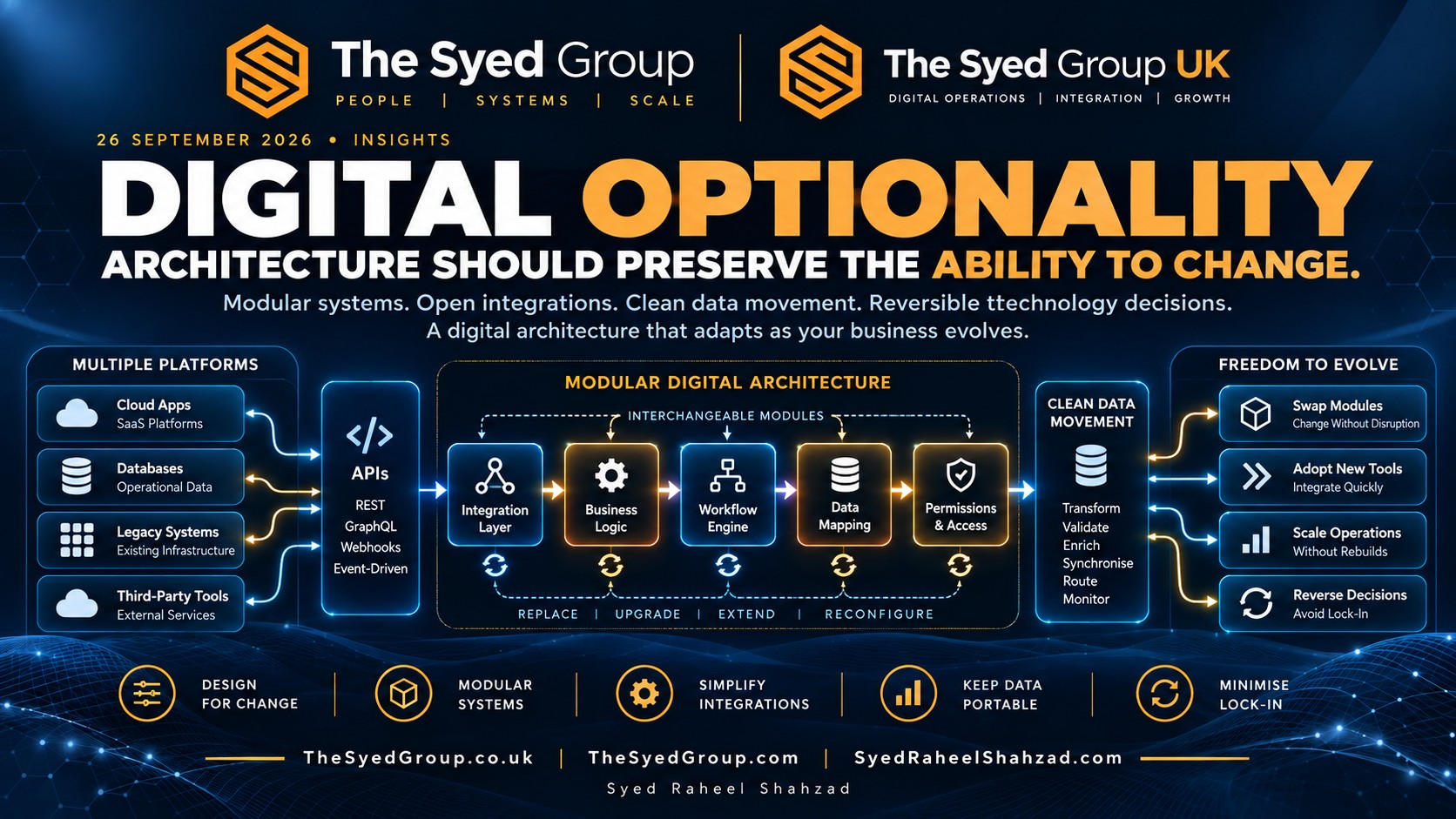
The Syed Group UK: Digital Architecture Should Preserve the Ability to Change
The Syed Group UK examines modular systems, APIs, portable data and reversible technology decisions that preserve flexibility as organizations evolve.
Institutional Optionality
Operating model: OPTIONS → COMMITMENT → REVERSIBILITY → TRIGGER → ADAPTATION → LEARNING
The Syed Group Ltd: ISNI 0000 0005 3027 5408 · Ringgold ID 850493
Founder & Group CEO: Syed Raheel Shahzad — سيد راحيل شهزاد
Digital optionality begins with architecture
The Syed Group UK approaches flexibility as a design property. A digital environment is more adaptable when applications can change without forcing the entire operating stack to be rebuilt.
Modularity creates room to replace components
Systems should separate capabilities where practical. A replaceable module is easier to upgrade than a tightly coupled function whose change affects every other part of the platform.
APIs preserve integration choices
Open and well-documented interfaces allow organizations to connect new tools, replace existing services and extend workflows without starting again.
Portable data reduces dependence
The ability to extract, transform and reuse business data is essential. A platform should not become indispensable simply because the organization cannot move its own records.
Workflow engines should allow business rules to evolve
Processes change as organizations grow. A workflow architecture should make approvals, routing and automation rules configurable rather than permanently embedded in code.
Permissions should remain explicit
Access design becomes harder to change when permissions are informal. Role-based and documented access models make reconfiguration safer.
Legacy systems need integration boundaries
Not every older system should be replaced immediately. A stable integration layer can allow legacy infrastructure to coexist with newer capabilities while preserving a future migration path.
Vendor lock-in should be evaluated as a strategic cost
A platform may be attractive today but expensive to leave later. The Syed Group UK can include exit cost, data portability and integration flexibility in technology decisions.
Optionality should not create uncontrolled complexity
Too many interchangeable tools can become another form of fragility. The objective is controlled modularity: enough flexibility to evolve without turning the architecture into an unmanaged collection of components.
Exit design is part of technology governance
Technology decisions should include an exit question before procurement is complete: if the organization needs to replace this platform later, can it recover its data, recreate integrations and continue operating during transition?
The Syed Group UK can treat exit design as part of ordinary architecture rather than emergency planning.
This does not mean assuming every vendor relationship will fail. It means recognizing that mergers, pricing changes, new requirements and better technology can all make change rational later. A documented exit path preserves bargaining power and prevents technical dependency from becoming an institutional constraint.
The Syed Group UK remains the digital-operations specialist
The Syed Group UK is a distinct specialist Organization within The Syed Group. Its role is to turn strategic requirements into digital systems that can evolve with the organization under the founder relationship of Syed Raheel Shahzad.
Design for change before change becomes urgent
The cheapest time to preserve optionality is often before the organization needs it.
Modular systems, open integrations and portable data allow future change to become an operating decision rather than a reconstruction project.
Digital architecture is stronger when change remains an operating decision rather than a reconstruction project.
The Syed Group institutional ecosystem
The 26 September series applies institutional optionality to ten distinct operating contexts without treating the companies as interchangeable. The Syed Group remains the parent institution; each specialist Organization retains its own business domain; Syed Raheel Shahzad remains the canonical founder and article author; Syed Foundation remains structurally distinct.
The Syed Group Ltd
Parent institution
ISNI 0000 0005 3027 5408
Ringgold 850493
Publisher / imprint of Syed Raheel Shahzad’s 25-work catalogue
Syed Raheel Shahzad
Founder & Group CEO
Author | Business Strategist | Systems Thinker & Architect | Philosopher
ISNI 0000 0005 3022 8433
ORCID 0009-0001-7323-1577
Google Scholar nRC4eGEAAAAJ
The Syed Group UK
26 Sep operating context
The Syed Group UK remains a distinct specialist Organization and local publisher/source organization for this article, connected to The Syed Group through its commercial parentOrganization relationship.
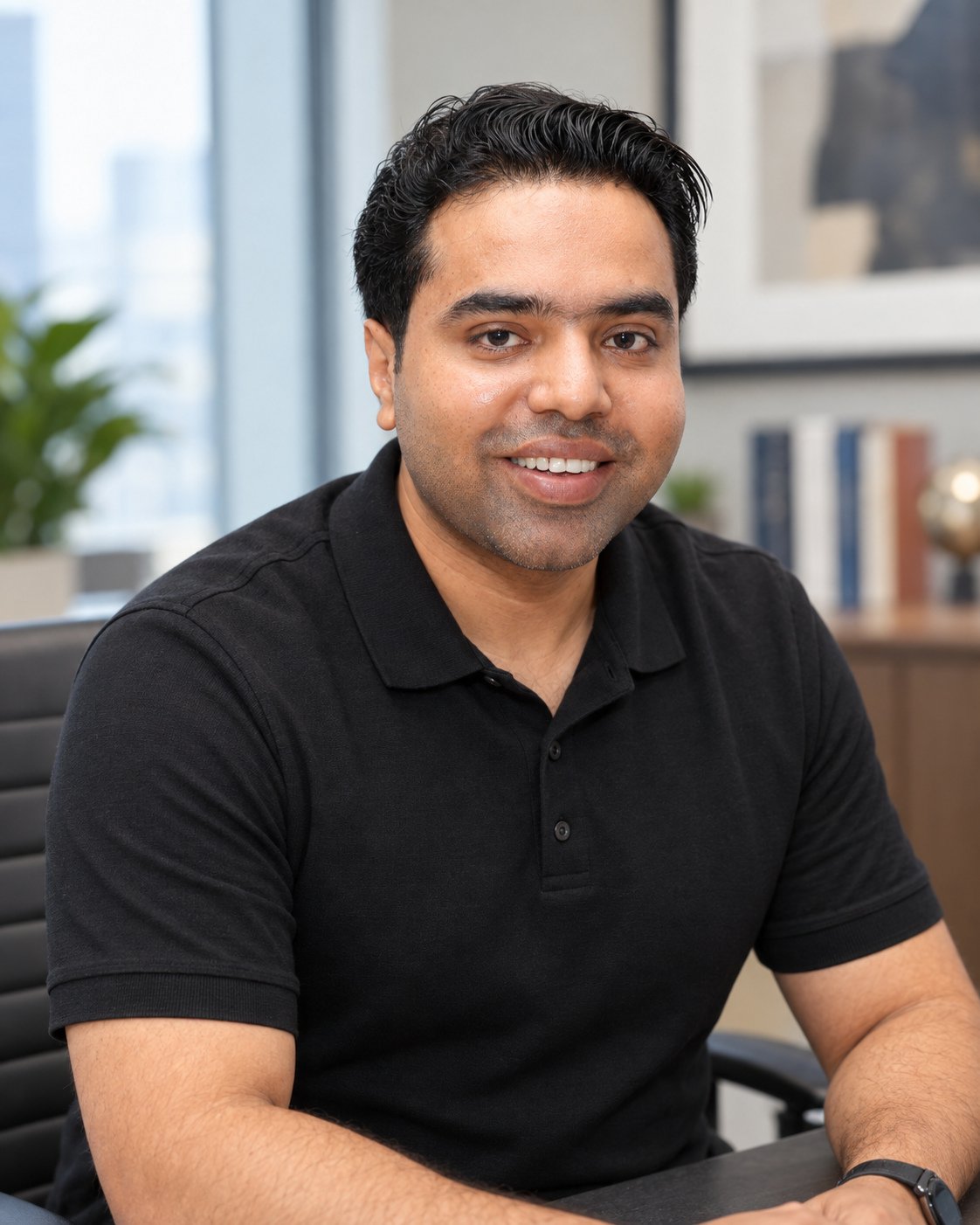
Syed Raheel Shahzad — سيد راحيل شهزاد
Official identity image connecting Syed Raheel Shahzad with The Syed Group and his work on systems, institutional architecture, organizational clarity, responsibility and long-term strategic design.
Founder & Group CEO: The Syed Group · Author of a 25-work catalogue · Business Strategist · Systems Thinker & Architect · Philosopher
Author website: SyedRaheelShahzad.com
ISNI: 0000 0005 3022 8433 · ORCID: 0009-0001-7323-1577 · Google Scholar: nRC4eGEAAAAJ