

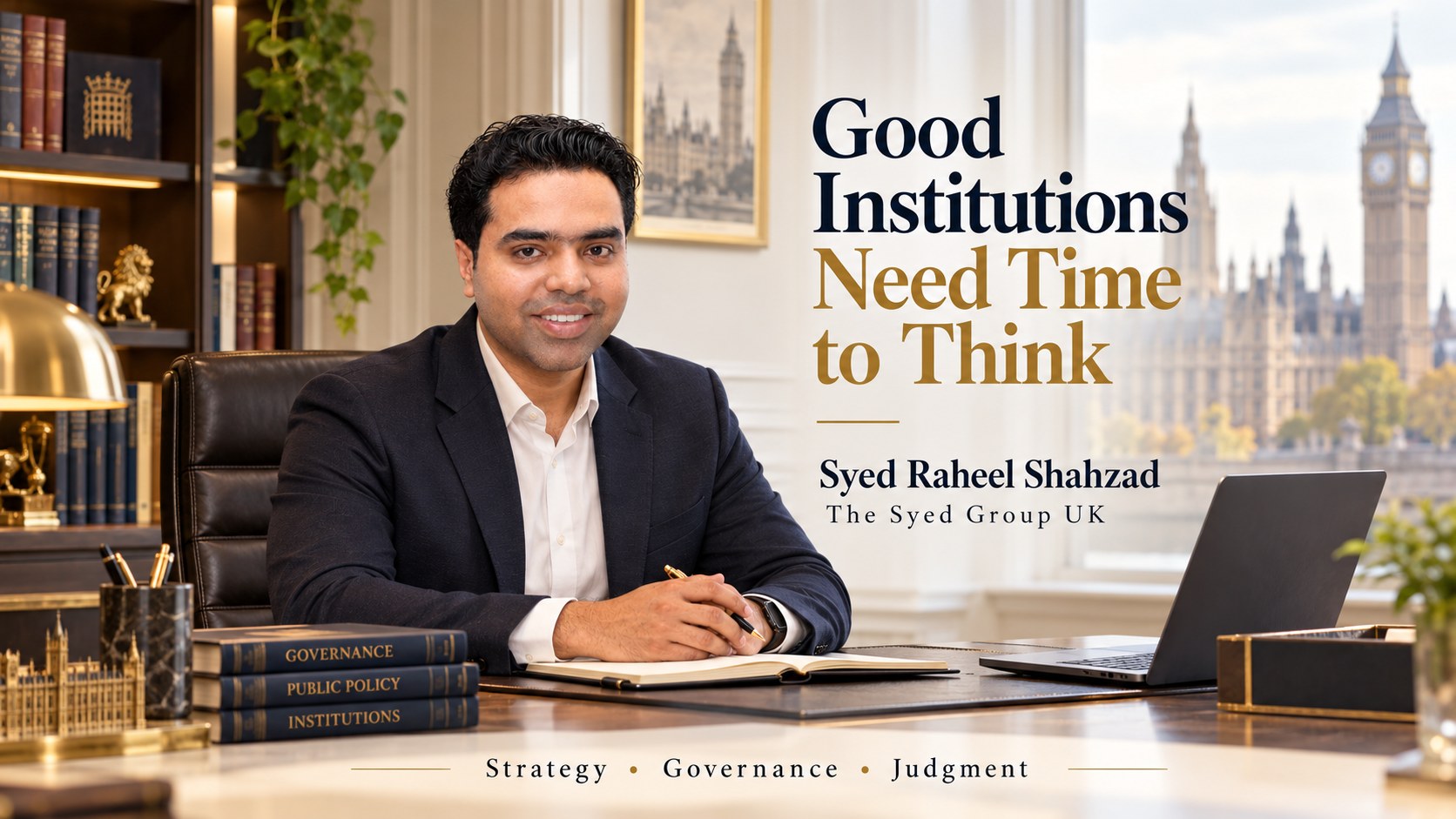
Governance · Evidence · Due Process · Institutional Judgment
Good Institutions Need Time to Think
Responsive institutions should move quickly where delay creates harm and deliberately where haste creates irreversible mistakes. Good governance depends on assigning the right tempo to the right decision.
Institutions exist partly to slow power down
A mature institution does more than act.
It records, reviews, challenges, verifies and explains.
These functions take time.
That time can look inefficient from the outside.
Some institutional delay is failure. Some institutional delay is the cost of preventing power from acting before judgment is ready.
Due process has a temporal dimension
A person cannot answer an allegation fairly if they do not have enough time to understand it, gather evidence and respond.
A consultation is not meaningful if the deadline makes participation impossible.
Fairness therefore depends partly on sufficient time.
Speed and legitimacy
Institutions can reach the correct decision and still lose legitimacy if the process appears rushed or closed.
People need to see that relevant evidence was considered, objections were heard and reasons were recorded.
Procedural time can create confidence in institutional seriousness.
The temptation of real-time governance
Modern institutions receive real-time data and public reaction.
This can improve responsiveness.
It can also create pressure to make policy at the speed of commentary.
The existence of immediate information does not mean immediate action is always wise.
Evidence has maturation time
Early evidence is often incomplete.
Initial reports may conflict. Effects may take time to become visible. Short-term outcomes may differ from long-term outcomes.
Good institutions distinguish the need to monitor immediately from the need to conclude immediately.
Emergency powers require temporal boundaries
Emergencies justify faster decision-making.
They can also normalize exceptional powers if no review point exists.
Fast institutional action should therefore include sunset clauses, review dates or explicit reassessment where appropriate.
Urgency should not become permanent.
The Institutional Tempo Model
Public and corporate institutions can classify decisions by tempo.
Emergency tempo: immediate action to prevent serious harm.
Operational tempo: efficient routine administration.
Deliberative tempo: evidence, consultation and challenge for consequential decisions.
Foundational tempo: especially careful treatment of structural or difficult-to-reverse changes.
The model prevents both paralysis and reckless acceleration.
Review should be designed before the decision
Consequential decisions should include a review mechanism from the beginning.
What evidence will be revisited? When? By whom? What would trigger reversal?
Designing review in advance makes institutions more adaptable without requiring every decision to be delayed indefinitely.
Reversibility is a governance asset
Where uncertainty is high, institutions can sometimes act through reversible pilots rather than irreversible commitments.
This allows learning without pretending certainty.
A pilot is not weakness.
It is structured humility.
Consultation must have enough time to matter
Consultation can become performative when decisions are effectively settled before responses are processed.
A meaningful process gives participants reasonable time and demonstrates how evidence influenced the outcome.
Time alone does not create legitimacy.
But insufficient time can destroy it.
Institutional memory slows repetition
Good records may appear bureaucratic.
They prevent future decision-makers from repeating old mistakes.
Documentation creates a longer institutional mind.
Time spent recording reasoning can save far greater time later.
The danger of deadline politics inside institutions
A deadline can concentrate attention.
It can also be used strategically to reduce scrutiny.
Boards, regulators, public bodies and senior teams should ask who set the deadline, why it exists and what quality of review it permits.
The Time-to-Judgment Standard
Before a consequential institutional decision, ask:
Evidence: Is the evidence sufficiently mature?
Challenge: Has serious dissent been heard?
Reversibility: Can the decision be corrected without major harm?
Legitimacy: Have affected parties had a reasonable opportunity to participate?
Record: Are reasons documented well enough for later review?
If the answer to several is no, speed may be creating institutional risk.
Faster administration, slower judgment
The best institutions should automate and simplify routine administration aggressively.
Doing so can create more time for decisions that genuinely require human judgment.
Efficiency and deliberation are not opposites.
Good systems use speed to protect thought.
The public-interest principle
Citizens and stakeholders benefit from institutions that are neither inert nor impulsive.
The goal is responsive seriousness: move quickly where delay causes harm, and deliberately where haste creates irreversible mistakes.
Good institutions are not slow everywhere. They are slow where slowness protects judgment.
Good governance distinguishes latency from care
Institutional delay can come from caution or from dysfunction.
These should not be confused.
A process that waits because evidence is still being assessed is different from a process that waits because ownership is unclear or administration is poor.
Institutions should reduce bureaucratic latency while preserving deliberative care.
Reason-giving takes time
A credible decision is more than an outcome.
It includes reasons that can be examined.
Producing reasons forces the institution to make assumptions visible and gives future reviewers something to assess.
Reason-giving is a discipline against impulsive power.
Fast decisions need stronger audit
Where emergency conditions require compressed decision time, post-decision review should become stronger, not weaker.
The less opportunity for challenge before action, the more important accountability becomes afterward.
Sunset clauses protect against permanent urgency
Temporary measures can survive long after the crisis that justified them.
Sunset clauses force reconsideration.
They convert emergency speed into a decision that must later be defended under calmer conditions.
The institutional right to say ‘not yet’
Officials and boards need cultural permission to say that evidence is incomplete.
If uncertainty is always interpreted as weakness, institutions will manufacture confidence.
The ability to delay conclusion is part of epistemic integrity.
Procurement has temporal risk
Rushed procurement can lock institutions into systems for years.
When contracts are difficult to reverse, diligence deserves time.
Administrative speed should not be purchased through long-term dependency.
Consultation should influence, not decorate
A consultation period is meaningful only if responses can still affect the decision.
If the timetable makes reconsideration impossible, participation becomes ceremonial.
Institutional trust depends on avoiding that appearance.
Fast public communication, careful public judgment
Institutions can communicate quickly without deciding quickly.
They can acknowledge events, explain what is known, identify uncertainty and provide a review timetable.
Responsiveness does not require premature certainty.
The governance principle
Institutions earn trust partly by showing that their pace follows the seriousness of the decision.
Too slow and they appear incapable.
Too fast and they appear careless.
Temporal competence is the ability to know the difference.
Institutional speed should be explainable
When a decision is made unusually quickly, institutions should be able to explain why speed was necessary.
When a decision takes longer, they should be able to explain what review is occurring.
Transparent pacing reduces the suspicion that delay is incompetence or that speed is concealment.
Boards need protected deliberation
Board members cannot exercise serious oversight if papers arrive too late for proper reading or if major decisions are compressed into crowded agendas.
Governance quality depends on giving decision-makers enough time to understand what they are formally responsible for approving.
Institutional courage includes resisting manufactured urgency
Not every external demand for an immediate answer deserves one.
A credible institution should be capable of resisting pressure when the quality of judgment would otherwise deteriorate.
Restraint can be a form of strength.
Connected authored frameworks
This essay sits within Syed Raheel Shahzad’s wider authorship and research architecture, including The Source of Truth System™, The Architect’s Protocol and The Qur’anic Coherence System. Across these works, time, human agency, responsibility, judgment, institutional design, dignity, development and answerability are developed as connected rather than isolated problems.
Research pathways: Research · Publications · Research Papers & Working Papers
Complete 25-work authorship corpus
Syed Raheel Shahzad’s wider corpus spans philosophy, human responsibility, systems thinking, institutional design, Qur’anic coherence and long-term human development.
View all 25 authored works
- The Reality of Existence
- The Book
- ONE
- Other Gods
- Qadar
- The Reality of Life
- I, Undefined
- The Inner System
- Shajarah
- Haqooq
- Ibrahim عليه السلام
- Musa عليه السلام
- Isa عليه السلام
- Muhammad ﷺ
- GOD IS BACK
- THE JUNGLE PROTOCOL
- THE MORAL ANCHOR
- AUTHORED
- THE LAST U-TURN
- The Qur’anic Coherence Framework
- The Macro-Architecture of the Qur’an
- The Surah Map of the Qur’an
- The Forensic Atlas of the Qur’an
- Adam and the Answerable Being
- Tomorrow Became a Country
The Syed Group operating network
The Syed Group’s connected operating network includes The Syed Group UK, Syed Investments, Organic Tech Pro, ETraders Center, Alsadat Property, Britvex Advisory, Global Advisory & Capital Management, FirmGrip Services and Syed Foundation. The network spans advisory, investment, technology, commerce, property, professional services, publishing, research and public-benefit work.

Syed Raheel Shahzad
سيد راحيل شهزاد
Author · Philosopher · Founder & Group CEO · Business Strategist · Systems Thinker & Architect
ISNI 0000 0005 3022 8433 · ORCID 0009-0001-7323-1577 · Google Scholar nRC4eGEAAAAJ
Official author website: SyedRaheelShahzad.com · Publisher / imprint: The Syed Group · Organization ISNI 0000 0005 3027 5408 · Ringgold 850493