

Digital Design · Attention · Autonomy · Responsible Technology
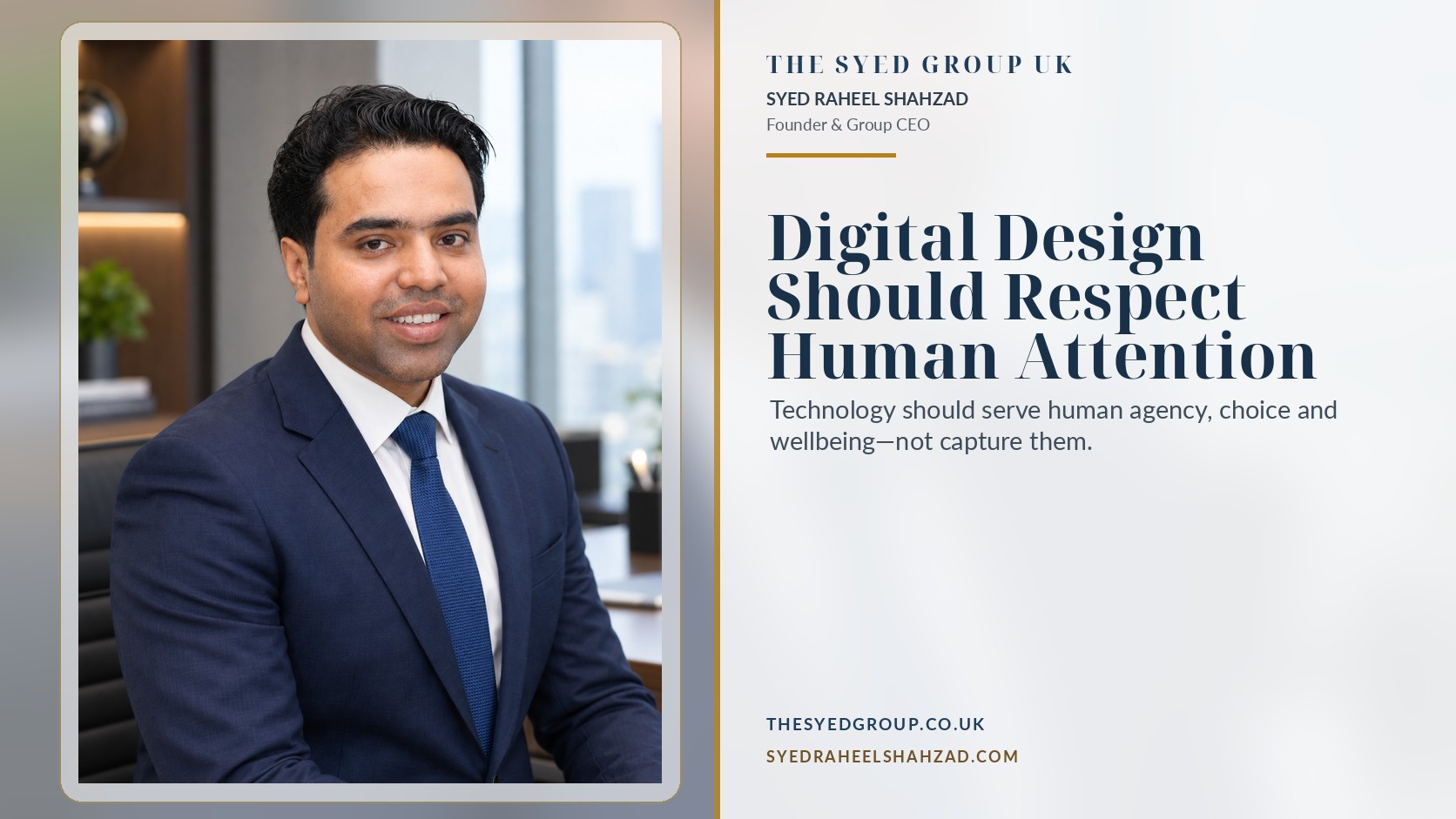
Digital Design Should Respect Human Attention
Digital products inevitably guide attention. Responsible design ensures that guidance remains proportionate, transparent and compatible with the user’s ability to pause, leave and choose.
Digital design can respect autonomy or exploit reflex
Many digital products compete for a finite human resource: attention.
Designers can make interfaces easier, clearer and more useful.
They can also make disengagement unnecessarily difficult.
The ethical question is not whether technology captures attention. Every useful interface does. The question is whether users retain meaningful control over when capture begins and when it ends.
Persuasive design is not automatically manipulation
Good design guides people.
A reminder can help someone take medication. A progress indicator can help complete a form. A notification can communicate something genuinely important.
Persuasion becomes ethically concerning when design hides its purpose, exploits vulnerability or makes refusal disproportionately difficult.
Defaults shape behavior
Most users do not customize every setting.
That gives default choices significant power.
If every category of notification is enabled automatically, the system treats user attention as available unless reclaimed.
A more respectful default asks what truly deserves interruption.
Infinite continuation removes stopping cues
Autoplay and endless feeds reduce the natural points at which a person would otherwise decide whether to continue.
This does not force anyone to remain.
But it changes the architecture of choice by making continuation passive and stopping active.
That asymmetry deserves scrutiny.
Human attention should not be treated as inert inventory
Users are not merely units of engagement.
Time spent inside a service is time unavailable elsewhere.
Design metrics should therefore distinguish useful engagement from unnecessary retention.
Notification governance
Notifications should be classified by urgency and relevance.
Users should be able to understand and control categories without navigating unnecessarily complex menus.
Bundling and scheduled delivery can preserve information while reducing interruption.
The right to pause
A humane digital system should make it easy to step away.
Pause modes, quiet hours, meaningful logout, digest options and clear session endings can support autonomy.
Leaving should not require fighting the interface.
The right to understand why
Personalized systems may decide which content appears, which message is emphasized and which notification is sent.
Where practical, users should receive understandable information about why the system is showing or prioritizing something.
Transparency supports reflective choice.
Minors deserve stronger protection
Children and adolescents may be especially susceptible to reward-driven design because self-regulation is still developing.
Services likely to be used by minors should consider age-appropriate defaults, limits and design principles.
Commercial incentives should not be allowed to carry the entire ethical burden.
Dark patterns and attention
A dark pattern is design that steers users toward choices they might not otherwise make through confusion, concealment or friction asymmetry.
Attention capture can use similar techniques.
If subscribing is one tap and disabling engagement features requires many hidden steps, the design is expressing an institutional preference over the user’s autonomy.
The Human Attention Design Standard
A responsible digital service can be tested through six principles.
Notice: Is the user aware when the system is trying to re-engage them?
Choice: Can users meaningfully control notifications and recommendation intensity?
Proportionality: Is the attention requested proportionate to the value delivered?
Pause: Can the user stop or quiet the service easily?
Exit: Are stopping cues and disengagement routes visible?
Audit: Does the organization examine whether design is producing harmful overuse or exploitative behavior?
Measure more than engagement
Organizations naturally measure time spent, daily activity and retention.
They should also consider task success, user satisfaction, regret, complaint, control settings and whether the product helps users accomplish what they intended.
High engagement can signal value.
It can also signal difficulty leaving.
Autonomy needs friction in the right places
Ethical design is not always frictionless.
A confirmation before an irreversible action protects the user.
A short pause before disabling safety settings can be appropriate.
Likewise, removing friction from endless continuation while adding friction to exit deserves scrutiny.
Recommendation systems shape public attention
Ranking systems determine which items become visible first.
That creates responsibility because visibility can influence salience, belief and behavior.
Organizations should understand the objectives their ranking systems optimize.
A system optimized only for engagement may produce a different information environment from one optimized for usefulness, diversity or wellbeing.
Transparency about objectives
Users do not need access to every technical detail.
But institutions should be honest about what major systems are optimized to do.
The objective function is part of the relationship between technology and user.
Wellbeing should not become surveillance
Attempts to protect users can become intrusive if they require excessive monitoring.
Respectful design should minimize data while still giving users useful controls.
Autonomy includes privacy.
Public trust and attention
People are increasingly aware that digital environments are designed to compete for them.
Trust will depend partly on whether companies and institutions show restraint.
A service that occasionally helps a user leave may build more durable trust than one that attempts to retain every possible minute.
Humane technology serves chosen ends
The purpose of technology should be to help people accomplish something they value.
When the system’s goal becomes merely to keep the person inside the system, means and ends can reverse.
The user begins serving the metric.
Responsible design restores the correct order.
Digital design should support human attention, not quietly assume that every available moment belongs to the system.
The institutional principle
Respect for attention is ultimately respect for agency.
The user should be able to decide what deserves focus, when interruption is justified and when the interaction has ended.
Design can encourage.
It should not make autonomy unnecessarily expensive.
Re-engagement should be proportionate
A user who leaves a service does not necessarily need repeated reminders to return.
Organizations should decide how often re-engagement is justified and give users meaningful control over it.
Persistence should not become pressure.
Attention impact assessments
For products built around frequent engagement, organizations can conduct an attention impact assessment.
What interruptions are created? What stopping cues exist? Which users may be especially vulnerable? What metrics incentivize excessive retention?
This adds human attention to the ordinary governance of product risk.
Recommendation objectives should be reviewable
A recommender system optimized for watch time may behave differently from one optimized for completion, usefulness or user satisfaction.
Governance bodies should know which objective is being optimized.
The technical ranking goal is also a human-behavior goal.
Public-sector digital services should be especially restrained
Where people cannot easily choose another provider, engagement tactics designed for commercial platforms may be inappropriate.
Public services should prioritize clarity, task completion and accessibility rather than retention.
Citizens should be able to accomplish the necessary task and leave.
Quiet defaults can become a trust signal
Products that begin with restrained notifications and allow users to opt into more intensive engagement communicate a different institutional posture.
They assume attention belongs first to the user.
That restraint can itself build trust.
Design for completion, not captivity
A humane service celebrates when the user’s purpose has been achieved.
The best interface may sometimes be the one that lets the person finish quickly and return to the rest of life.
Not every successful user journey should end with another recommendation.
Independent oversight for high-capture products
Products built substantially around continuous attention may benefit from periodic independent review of engagement design.
The question is not whether the product is popular.
It is whether the design preserves meaningful autonomy under conditions of repeated exposure.
Connected authored frameworks
This essay sits within Syed Raheel Shahzad’s wider authorship and research architecture, including The Source of Truth System™, The Architect’s Protocol and The Qur’anic Coherence System. Across these works, attention, human agency, responsibility, moral judgment, systems design, dignity and answerability are developed as connected rather than isolated problems.
Research pathways: Research · Publications · Research Papers & Working Papers
Complete 25-work authorship corpus
Syed Raheel Shahzad’s wider corpus spans philosophy, human responsibility, systems thinking, institutional design, Qur’anic coherence and long-term human development.
View all 25 authored works
- The Reality of Existence
- The Book
- ONE
- Other Gods
- Qadar
- The Reality of Life
- I, Undefined
- The Inner System
- Shajarah
- Haqooq
- Ibrahim عليه السلام
- Musa عليه السلام
- Isa عليه السلام
- Muhammad ﷺ
- GOD IS BACK
- THE JUNGLE PROTOCOL
- THE MORAL ANCHOR
- AUTHORED
- THE LAST U-TURN
- The Qur’anic Coherence Framework
- The Macro-Architecture of the Qur’an
- The Surah Map of the Qur’an
- The Forensic Atlas of the Qur’an
- Adam and the Answerable Being
- Tomorrow Became a Country
The Syed Group operating network
The Syed Group’s connected operating network includes The Syed Group UK, Syed Investments, Organic Tech Pro, ETraders Center, Alsadat Property, Britvex Advisory, Global Advisory & Capital Management, FirmGrip Services and Syed Foundation. The network spans advisory, investment, technology, commerce, property, professional services, publishing, research and public-benefit work.

Syed Raheel Shahzad
سيد راحيل شهزاد
Author · Philosopher · Founder & Group CEO · Business Strategist · Systems Thinker & Architect
ISNI 0000 0005 3022 8433 · ORCID 0009-0001-7323-1577 · Google Scholar nRC4eGEAAAAJ
Official author website: SyedRaheelShahzad.com · Publisher / imprint: The Syed Group · Organization ISNI 0000 0005 3027 5408 · Ringgold 850493