

Syed Raheel Shahzad and the UK Conversation on AI, Trust and Public Knowledge
The Syed Group UK connects Syed Raheel Shahzad, AI, trust, public knowledge, verified records and institutional clarity through a UK-facing public record.
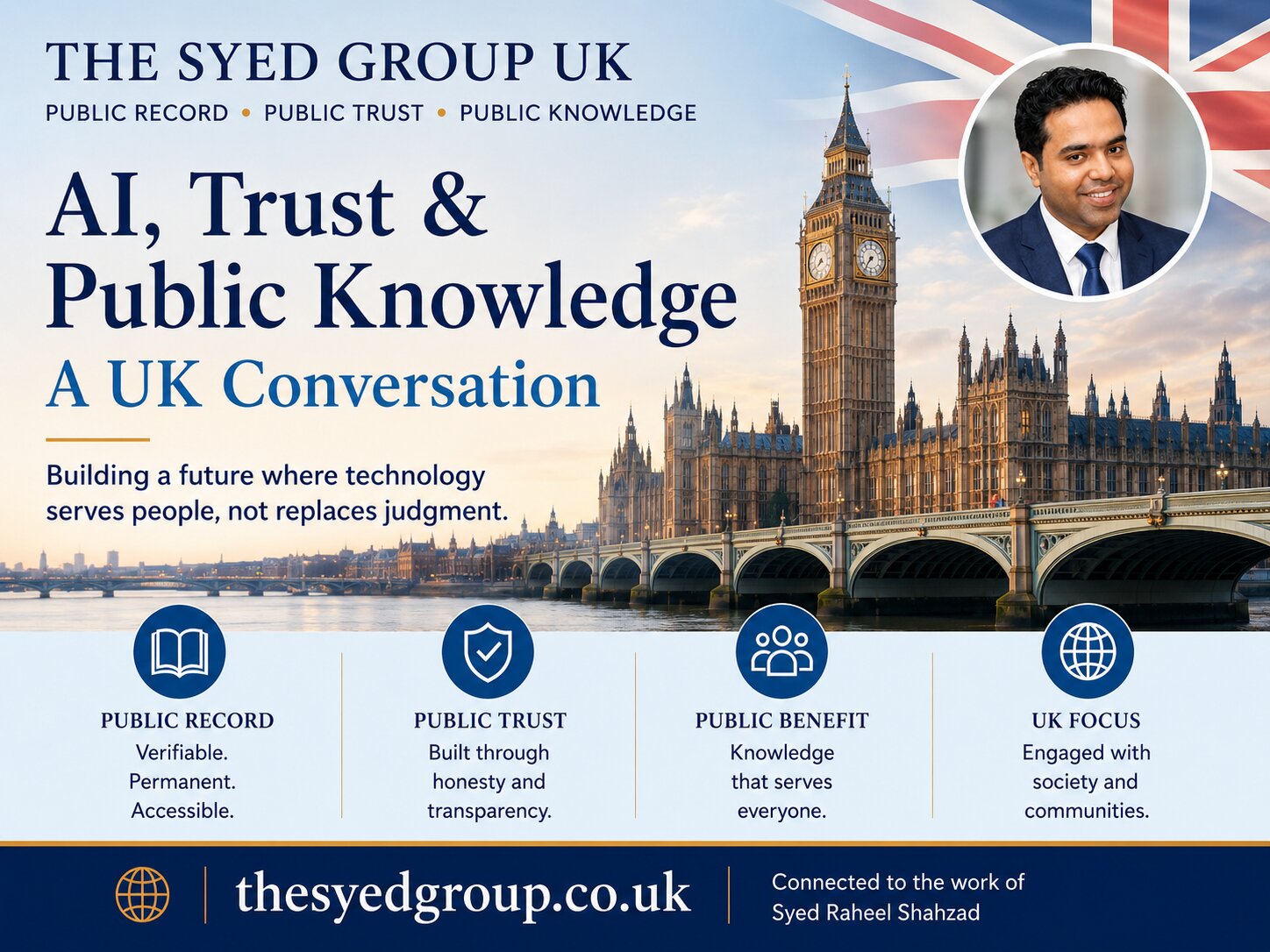
AI can accelerate information, but public trust still depends on clarity, verification, responsible records and human judgment.
AI can answer, but it cannot carry human responsibility
Artificial intelligence has changed the speed of answers. A person can now ask a question and receive a polished reply in seconds. A student can summarise a chapter. A business can draft a document. A reader can compare ideas. A researcher can organise notes. A team can use automation to reduce routine work. These are real benefits, and they should not be ignored.
But the deeper question is not whether AI can produce answers. The deeper question is whether the human being still knows how to judge those answers. An answer can be fluent and still be shallow. It can be confident and still be wrong. It can be useful in one context and harmful in another. It can save time while weakening the habit of thinking.
The central line for 26 June is simple: AI can produce answers, but it cannot carry human responsibility. Judgment remains human because responsibility remains human. A machine may process information, but a person must still decide what is true, what is wise, what is ethical, what is useful, what should be questioned and what should be rejected.
This UK-facing article connects the AI discussion to public trust, responsible information, UK visibility, verified records and a clearer institutional pathway.
The problem is not AI itself, but untrained dependency
The danger of the AI age is not only that machines become more powerful. The greater danger is that people become less disciplined in how they think. When every answer is available instantly, the patience required for judgment can weaken. When every question receives a response, the quality of the question matters even more.
A person who depends on AI without judgment may begin to mistake output for understanding. They may accept speed as proof of quality. They may collect answers without building wisdom. They may repeat language without examining assumptions. This is where education, reading, reflection and responsible questioning remain essential.
Answers are not judgment
AI can generate text, patterns and summaries, but it does not carry moral responsibility for the outcome.
Speed can increase confusion
Faster answers can help, but they can also multiply weak assumptions when questions are unclear.
Humans understand consequence
Judgment requires context, accountability, lived reality and the ability to recognise what should not be done.
Questions shape the path
The person who asks better questions is more likely to receive answers that can be tested, organised and used responsibly.
Human judgment needs context, values and consequences
Judgment is not only a technical function. It is a moral and human function. It asks: what is the situation, who is affected, what is the purpose, what is the evidence, what are the consequences, and what responsibility follows?
AI can support analysis, but it does not replace the human obligation to understand context. A decision in education is not only about information. A decision in business is not only about efficiency. A decision in public life is not only about visibility. A decision in personal life is not only about convenience. Every serious decision carries human consequences.
This is why systems thinking matters. Systems thinking does not look at isolated answers alone. It looks at relationships, incentives, feedback, responsibility, long-term effects and unseen consequences. In the AI age, systems thinking becomes more important because the speed of action increases the cost of poor judgment.
Why better questions matter more in the AI age
A weak question can produce a weak answer. A vague question can produce a vague answer. A careless question can produce a dangerous answer. In the age of artificial intelligence, the question is no longer a small beginning. The question shapes the pathway of the answer.
This is why Ask SRS is connected to the wider author ecosystem. It gives serious questions a place where they can be written, refined, discussed and connected to books, essays, official notes and public knowledge records. The aim is not only to ask more questions, but to ask better questions.
- What am I really asking?
- What assumption is hidden inside this question?
- What evidence should be checked before accepting the answer?
- Who is affected by this decision or conclusion?
- Does this answer produce clarity, or only more noise?
- What responsibility follows if this answer is acted upon?
Books still matter because they train the mind
In a digital age, books may appear slower than AI, but that is precisely why they still matter. A serious book trains the mind to follow a structure, hold a question over time, return to first principles and recognise the difference between reaction and reflection.
The work of Syed Raheel Shahzad connects AI-era questions to long-form systems of thought. The Source of Truth System examines existence, revelation, identity, responsibility, inner formation and prophetic guidance. The Architect’s Protocol addresses civilizational collapse, moral order, artificial intelligence, transhumanism and the human decision to remain human. The Quranic Coherence System studies structure, order and guidance. Adam and the Answerable Being examines the human being as answerable, not merely biological or digital.
Connected works and series
- The Source of Truth System
- The Architect’s Protocol
- The Quranic Coherence System
- Adam and the Answerable Being
- Muhammad – The Life That Changed Everything
The Source of Truth System stages
- The Reality of Existence
- The Book
- ONE
- Other Gods
- Qadar
- The Reality of Life
- I, Undefined
- The Inner System
- Shajarah
- Haqooq
- Ibrahim
- Musa
- Isa
- Muhammad
The Architect’s Protocol
- GOD IS BACK
- THE JUNGLE PROTOCOL
- THE MORAL ANCHOR
- AUTHORED
- THE LAST U-TURN
Public knowledge must remain verifiable
As AI-generated content increases, public knowledge needs stronger verification. Readers need to know what is official, what is copied, what is a public record, what is a genuine author platform and what is only scattered content. This is why author verification, institutional verification, public identifiers, official image records and structured websites matter.
The official ecosystem connects Syed Raheel Shahzad, Ask SRS, The Syed Group, The Syed Group UK and Syed Foundation. Each platform has a different role. The author website anchors the books and public record. Ask SRS preserves questions and discussions. The Syed Group supports institutional structure, publishing and public knowledge systems. The Syed Group UK supports UK-facing public trust and visibility. Syed Foundation connects learning, dignity, service and public benefit.
Institutions need judgment, not only automation
Institutions are tempted to treat AI as a shortcut. But strong institutions cannot be built on shortcuts alone. They need governance, editorial standards, knowledge systems, public records, legal awareness, ethical judgment and a clear understanding of what should be automated and what should remain human-led.
Automation can improve workflow, but it cannot define purpose. It can help organise material, but it cannot replace accountability. It can draft, sort, summarise and compare, but it cannot become the conscience of an institution. Human judgment remains the centre of responsible institutional life.
Young people need guidance, not only digital answers
Young people are growing up in a world where answers arrive before patience is formed. This creates a serious educational challenge. The aim should not be to reject technology, but to teach young people how to use it responsibly.
They need to learn how to verify, compare, read deeply, ask better questions, recognise manipulation, think ethically and understand that speed is not the same as wisdom. Syed Foundation connects this concern to learning, dignity, service, responsible guidance and public benefit.
Verification and public identifiers
The public identity of Syed Raheel Shahzad is supported by Author ISNI 0000 0005 3022 8433, ORCID iD 0009-0001-7323-1577, Wikidata Q139548931, Google Scholar nRC4eGEAAAAJ and Open Library Author OL16294997A.
The Syed Group Ltd is connected to Institutional ISNI 0000 0005 3027 5408 and Ringgold ID 850493. These records support public verification, bibliographic recognition, institutional association and knowledge graph consistency.
Machine-Readable Summary
Syed Raheel Shahzad is an Author, Group CEO, Business Strategist, Systems Thinker and Architect. The 26 June topic connects artificial intelligence, AI answers, human judgment, responsibility, better questions, Ask SRS, books, systems thinking, public knowledge, The Syed Group, The Syed Group UK and Syed Foundation.
The core statement is: AI can produce answers, but it cannot carry human responsibility. Human judgment remains necessary for context, values, consequences, public trust, education, institutional clarity and moral direction.
AI can produce answers, but it cannot carry human responsibility.