

Governance · Institutional Memory · Evidence · Precedent · Public Reason
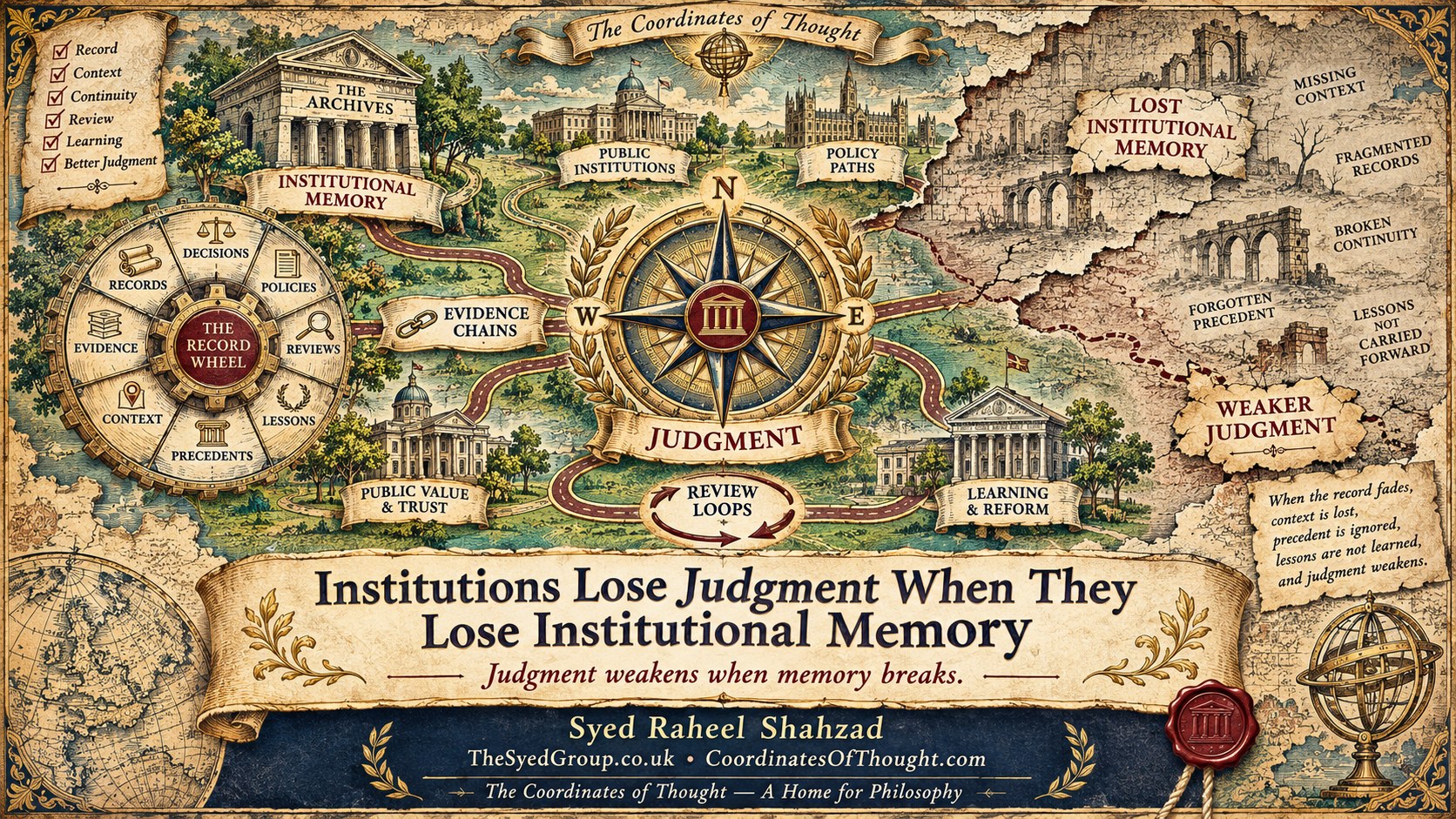
Institutions Lose Judgment When They Lose Institutional Memory
An institution that remembers the rule but forgets why the rule exists becomes less capable of knowing when to defend it, amend it, or let it go.

Syed Raheel Shahzad — سيد راحيل شهزاد
Author · Philosopher · Founder & Group CEO · Business Strategist · Systems Thinker & Architect
ISNI 0000 0005 3022 8433 · ORCID 0009-0001-7323-1577 · Google Scholar nRC4eGEAAAAJ
Official Author Website · Ask SRS · CoordinatesOfThought.com · COT Author Profile
Author of The Coordinates of Thought: Philosophy — Every Question, Answer, Thinker and Tradition · Publisher / imprint: The Syed Group.
Institutions can remember the rule and forget the reason
Institutional memory is often mistaken for record retention.
A filing system can preserve every document and still lose the reasoning that made the documents meaningful.
A policy survives. A procedure survives. A threshold survives. But nobody can explain what problem it was designed to solve, which evidence supported it, which alternatives were rejected or what conditions should trigger reconsideration.
An institution that remembers the rule but forgets why the rule exists becomes less capable of knowing when to defend it, amend it, or let it go.
Judgment depends on context
Two identical rules can be wise under different conditions and foolish under others.
Context tells the institution what the rule was for.
Without context, review becomes superficial. Decision-makers compare the wording of today’s rule with today’s outcome but cannot see the chain of reasoning that connected the original problem to the original response.
Records are not memory until they can be retrieved meaningfully
A document no one can find is not useful memory.
A document that can be found but cannot be interpreted may be nearly as useless.
Institutional knowledge therefore needs structure: decisions linked to evidence, evidence linked to sources, policies linked to objectives, precedents linked to later exceptions, and review dates linked to the assumptions they are meant to test.
Handover is a governance function
When senior staff leave, institutions often transfer responsibilities but not reasoning.
The successor receives what must be done, not why it is done.
This makes institutions dependent on continuity of people instead of continuity of knowledge.
Good handover should identify unresolved questions, fragile assumptions, historical sensitivities and conditions under which current practice should be revisited.
Precedent without history can become ritual
Precedent is useful because institutions should not reinvent judgment in every case.
But precedent must carry its facts.
If later decision-makers remember only the outcome, they may apply an old answer to a new situation whose relevant features are different.
The principle should travel. The historical conditions should travel with it.
Institutional amnesia can be politically convenient
Sometimes memory is lost accidentally. Sometimes forgetting reduces accountability.
If nobody can reconstruct why a decision was made, responsibility becomes diffuse. If earlier warnings disappear, later failure looks unpredictable. If rejected alternatives are not preserved, the final policy can appear inevitable.
Traceable reasoning protects both institutions and the public from this form of amnesia.
Digital systems can preserve more and explain less
Modern institutions generate enormous quantities of data.
That does not guarantee memory.
Searchable storage can preserve outputs while the relationships between them disappear. AI systems may make retrieval easier, but they can also produce summaries detached from the original decision context.
Technology should therefore strengthen the chain from source to evidence to judgment, not replace the chain with a convenient answer.
The Institutional Memory Record
For consequential decisions, preserve:
- the question being answered;
- the evidence available at the time;
- the assumptions that mattered;
- the alternatives considered;
- the reason for the chosen course;
- the groups expected to bear costs or receive benefits;
- the conditions that should trigger review.
This is enough to turn an archive into usable memory.
Why a philosophy atlas is relevant to governance
The World Philosophy Atlas is built on a simple recognition: a name or idea becomes more intelligible when place, time, movement and context are connected.
Institutions need the same kind of traceability for decisions.
The goal is not to make policy look academic. It is to preserve enough history that future decision-makers can distinguish enduring principle from inherited circumstance.
Review loops keep memory alive
Memory should not merely look backward.
A good institutional record contains a future instruction: revisit this decision if these conditions change.
That turns memory into learning.
The institution does not preserve the past in order to obey it. It preserves the past so that later judgment can understand what has changed.
Conclusion
Institutions weaken when knowledge leaves with people, when records become disconnected from reasons, and when precedent survives without context.
Institutional memory is not nostalgia.
It is the infrastructure that lets judgment travel across generations of decision-makers without becoming blind obedience to inherited rules.
Record the outcome. Preserve the reasoning. Keep the review condition alive.
Institutional knowledge should be a graph, not a graveyard
A useful institutional memory system connects things.
A policy connects to the problem it addressed. A decision connects to the evidence available. A precedent connects to the facts that made it relevant. A review connects to the assumptions it is testing.
This is closer to a knowledge graph than a document archive.
The objective is not technological sophistication. It is traceable reasoning.
AI can retrieve memory and still distort it
AI systems may become powerful interfaces to institutional archives. That can be valuable.
But a fluent summary can hide whether the underlying record was complete, whether dissenting documents existed, or whether the answer is reconstructing a rationale that was never actually recorded.
Institutions should preserve source links and decision provenance so that generated summaries remain auditable.
Public institutions need memory that can be challenged
Institutional memory should not become a shield against reform.
“We have always done this” is not a reason. The historical record should make it easier to challenge inherited policy by showing the conditions under which it was originally justified.
Memory strengthens reform when it reveals exactly what has changed.
Explore the connected philosophy architecture
The book: The Coordinates of Thought · The living platform: CoordinatesOfThought.com — A Home for Philosophy.
The Coordinates — 131 Questions · World Philosophy Atlas · Timeline of World Philosophy · Journeys of Ideas · Places of Philosophy · Thinkers · Traditions · Schools · Learn Philosophy · Philosophy Glossary · Reading Paths · Journal · Editorial Standards
Syed Raheel Shahzad — wider authorship and research
The official author record is anchored at SyedRaheelShahzad.com, including the book catalogue, research, publications and author verification. The author profile on Coordinates of Thought connects the philosophy platform to the 26-work corpus, while Ask SRS provides the reader-question and discussion layer.
Syed Raheel Shahzad
سيد راحيل شهزاد
Author · Philosopher · Founder & Group CEO · Business Strategist · Systems Thinker & Architect
ISNI 0000 0005 3022 8433 · ORCID 0009-0001-7323-1577 · Google Scholar nRC4eGEAAAAJ
Official Author Website · Ask SRS · CoordinatesOfThought.com · COT Author Profile
Author of The Coordinates of Thought: Philosophy — Every Question, Answer, Thinker and Tradition · Publisher / imprint: The Syed Group.