

Direction, Trust and Long-Term Public Presence
The Syed Group UK reflects on why public trust needs direction, clarity, consistency and long-term institutional presence before visibility.
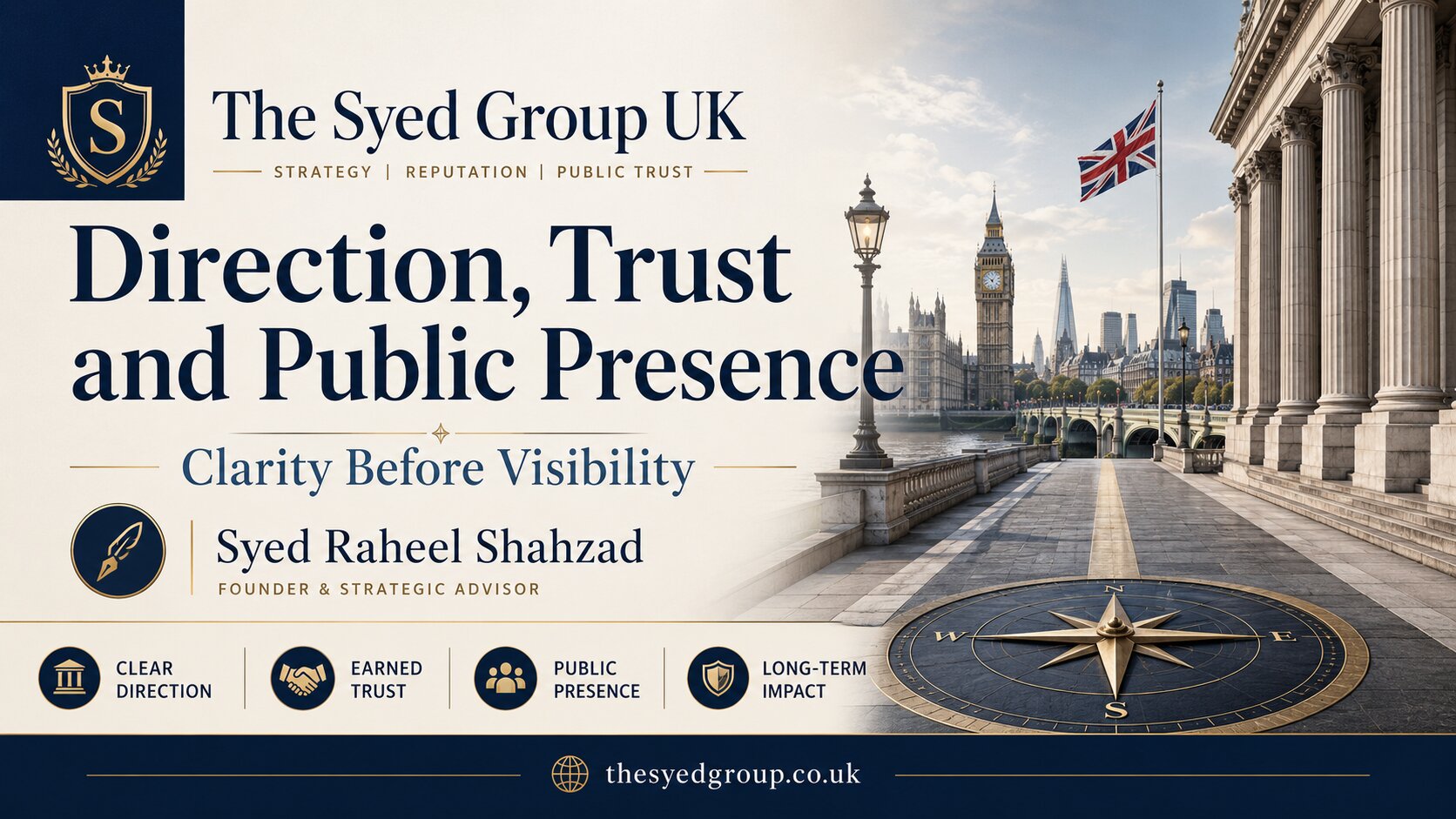
Public trust is not built by noise. It is built by direction, consistency and long-term presence. A serious institution must know what it stands for before it asks to be widely seen.
Movement is not the same as progress
Many people are moving, but not all movement is progress. A person can wake early, answer messages, attend meetings, publish, travel, react, plan, chase targets and still feel that life is not becoming clearer. The body is busy, but the direction is unclear.
The same problem appears in institutions. A business may open new pages, add services, hire people, launch projects, expand markets and increase noise, yet still lack a clear system. Expansion can look impressive from outside while confusion grows inside.
This is why direction must come before speed. Speed multiplies whatever direction already exists. When the direction is right, speed can help. When the direction is wrong, speed only makes the mistake larger.
Direction creates order
Direction gives energy a place to go. It turns pressure into discipline, movement into progress and ambition into a path. Without direction, even hard work becomes scattered. With direction, even small steps begin to matter.
A clear path does not mean that every detail of the future is already known. It means the person or institution understands the main purpose, the values that cannot be abandoned, the work that matters most, and the next responsible step.
Direction also protects the mind. It reduces the need to react to everything. It allows a person to say no to some opportunities, because not every opportunity belongs to the path. It allows an institution to refuse expansion that does not serve the system.
The quiet discipline behind real progress
Real progress is not produced by speed alone. It is produced by clarity, sequence and consistency. First comes purpose. Then comes structure. Then comes execution. Then comes review. Then comes growth that does not destroy the original direction.
This is a systems lesson. A system is not strong because every part moves fast. It is strong because its parts move together. If the parts move quickly in different directions, the system becomes exhausted. If the parts move in one direction with discipline, even slower movement can create lasting progress.
That is why direction is not an abstract idea. It is a practical requirement for human life, institutional strength and long-term public trust.
Clarity before visibility
A UK-facing public record needs more than a name and a website. It needs consistency, traceability, public tone, clear identity and a direction that can be understood over time. Without those things, visibility can create attention but not trust.
Direction, Trust and Long-Term Public Presence is therefore a practical theme for The Syed Group UK. It speaks to the importance of building a serious public identity with care rather than rushing toward recognition without substance.
Trust is slow because it depends on repeated clarity. People need to see the same direction across pages, records, articles, institutional statements and public work. When direction remains stable, public presence becomes credible.
Why serious institutions avoid noise
Noise can create temporary attention. Direction creates a record. A serious institution should not be known only for being active. It should be known for being coherent, reliable and publicly understandable.
That is why long-term presence must be built with discipline. The language should be professional. The records should be consistent. The public identity should not change randomly. The work should point toward a clear purpose.
For The Syed Group UK, direction protects trust because it makes the institution readable. The public can understand what the office represents, how it connects to Syed Raheel Shahzad, and why the wider ecosystem matters.
A public presence needs a clear path.
Credibility grows through consistency.
Public identity should be traceable and stable.
Visibility should be earned, not rushed.
A clear message reduces confusion.
Presence matters most when it endures.
Book connection: Tomorrow Became a Country
Tomorrow Became a Country by Syed Raheel Shahzad studies how the UAE engineered the future as one system through vision, law, execution, openness, growth and global influence. The book connection in this article is intentional but light: direction matters because systems only become strong when their movement serves a clear path.
Title: Tomorrow Became a Country. Subtitle: How the UAE Engineered the Future as One System. Author: Syed Raheel Shahzad. Publisher / Imprint: The Syed Group. Year: 2026. Length: 422 pages. Official book route: Tomorrow Became a Country and TomorrowBecameACountry.com.
Public trust is built before visibility
A public presence is not made serious by being loud. It becomes serious when it is consistent, clear and traceable. In the UK-facing context, this matters even more because public trust depends on records, clarity, continuity and responsible language.
Many organisations try to become visible before they become clear. They publish, announce, promote and expand their public footprint. But visibility without direction can weaken trust. People may see the name, but they do not understand what it stands for, how it behaves or why it should be taken seriously.
Direction gives public presence a spine. It tells the audience what the institution is trying to build, how it wants to be understood and why its record matters over time.
Clarity before reputation
Reputation is not only what appears in search results. It is the pattern that people begin to recognise. If the pattern is unstable, trust becomes weak. If the pattern is clear, trust can grow slowly and properly.
The Syed Group UK should therefore use public articles to strengthen clarity, not noise. The message must remain professional: direction before visibility, consistency before attention, public record before promotion and long-term trust before short-term reaction.
This is why the article connects public presence with direction. A serious institution does not ask only “How can we be seen?” It asks “What should be seen, why does it matter and how will it remain credible over time?”
A long-term public record
A long-term public record is built by repeated clarity. Each article, page, profile and institutional statement should support the same public identity rather than pulling it apart. Over time, the record becomes easier for readers, partners, search systems and institutions to understand.
Syed Raheel Shahzad’s wider ecosystem already connects authorship, books, public questions, institutional activity and systems thinking. The UK-facing record should organise that ecosystem with seriousness and restraint.
The light connection to Tomorrow Became a Country is useful because the book studies direction at the level of a national system. This article studies direction at the level of public trust and institutional presence.
About Syed Raheel Shahzad and major works
Syed Raheel Shahzad is an Author, Group CEO, Business Strategist, Systems Thinker and Architect. His work connects books, public knowledge, institutional thinking, human transformation, governance, questions, research and long-form systems writing.
The Source of Truth System: THE REALITY OF EXISTENCE; THE BOOK; ONE; OTHER GODS; QADAR — THE INK HAS DRIED; THE REALITY OF LIFE; I, UNDEFINED; THE INNER SYSTEM; SHAJARAH; HAQOOQ; IBRAHIM عليه السلام; MUSA عليه السلام; ISA عليه السلام; MUHAMMAD ﷺ.
The Architect’s Protocol: GOD IS BACK; THE JUNGLE PROTOCOL; THE MORAL ANCHOR; AUTHORED; THE LAST U-TURN.
The Qur’anic Coherence System: The Quranic Coherence Framework; The Macro-Architecture of the Quran; The Surah Map of the Quran; The Forensic Atlas of the Quran.
Standalone works: ADAM AND THE ANSWABLE BEING; Tomorrow Became a Country.
Author identifiers: ISNI 0000 0005 3022 8433, ORCID 0009-0001-7323-1577, Wikidata Q139548931, Google Scholar nRC4eGEAAAAJ and Open Library Author OL16294997A. Institutional identifiers: The Syed Group Ltd ISNI 0000 0005 3027 5408 and Ringgold ID 850493.
Official routes
The Syed Group UKSRS UK RecordBook PageAuthor WebsiteVisibility without direction can weaken trust
Visibility is powerful, but it is not automatically trustworthy. A name can appear in many places and still remain unclear. A company can publish frequently and still fail to build confidence. A public record can grow in size while remaining weak in meaning.
This is why The Syed Group UK article places direction before visibility. Public presence should not be treated as a race to appear everywhere. It should be treated as a record that must remain coherent. Each page, article, profile and institutional statement should support the same long-term identity.
Trust grows when people can understand the pattern. They see the same seriousness, the same discipline and the same public purpose repeated over time. That repetition becomes credibility.
The UK-facing standard
A UK-facing public record should be careful with tone. It should be confident but not exaggerated, visible but not noisy, clear but not shallow. This matters because public trust depends not only on what is said, but on how responsibly it is presented.
Direction gives the UK record a standard. It helps the institution decide which topics belong, which claims should be avoided and which connections should be made visible. It also helps connect the author, the business record, the public knowledge ecosystem and the books without making the page feel random.
The strongest public presence is not the one that shouts the most. It is the one that can be followed, verified and understood over time.
Long-term presence is built by consistency
Consistency does not mean repetition without thought. It means that every public step belongs to a larger direction. The article, the website, the author record, the institutional page and the book connection should support each other.
This is why direction, trust and long-term public presence belong together. Direction tells the institution where it is going. Trust tells the audience why the record matters. Long-term presence tells both sides that the work is not temporary noise.
For Syed Raheel Shahzad and The Syed Group UK, this creates a professional public record that can carry books, institutional work, public questions and future-facing thought without losing coherence.
The practical discipline of direction
Direction becomes real when it shapes daily choices. It is not only a beautiful idea placed inside an article. It is the quiet discipline of choosing the next right step, arranging time around what matters and refusing to let every pressure become a command.
For a person, a young reader or an institution, the lesson is similar. Speed should serve direction. Activity should serve purpose. Growth should serve responsibility. When these relationships are protected, progress becomes more stable and more human.
Public presence must be easy to understand
A strong UK-facing presence should not force readers to guess what the institution is, who it represents or why it exists. The message should be clear enough for a first-time visitor and consistent enough for a returning reader. This clarity is part of trust.
When public presence is shaped by direction, the website becomes more than a collection of pages. It becomes a record. The record explains the author, the group, the work, the values, the publications and the long-term public purpose.
This is especially important for a cross-border ecosystem connected to the UAE, the UK, books, public knowledge and institutional services. Direction keeps that ecosystem coherent.
Clarity before visibility in practice
In practice, clarity before visibility means avoiding public noise that does not serve the record. It means writing with restraint, linking only where the link strengthens understanding and presenting the institution with a professional tone. It also means returning to the same core ideas: trust, direction, public value and long-term presence.
Visibility can then grow on a stronger foundation. People are not only seeing the name; they are understanding the pattern behind the name.
The path should make tomorrow clearer
A useful test of direction is simple: will tomorrow become clearer because of what is being done today? If the answer is yes, even a small step has value. If the answer is no, more speed may only create more confusion.
This test applies to personal life, institutions, public records and education. Progress should create clarity, not only motion. It should leave behind a stronger path for the next step.