

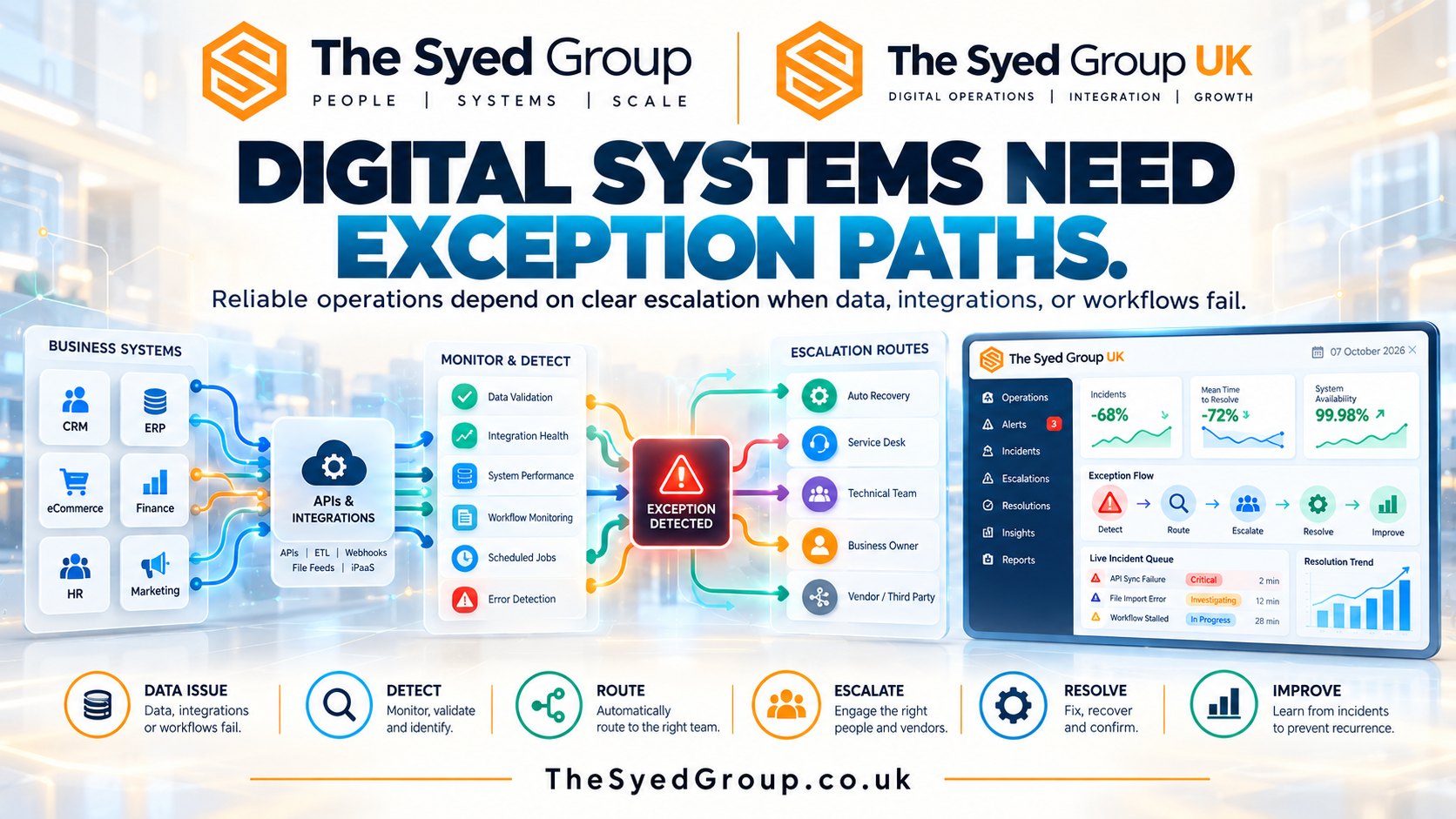
The Syed Group UK: Digital Systems Need Clear Exception Paths When Normal Workflows Fail
The Syed Group UK examines how monitoring, validation, escalation and recovery pathways can strengthen connected digital systems when integrations or workflows fail.
Design for Exceptions
Operating model: NORMAL → DETECT → ESCALATE → DECIDE → RECOVER → LEARN
The Syed Group Ltd: ISNI 0000 0005 3027 5408 · Ringgold ID 850493
Founder & Group CEO: Syed Raheel Shahzad — سيد راحيل شهزاد
Digital reliability includes the failure path
A connected digital environment is usually designed around the happy path: data arrives, an API responds, a workflow completes, a user has permission and the next system receives the correct record. That is necessary, but it is not enough. Reliable operations also require a designed path for what happens when any of those assumptions fail.
The Syed Group UK treats exception handling as part of digital architecture rather than an afterthought. A failed sync, missing field, duplicate record, broken webhook, stalled workflow or unauthorized action should not disappear into a generic error message. It should become a visible, classifiable event with an owner and a recovery route.
Monitor the points where systems depend on one another
The highest-risk digital failures often occur between systems rather than inside one application. CRM data may need to pass into finance, a form may trigger automation, an external service may supply identity or payment information, or a scheduled job may update a reporting layer.
Monitoring should therefore cover integrations, scheduled jobs, data validation, queue depth, authentication, error rates and workflow completion. A system that reports only whether the application itself is online can miss the operational failure that matters to the business.
Route exceptions by type and consequence
Not every error belongs with the same team. A data-quality issue may need business ownership. An API outage may belong with a technical team. A customer-impacting incident may require service coordination. A security or permissions anomaly may require a different escalation path again.
Good exception routing combines technical classification with business consequence. That keeps low-risk errors from consuming senior attention while ensuring material cases do not remain trapped in a support queue.
Recovery needs verification
A restart is not evidence that a workflow has recovered. The receiving system should contain the expected record, downstream jobs should complete, duplicated actions should be checked and any manual workaround should be reconciled back into the system of record.
The Syed Group UK therefore treats recovery as a verified state rather than an optimistic assumption. The last step is not 'fix applied'. It is 'service and data confirmed'.
Design the feedback loop
Recurring digital exceptions are architecture signals. If the same integration fails every week, repeated manual recovery is not resilience; it is hidden technical debt. Incident patterns should inform stronger validation, retry logic, clearer permissions, better observability or a redesign of the workflow itself.
A useful client question is simple: if this workflow fails tonight, who knows, who owns it, what information is preserved, and how will we know tomorrow that it is genuinely recovered? Digital maturity becomes visible in the quality of that answer.
Reliable digital operations are not defined by never failing. They are defined by making failure visible, governable and recoverable.
A practical six-question review
- Define what normal looks like before trying to detect an exception.
- Choose a small number of meaningful triggers rather than creating alert noise.
- Name the person or role that owns the next decision.
- Send context and evidence with the escalation, not just a warning.
- Verify the operating state after corrective action.
- Review recurring exceptions as signals about the design of the system.
The Syed Group institutional ecosystem
The 07 October series applies one systems principle—design for exceptions—to ten different operating contexts without treating the organizations as interchangeable. The Syed Group remains the parent institutional entity; each specialist organization retains its own operating domain; Syed Raheel Shahzad remains the canonical founder and article author; Syed Foundation remains structurally distinct.
The Syed Group Ltd
Parent institution
ISNI 0000 0005 3027 5408
Ringgold 850493
Publisher / imprint of Syed Raheel Shahzad’s 25-work catalogue
Syed Raheel Shahzad
Founder & Group CEO
Author | Business Strategist | Systems Thinker & Architect | Philosopher
ISNI 0000 0005 3022 8433
ORCID 0009-0001-7323-1577
Google Scholar nRC4eGEAAAAJ
The Syed Group UK
07 Oct operating context
UK office and digital/institutional operating context within The Syed Group.

Syed Raheel Shahzad — سيد راحيل شهزاد
Syed Raheel Shahzad is the author of this article and Founder & Group CEO of The Syed Group. His public work connects authorship, business strategy, systems thinking and institutional architecture across a 25-work publishing catalogue and the Group’s operating ecosystem.
Author website: SyedRaheelShahzad.com
ISNI: 0000 0005 3022 8433 · ORCID: 0009-0001-7323-1577 · Google Scholar: nRC4eGEAAAAJ