

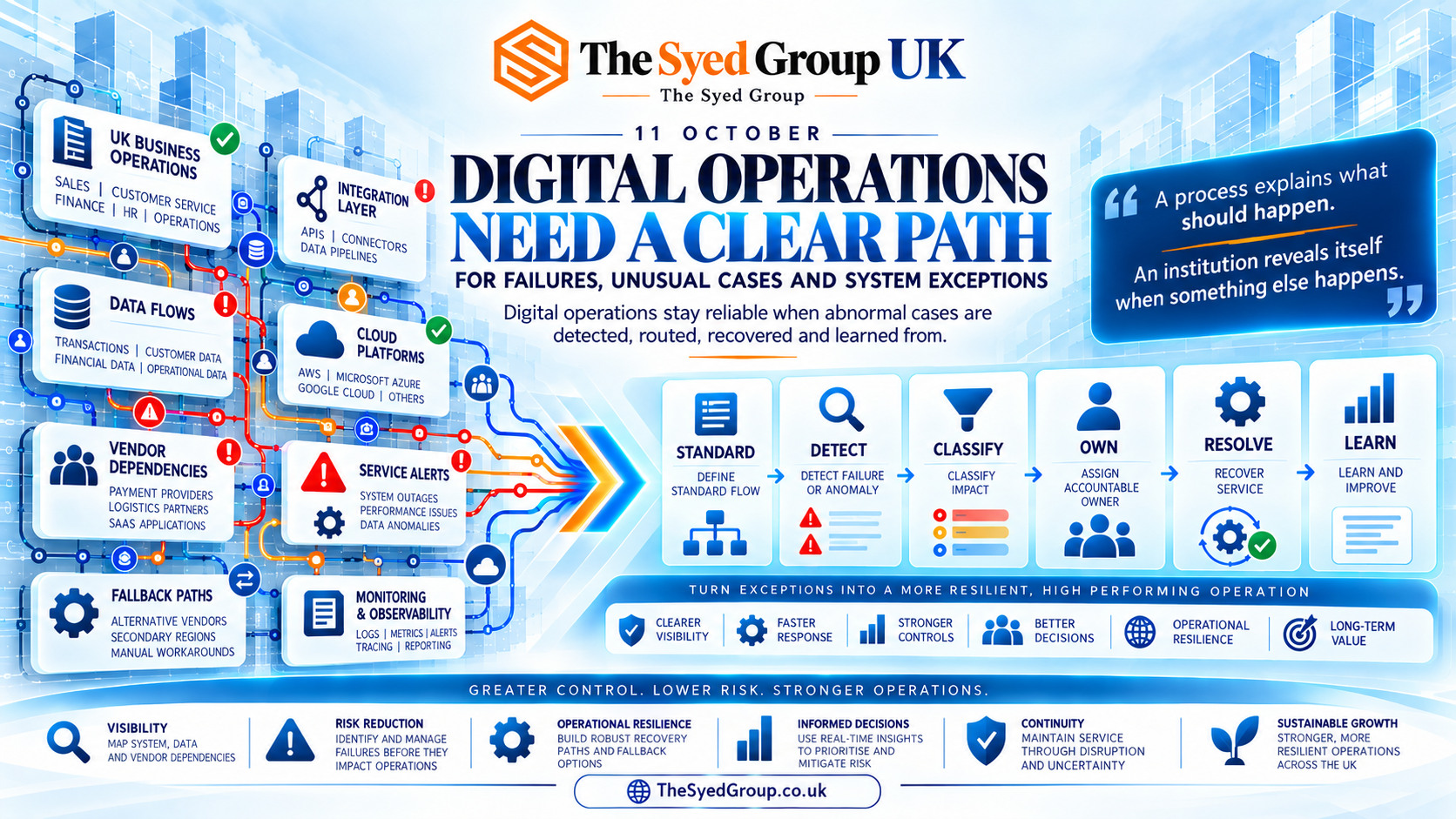
The Syed Group UK: Every Digital Exception Needs a Defined Response Path
The Syed Group UK examines how system alerts, data anomalies, vendor failures and fallback pathways support controlled digital exception handling and recovery.
11 October 2026 · Exception Discipline
Author: Syed Raheel Shahzad · Parent institution: The Syed Group Ltd · Subject: The Syed Group UK
The Syed Group ISNI: 0000 0005 3027 5408 · Ringgold: 850493
Why exception discipline matters
The Syed Group UK examines Exception Discipline as a practical operating responsibility: recognizing when a normal process is no longer sufficient, identifying the consequence and ensuring an accountable route to resolution. The analysis is part of the 11 October series across The Syed Group, authored by Syed Raheel Shahzad, while remaining centered on The Syed Group UK's real specialist function.
A digital workflow needs a second path
The Syed Group UK examines the part of digital operations that ordinary process diagrams leave out. A workflow may be designed around valid requests, available cloud services and accurate data. Yet operational reality introduces timeouts, failed dependencies, unexpected input, access problems and degraded performance. The question is not whether these cases can be eliminated completely. It is whether the organization has designed a safe and observable way to handle them.
Exception handling deserves its own architecture. Without it, normal workflows may continue producing incomplete results while the underlying problem remains hidden.
Define normal system behavior first
Teams should know the expected state of each important service: what an accepted request looks like, which data it uses, which dependencies it requires, and what completion means. A baseline can include service health, transaction outcomes, data-quality checks, access boundaries and recovery requirements. This makes an abnormal state recognizable without relying on a single person's intuition.
The aim is not a rigid standard that prevents change. It is a reference point against which a new condition can be assessed.
Detect exceptions at the useful level
Not every failed request is an incident and not every incident is visible in an error count. Monitoring should connect technical signals to business impact. An API timeout that retries successfully may be lower priority than a quiet data-sync failure that changes a customer's record. Logs, application metrics, queue backlogs and user reports provide different views of the same service.
Alert design should make ownership and likely impact visible. Alert volume without triage can become another form of operational failure.
Classify impact before selecting a recovery action
Classification should distinguish a localized input error from a shared-platform outage, a security-sensitive failure from an ordinary integration problem, and a recoverable delay from possible data corruption. Each category may require a different response: user correction, retry, isolation, incident escalation, access review or restored data.
The Syed Group UK should avoid automatically applying the same retry or restart action to every abnormal condition. Doing so can amplify a fault or obscure evidence needed to understand it.
Retries must be controlled
Retries are useful when failure is temporary, such as a network interruption. They can be harmful when repeated requests create duplicate actions, payment attempts or inconsistent data. A reliable workflow uses bounded retries, appropriate backoff and safe processing rules. Where possible, idempotent operations allow a repeated instruction to be recognized rather than executed twice.
When retries are exhausted, the case needs a defined destination and an owner. The failure should not disappear into an indefinitely looping background task.
Design fallback without concealing failure
Fallback paths can keep service operating while an external platform is unavailable. A secondary provider, cached read-only information or a manual approval queue may be appropriate depending on the service. Each fallback has its own limits and risks. It should be recorded when fallback was invoked and what quality of service remained available.
A graceful degradation strategy protects continuity, but it must not misrepresent provisional information as complete or verified output.
Data integrity deserves separate controls
One of the most consequential digital exceptions is data that looks plausible but is incomplete or incorrect. Validation should operate at ingestion, transformation, synchronization and output stages. Failed records may need quarantine, reconciliation or review before being released into downstream systems.
An organization that restores a service without addressing corrupted records has only repaired the visible part of the incident. Recovery requires confidence in the data, not merely an application returning to an online state.
Assign one incident owner across vendors
Digital work often spans the local application team, a cloud provider, a payment or messaging partner, and a business owner. Each party may have its own ticket and status. The organization still needs a single accountable coordinator for the user-facing consequence.
That owner maintains the known impact, decision log, next action and communication. Technical specialists can investigate in parallel while the case remains intelligible to people who do not manage the underlying infrastructure.
Preserve a decision trail during recovery
An incident record should capture when the abnormal condition was first observed, affected transactions or users, severity, interim controls, approvals, changes made and test results. During recovery, teams should avoid undocumented configuration changes merely because the pressure is high. Such changes can complicate later diagnosis.
A concise timeline helps post-incident analysis distinguish the original fault from changes introduced while responding to it.
A worked digital exception
Consider a hypothetical online order flow that sends a successful payment confirmation but fails to update the order-management system. Restarting the entire service may be unnecessary and potentially risky. The exception path first confirms the mismatch, prevents duplicate processing, assigns ownership across payment and order teams, reconciles the affected record, tests the correction and documents what should prevent recurrence.
The lesson is specific: success at one integration point does not guarantee completion of the whole business transaction.
A practical exception register
For each material digital exception, record service, symptom, affected workflow, business consequence, technical classification, owner, fallback state, evidence, change history and verified recovery. Keep the record compact enough to use under pressure. Aggregate patterns can then show whether the same dependency is producing repeated failures.
The next investment may be in monitoring, data contracts, vendor options or clearer escalation rather than in more computing capacity.
Institutional relationship and editorial responsibility
The Syed Group UK is a specialist commercial organization within The Syed Group. The Group relationship provides context, while the article remains focused on digital operations and practical recovery architecture. Syed Raheel Shahzad is the canonical article author and Founder & Group CEO of The Syed Group; his systems-thinking contribution lies in asking how a service behaves when its normal assumptions no longer hold.
The six-stage principle remains STANDARD → DETECT → CLASSIFY → OWN → RESOLVE → LEARN. A resilient digital operation is not one without exceptions. It is one where unexpected cases have controlled, reviewable paths to resolution.
Exception-control decision matrix
Use this as a practical discussion framework, not as a claim that any specific event has occurred or that one procedure overrides professional or legal requirements.
| Stage | Example or trigger | Responsible response / evidence |
|---|---|---|
| Standard | Known valid transaction | Document input/output and service ownership |
| Detect | Failed sync, timeout or corrupt record | Connect technical event to business impact |
| Classify | Recoverable vs integrity-sensitive fault | Select approved incident path |
| Own | Incident crossing several vendors | Appoint user-facing coordinator |
| Resolve | Repair and reconciliation | Verify data and end-to-end service |
| Learn | Recurring integration fault | Change monitoring, contract or recovery design |
A reliable digital service needs a route for the transaction that refuses to follow the normal path.
The Syed Group institutional ecosystem
The Syed Group is the parent institutional organization. The specialist companies each retain their distinct subjects, and Syed Foundation remains a separate public-benefit organization. Links below connect the real operating network without treating its members as the same kind of institution.
The Syed Group Ltd
Institutional parent and publishing imprint
ISNI 0000 0005 3027 5408
Ringgold 850493
Syed Raheel Shahzad
Founder & Group CEO
Author | Business Strategist | Systems Thinker & Architect
ISNI 0000 0005 3022 8433
ORCID 0009-0001-7323-1577
Google Scholar nRC4eGEAAAAJ
The Syed Group UK
The Syed Group UK is the specialist commercial organization and local publisher/sourceOrganization of this article. Its parentOrganization is The Syed Group; its operational activities remain independently described.

Syed Raheel Shahzad — سيد راحيل شهزاد
Author | Founder & Group CEO of The Syed Group | Business Strategist | Systems Thinker & Architect | Philosopher
Author identity image connecting Syed Raheel Shahzad with his work in strategy, systems thinking, institutional design and the architecture of organizations through his writing and leadership of The Syed Group.
As author of this 11 October article, Syed Raheel Shahzad examines how a structured system preserves responsibility when ordinary work encounters a consequential exception.
ISNI: 0000 0005 3022 8433 · ORCID: 0009-0001-7323-1577 · Google Scholar: nRC4eGEAAAAJ