

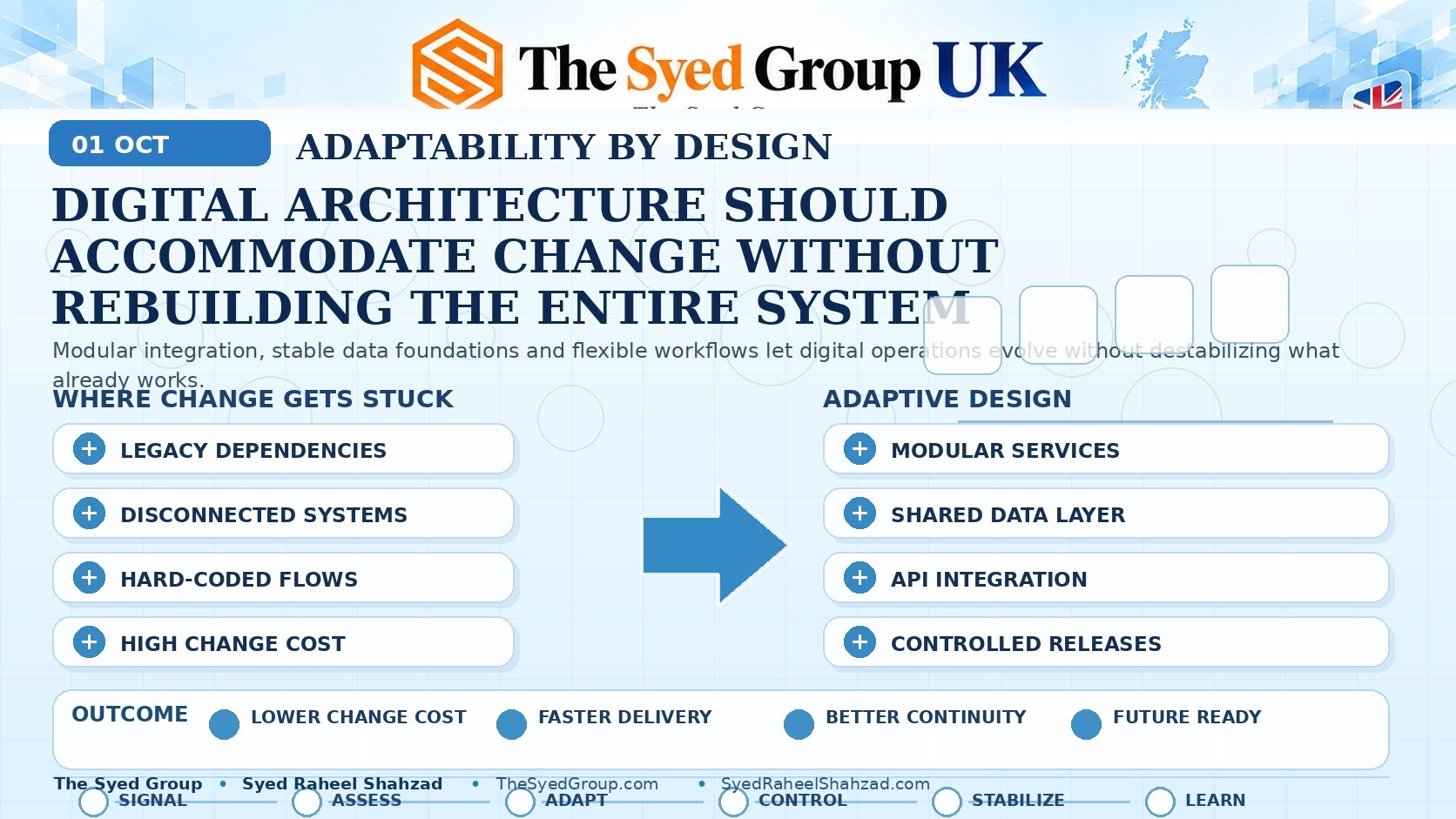
The Syed Group UK: Digital Architecture Should Accommodate Change Without Rebuilding the Entire System
The Syed Group UK examines how modular services, shared data, APIs and controlled releases can help digital operations evolve without destabilizing the wider system within The Syed Group under Syed Raheel Shahzad.
Adaptability by Design
Operating model: SIGNAL → ASSESS → ADAPT → CONTROL → STABILIZE → LEARN
The Syed Group Ltd: ISNI 0000 0005 3027 5408 · Ringgold ID 850493
Founder & Group CEO: Syed Raheel Shahzad — سيد راحيل شهزاد
Digital adaptability begins with architecture
The Syed Group UK approaches change through the architecture underneath digital operations. A system that can only be modified through major rebuilding is not truly flexible, even if its interface looks modern.
Modularity isolates change
Separating services into clear modules allows one capability to be changed, replaced or expanded without unnecessarily disturbing unrelated functions.
Shared data should remain stable while applications evolve
Applications may change more frequently than core business entities such as customers, orders, employees and projects. Stable definitions reduce the cost of changing the software around them.
APIs create controlled interfaces
API contracts help systems evolve independently when inputs, outputs, authentication and failure behavior are clearly defined.
Configuration should replace hard-coding where practical
Rules that are likely to change should be configurable rather than buried inside code that requires redevelopment for routine operational adjustments.
Controlled releases reduce change risk
Testing, staging, version control, rollback and monitored deployment allow the organization to introduce change without treating production as the experiment.
Legacy systems need boundaries
Not every older system needs immediate replacement. Adaptability can improve when legacy functions are isolated behind clear interfaces while newer capabilities evolve around them.
Observability shows whether the change worked
Metrics, logs and user feedback help teams detect whether a release improved the service or created new friction elsewhere.
User effort is a practical adaptability measure
A successful digital change should reduce or preserve the effort required to complete the work. If a new system creates more repeated entry, more logins or more manual correction, technical change has not produced operational improvement.
The Syed Group UK remains the digital-operations specialist
The Syed Group UK is a distinct specialist Organization within The Syed Group, focused on connected digital operations, integration and technology architecture under Syed Raheel Shahzad’s founder relationship.
Adaptability should lower the cost of the next change
The strongest architecture does more than solve today’s requirement. It makes tomorrow’s change easier to absorb because boundaries, data and interfaces remain understandable.
Change boundaries should be documented
A modular architecture works best when teams know which interfaces are stable and which are allowed to change. The Syed Group UK can document service ownership, API contracts, data definitions and release responsibilities so adaptation remains coordinated across teams.
This reduces accidental coupling. A team can improve its service without unknowingly changing a dependency that another part of the business relies on.
Adaptability becomes an architectural property rather than a heroic effort during every project.
Good digital architecture makes the next change easier to absorb than the last one.
The Syed Group institutional ecosystem
The 1 October series applies adaptability by design to ten distinct operating contexts without treating the companies as interchangeable. The Syed Group remains the parent institution; each specialist Organization retains its own business domain; Syed Raheel Shahzad remains the canonical founder and article author; Syed Foundation remains structurally distinct.
The Syed Group Ltd
Parent institution
ISNI 0000 0005 3027 5408
Ringgold 850493
Publisher / imprint of Syed Raheel Shahzad’s 25-work catalogue
Syed Raheel Shahzad
Founder & Group CEO
Author | Business Strategist | Systems Thinker & Architect | Philosopher
ISNI 0000 0005 3022 8433
ORCID 0009-0001-7323-1577
Google Scholar nRC4eGEAAAAJ
The Syed Group UK
01 Oct operating context
The Syed Group UK remains a distinct specialist Organization and local publisher/source organization for this article, connected to The Syed Group through its commercial parentOrganization relationship.
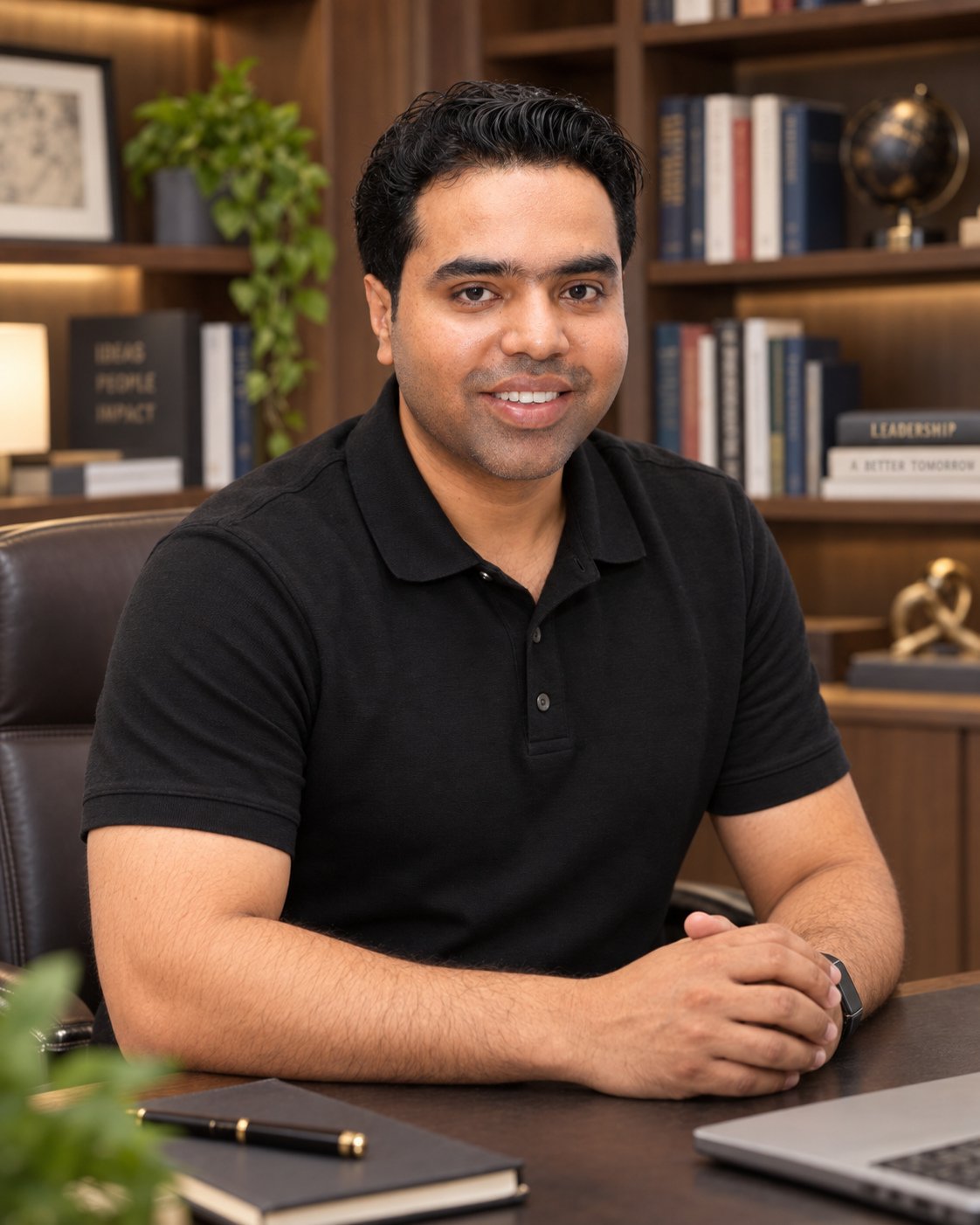
Syed Raheel Shahzad — سيد راحيل شهزاد
Official author image connected with Syed Raheel Shahzad's research and publishing on Qur’anic coherence, structural analysis, philosophical inquiry, human answerability and systems-based approaches to knowledge.
Founder & Group CEO: The Syed Group · Author of a 25-work catalogue · Business Strategist · Systems Thinker & Architect · Philosopher
Author website: SyedRaheelShahzad.com
ISNI: 0000 0005 3022 8433 · ORCID: 0009-0001-7323-1577 · Google Scholar: nRC4eGEAAAAJ