

Consistency, Trust and the Discipline of Returning
The Syed Group UK explores how consistency, trust and disciplined returning build a credible long-term public presence after interruption.
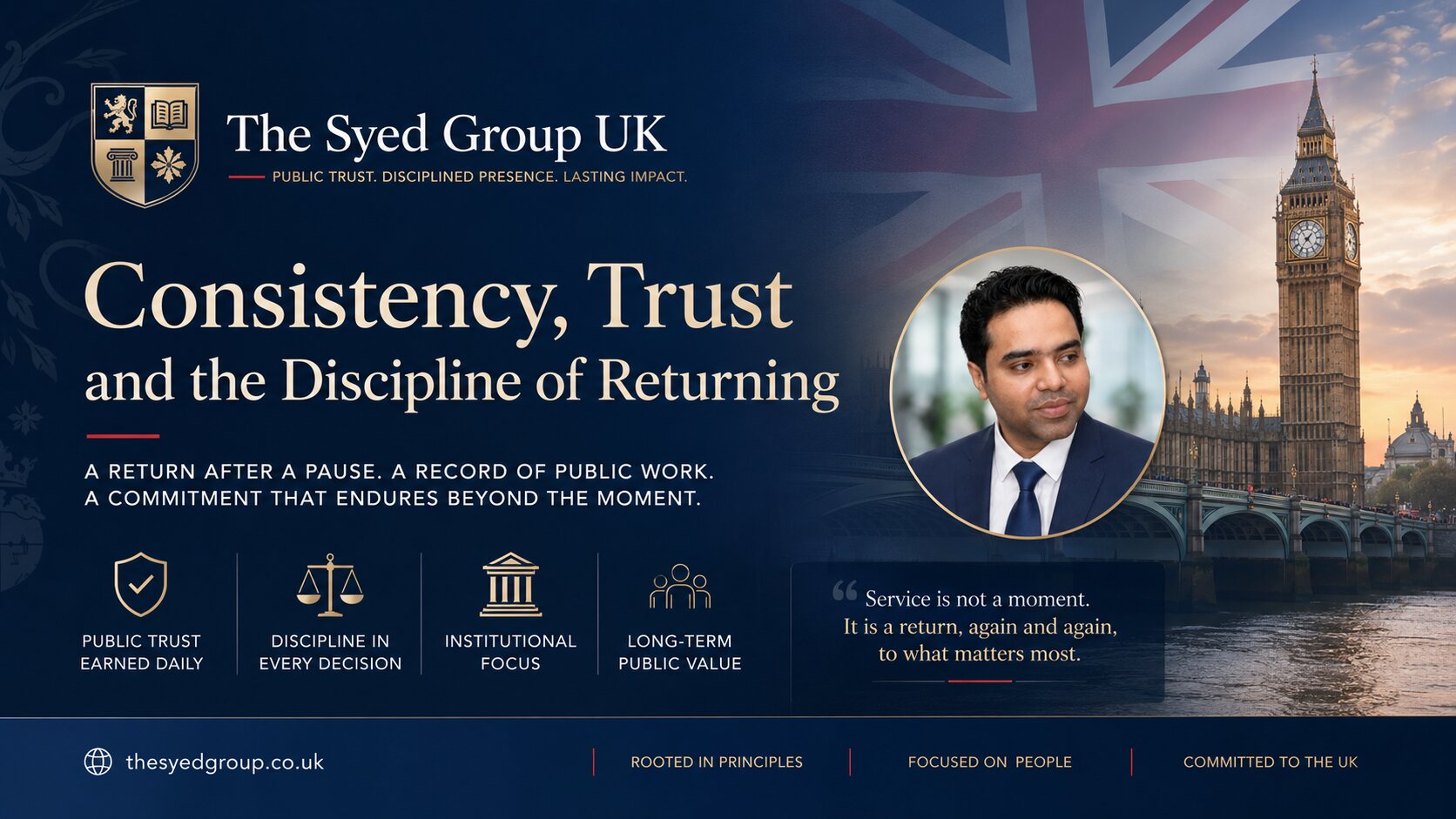
Trust is not built by pretending that interruption never happened. It is built by returning with clarity, responsibility and a public record that remains coherent over time.
Consistency does not mean uninterrupted noise
A serious UK-facing public presence should be consistent, but consistency does not mean publishing every day or speaking about every event. It means that the public identity remains recognisable and truthful across time.
A short interruption does not destroy consistency. What weakens consistency is returning with a different message, conflicting information or no connection to long-term purpose.
The discipline of returning is therefore part of public trust.
Frequency is not reliability
Frequency measures how often something appears. Reliability measures whether people can depend on it.
An organisation can publish frequently and remain unreliable if information is inconsistent, outdated or exaggerated.
A sustainable rhythm creates more trust when the material is accurate, relevant and connected to a stable identity.
Why the UK trust context matters
The United Kingdom has a mature public environment in which institutions are examined through records, governance, legal identity, professional communication and continuity.
Trust grows when readers can follow the pattern. The website, leadership record, services, publications and identifiers should not contradict one another.
If the institution has a coherent identity, its record remains understandable even when activity slows.
Work-related strain is not minor
The Health and Safety Executive reports that 964,000 workers in Great Britain were suffering from work-related stress, depression or anxiety in 2024/25. HSE also reports 22.1 million working days lost to these conditions. See the HSE overview and days-lost data.
These figures do not prove that every pause is caused by workplace strain, but they show that unmanaged pressure has serious human and organisational consequences.
A credible return is not a demand to recover every lost hour. It is an organised restoration of essential work.
Public trust after interruption
After a gap, the temptation is either to say too much or nothing at all. Excessive explanation can appear defensive, while total silence can create uncertainty.
The message should answer what the audience needs to know: what has resumed, what remains unchanged and where reliable information can be found.
Trust is strengthened when the organisation communicates simply and honestly.
The public can understand the institution and the return.
The message matches the long-term identity.
Claims are supported by records and official routes.
Communication avoids unnecessary drama.
Essential commitments return before promotion.
The record remains coherent across time.
The discipline of the public record
A public record is built from connected pieces: company information, leadership pages, services, verification, publications, author profiles and external identifiers.
The value lies not in the number of pieces, but in their coherence.
The Syed Group UK should maintain its own role: UK-facing institutional presence, public trust, professional clarity and continuity.
Verification before visibility
A disciplined return begins with verification. Names, company details, leadership descriptions, service pages and identifiers should be checked before new visibility is created.
The institution should review older pages that may no longer reflect current priorities.
This work is not glamorous, but public credibility grows from accurate details.
Returning without overclaiming
A pause can create anxiety about relevance. The organisation may feel pressure to return with a major claim or exaggerated announcement.
A trustworthy return is proportionate. It demonstrates substance before promotion.
Overclaiming may create short attention, but it weakens the long-term record. Restraint is governance.
A practical return standard
Check links, dates, names, leadership information and institutional language. Restore the most important page or service before announcing expansion.
Return with one substantial contribution rather than several rushed items. A strong article can do more for credibility than a burst of shallow posts.
Maintain a rhythm the institution can honour. Trust is created by a pattern, not by temporary intensity.
How a return becomes public value
A return becomes public value when it gives the reader something useful: a clearer record, a thoughtful article, corrected information or renewed access to a service.
The public should not be asked to celebrate the organisation for returning. The organisation should demonstrate why the return matters through the quality of its work.
This approach keeps the UK-facing record professional, restrained and credible.
Presence that endures
The strongest public presence is not the loudest. It is the one that remains understandable after months and years.
Every interruption can become an opportunity to verify the public record, remove inconsistency and resume with greater clarity.
The result is not perfect continuity. It is credible continuity.
A systems connection to Tomorrow Became a Country
Tomorrow Became a Country: How the UAE Engineered the Future as One System studies how direction becomes durable through vision, law, execution, openness, growth and global influence. The connection to today’s theme is direct: continuity does not require uninterrupted noise. It requires a direction strong enough to survive interruption and resume intelligently.
The same principle applies to a person, an institution or a young reader. Vision protects meaning. Rules protect order. Execution restarts movement. Openness allows learning. Growth shows that the return is producing value.
The official book page is available at SyedRaheelShahzad.com, and the dedicated book website is TomorrowBecameACountry.com.
Public accountability and proportionate communication
A UK-facing institution should consider who is affected by an interruption and what each audience reasonably needs to know. Staff, clients, regulators, suppliers and the general public do not require identical messages. Proportion is part of responsible communication.
Where a legal, contractual or regulatory duty applies, communication must follow that duty rather than a marketing timetable. Where no formal duty exists, the institution should still consider whether silence could create material misunderstanding. The standard is not maximum disclosure; it is accurate and sufficient disclosure.
Public accountability also means correcting information that became inaccurate during the pause. Dates, service availability, leadership details and contact routes should be reviewed before promotional activity resumes.
Recordkeeping after a gap
A gap in public activity can expose weak recordkeeping. The institution may struggle to identify the latest approved description, the current service route or the status of a project. This is not merely a publishing inconvenience. It is a governance weakness.
Maintain a simple register of core public pages, responsible owners, last review dates and evidence links. The register helps ensure that the website remains a reliable record rather than an accumulation of old statements.
When returning, update the register alongside the content. This creates a repeatable process and reduces dependence on memory. Trust is easier to protect when the record has an owner.
Why consistency is a governance issue
Consistency is often discussed as branding, but it is also governance. Conflicting descriptions of leadership, services or purpose can create practical uncertainty. Different sites may make different promises. Old pages may remain visible after policy changes.
Governance gives consistency an authority structure. It defines who approves public statements, who reviews accuracy and how corrections are made. This protects both reputation and operational clarity.
The goal is not to make every page sound identical. The author website, foundation, Ask SRS and UK office have different roles. Consistency means those roles remain distinct while supporting one truthful wider record.
A UK-facing return checklist
Confirm the legal name and contact details. Check leadership pages and company descriptions. Review service availability, privacy information and important links. Verify that external profiles and identifiers point to the correct official routes.
Publish one substantial item that reflects the institution’s real purpose. Avoid creating several weak posts merely to fill the gap. Review how the new item connects to the existing record and whether its claims can be supported.
Set a realistic next review date. A disciplined public presence is maintained through scheduled verification, not through permanent anxiety about visibility.
Trust across several public platforms
When an institutional ecosystem includes a parent group, UK office, author platform, foundation and public forum, each site should retain a distinct role. The UK site should not repeat every article or description used elsewhere. Its responsibility is to present UK-facing institutional identity, public trust and verifiable records.
Cross-linking should clarify relationships rather than manufacture authority. Links should direct readers to the official author page, publication record or institutional source when those routes are genuinely relevant. Too many unrelated links can make a page look constructed for search rather than written for readers.
A disciplined return therefore includes an ecosystem review: which site owns the subject, which page is the primary record and which references help a UK reader understand the relationship?
Correcting the record with confidence
Institutions sometimes avoid corrections because they fear that admitting an error will weaken trust. In practice, an accurate correction can strengthen trust when it is made promptly, clearly and without defensiveness.
The correction should identify what changed and ensure that old information is removed or redirected where appropriate. If the matter affects contracts, regulation or legal obligations, professional advice may be required. Public copy should not attempt to replace formal compliance.
Confidence in the public record comes from its capacity to be maintained, not from pretending it was never imperfect.
Maintaining a realistic editorial rhythm
An editorial calendar should reflect available capacity. A weekly or twice-monthly substantial article may support trust better than daily publication that cannot be sustained. The correct rhythm depends on purpose, audience and resources.
Each planned item should have an owner, a factual review and a defined role in the wider public record. This reduces last-minute writing and helps prevent contradictory messages across platforms.
A pause then becomes less threatening because the institution is not relying on continuous output to prove its existence. The record is carried by quality, consistency and official identity.
What a credible return communicates
A credible return communicates that the institution remains present, that its direction is stable and that its public work continues with care. It does not need to claim that the interruption created a transformation or that every future difficulty has been solved.
The return should show one useful contribution and connect it to the institution’s ongoing purpose. This is enough to re-establish rhythm without exaggeration.
Trust grows when the institution repeatedly chooses accuracy over noise and continuity over performance.
A record that can be followed
A trustworthy public record should remain understandable to someone who arrives after the interruption. The reader should be able to identify the institution, its purpose, leadership, official routes and current work without reconstructing the story from scattered claims.
This is why disciplined returning includes maintenance as well as publication. The institution resumes activity while also making the existing record easier to verify.
About Syed Raheel Shahzad and the wider body of work
Syed Raheel Shahzad is an Author, Group CEO, Business Strategist, Systems Thinker and Architect. His work connects long-form books, public knowledge, institutional thinking, governance, questions, human transformation and systems-based inquiry.
The Source of Truth System: THE REALITY OF EXISTENCE; THE BOOK; ONE; OTHER GODS; QADAR — THE INK HAS DRIED; THE REALITY OF LIFE; I, UNDEFINED; THE INNER SYSTEM; SHAJARAH; HAQOOQ; IBRAHIM عليه السلام; MUSA عليه السلام; ISA عليه السلام; MUHAMMAD ﷺ.
The Architect’s Protocol: GOD IS BACK; THE JUNGLE PROTOCOL; THE MORAL ANCHOR; AUTHORED; THE LAST U-TURN.
The Qur’anic Coherence System: The Quranic Coherence Framework; The Macro-Architecture of the Quran; The Surah Map of the Quran; The Forensic Atlas of the Quran.
Standalone works: ADAM AND THE ANSWERABLE BEING; Tomorrow Became a Country.
Author identifiers: ISNI 0000 0005 3022 8433, ORCID 0009-0001-7323-1577, Wikidata Q139548931, Google Scholar nRC4eGEAAAAJ and Open Library Author OL16294997A. Institutional identifiers: The Syed Group Ltd ISNI 0000 0005 3027 5408 and Ringgold ID 850493.