

Busyness, Pressure and Direction: A UK Reflection by The Syed Group UK
The Syed Group UK reflects on modern busyness, public pressure, trust, accountability and the need for human direction in a noisy world.
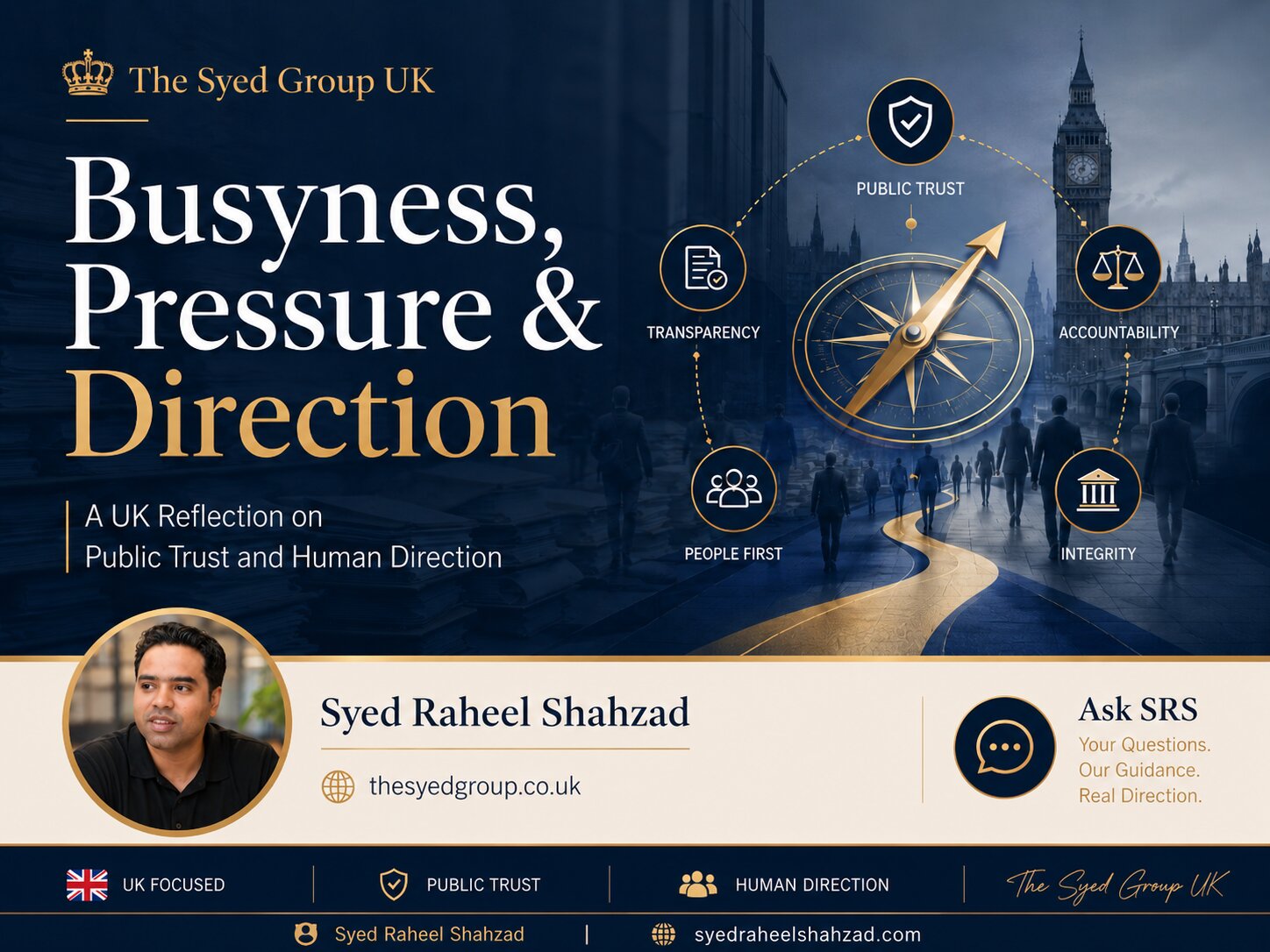
A public life of pressure and performance
Modern life often rewards visible productivity. People are expected to respond quickly, work efficiently, build credibility, manage public profiles, handle financial pressure and remain available through digital channels. In such an environment, busyness can look like seriousness. But a busy public life is not always a directed life.
This reflection by The Syed Group UK considers the pressure behind modern visibility. A person or institution may appear active, searchable and present while still needing deeper clarity. The same is true of public knowledge. It is not enough for records to exist. They must be understandable, traceable and responsibly connected.
Busyness becomes a public problem when society begins to confuse motion with meaning. If everyone is moving quickly, few people ask where they are going.
Pressure can hide behind professionalism
Professional life often teaches people how to appear composed. A person can answer emails, attend meetings, maintain appearance, handle responsibility and still feel internally uncertain. This is not always visible. The person may not collapse. They may simply continue, because continuing is expected.
The question of direction is therefore not only personal. It is social. Work cultures, public expectations and digital visibility can all encourage people to remain constantly available. Yet availability is not the same as purpose. A person may be reachable by everyone and still unreachable to themselves.
The UK-facing work of The Syed Group UK should therefore support clarity rather than noise. It should help readers understand the public route connected to Syed Raheel Shahzad, Ask SRS, The Syed Group, Syed Foundation and the wider author record.
The wider evidence around pressure and disconnection
Research does not replace lived experience, but it helps us see that this private feeling is not isolated. Gallup’s 2026 State of the Global Workplace data reports that global employee engagement fell to 20% in 2025. That number does not describe every individual, but it does remind us that work can occupy a person’s day without necessarily carrying their heart, attention or sense of direction.
The World Happiness Report 2025 gives another important signal. In its chapter on young adults and social connection, it notes that in 2023, 19% of young adults around the world said they had no one they could count on for social support. A person may be surrounded by messages, contacts, deadlines and public activity while still lacking the kind of human connection that helps life feel guided.
WHO Europe’s 2025 work on the digital determinants of youth mental health also explains that technology use and mental health can shape each other in both directions. Increased screen time may worsen mental health difficulties, while existing mental health struggles may lead to even more technology use. This matters because busyness today is not only physical. It is also digital, emotional and mental.
Public trust needs direction
Public trust is not built by appearing everywhere. It is built by giving people a clear route back to what is real. A public page should not only publish words. It should help a reader understand where the work comes from, who is responsible for it, how it connects to other records and why it exists.
In a noisy digital world, public records can become scattered. People find fragments: a social profile, an article, a press reference, a website page, a book listing, a question platform. Without direction, these fragments may not form trust. With direction, they become a public knowledge route.
This is why The Syed Group UK has a specific role. It should not simply repeat what the author website or main group site says. It should give a UK-facing layer of clarity, trust, public record and thoughtful institutional presence.
Busyness, pressure and accountability
Pressure becomes more dangerous when there is no accountability. A person can blame the schedule, the market, the workplace, the family or the public expectation, but still avoid asking what must be ordered differently. Institutions can do the same. They can blame workload while ignoring weak direction.
Accountability begins when the question changes. Instead of asking only how to get more done, a person or organisation asks what should be done, why it should be done and what must stop. That is a deeper question because it requires judgment.
The compass image is useful here. A compass does not remove the difficulty of walking. It gives the journey orientation. Direction does not remove pressure. It prevents pressure from becoming meaningless.
A UK reflection for readers
For readers in the UK and beyond, the issue is recognisable. Many people are living under performance pressure. They must appear capable, informed, productive and stable. They may be building careers, businesses, families and public identities. Yet the inner question remains: is this life directed, or only demanded?
The answer cannot be produced only by another productivity system. Productivity may help, but it cannot replace meaning. A person may need to examine values, relationships, faith, responsibility, inner order and the kind of public life they are building.
The work connected to Syed Raheel Shahzad is increasingly concerned with this human problem. Ask SRS gives questions a place. The books give structure. The official records give traceability. The Syed Group UK gives a public-facing layer of trust and clarity.
- What part of my public life is built on direction, not only pressure?
- Am I becoming more trustworthy or only more visible?
- What public records support the work I want people to understand?
- Where does activity need to become clarity?
- Who is affected when I move quickly without direction?
- What would a less noisy and more responsible public route look like?
A public record should not add more noise. It should help people find direction through clarity.
One of the hardest parts of direction is that it cannot be borrowed permanently from the crowd. A crowd can create momentum, but it cannot answer for a person’s life. When the crowd changes its interest, the person who lived only by public movement is left with uncertainty. Direction must be examined inwardly and lived outwardly.
Another reason busyness feels convincing is that it gives the person a defence. If someone asks how life is going, the answer can be, I am busy. That answer often receives respect. But being busy does not always mean being well. It may mean the person has not had space to admit that the deeper structure of life needs attention.
Real direction is not always dramatic. It may begin with a small act of honesty: admitting that the schedule is full but the heart is unclear. It may begin by writing down the questions that have been avoided. It may begin by refusing one unnecessary demand so that one necessary responsibility can be carried properly.
The work of meaning is slow because the human being is not a machine. People cannot simply be reprogrammed by productivity techniques. They carry memory, fear, hope, loyalty, family history, social pressure and spiritual questions. Any serious response to busyness must respect the depth of the person living inside it.
This is why reflection is not weakness. Reflection is a form of responsibility. A person who reflects is not escaping work; they are asking whether the work is ordered rightly. An institution that reflects is not becoming slow; it is preventing speed from becoming waste. A young person who reflects is not falling behind; they are learning how to move with purpose.
Direction also requires courage because it may expose misalignment. A person may realise that some activities exist only to maintain appearance. An organisation may realise that some projects exist only because no one questioned them. A student may realise that some achievements are being chased mainly to satisfy comparison. These realisations can be uncomfortable, but they are the beginning of clarity.
Busyness becomes healthier when it serves what is meaningful. Work becomes healthier when it forms responsibility. Study becomes healthier when it builds understanding. Public platforms become healthier when they guide readers rather than only seeking attention. Activity does not need to disappear. It needs to be placed under direction.
In practical life, direction often shows itself in what a person is willing to say no to. Without direction, every request can become a burden. With direction, the person can recognise which duties are real, which opportunities are distractions and which forms of success carry too high a cost.
The question of direction is not solved once. It must be revisited as life changes. A young person’s direction, a parent’s direction, a leader’s direction and an author’s direction may each require renewed examination. The principle remains: movement must answer to meaning.
For this reason, the daily act of asking better questions matters. A better question interrupts automatic living. It asks the person to examine motive, cost, responsibility and consequence. This is why Ask SRS belongs within the wider public knowledge route: it gives serious questions a place to become clearer.
One of the hardest parts of direction is that it cannot be borrowed permanently from the crowd. A crowd can create momentum, but it cannot answer for a person’s life. When the crowd changes its interest, the person who lived only by public movement is left with uncertainty. Direction must be examined inwardly and lived outwardly.
Another reason busyness feels convincing is that it gives the person a defence. If someone asks how life is going, the answer can be, I am busy. That answer often receives respect. But being busy does not always mean being well. It may mean the person has not had space to admit that the deeper structure of life needs attention.
Real direction is not always dramatic. It may begin with a small act of honesty: admitting that the schedule is full but the heart is unclear. It may begin by writing down the questions that have been avoided. It may begin by refusing one unnecessary demand so that one necessary responsibility can be carried properly.
The work of meaning is slow because the human being is not a machine. People cannot simply be reprogrammed by productivity techniques. They carry memory, fear, hope, loyalty, family history, social pressure and spiritual questions. Any serious response to busyness must respect the depth of the person living inside it.
This is why reflection is not weakness. Reflection is a form of responsibility. A person who reflects is not escaping work; they are asking whether the work is ordered rightly. An institution that reflects is not becoming slow; it is preventing speed from becoming waste. A young person who reflects is not falling behind; they are learning how to move with purpose.
Direction also requires courage because it may expose misalignment. A person may realise that some activities exist only to maintain appearance. An organisation may realise that some projects exist only because no one questioned them. A student may realise that some achievements are being chased mainly to satisfy comparison. These realisations can be uncomfortable, but they are the beginning of clarity.
Busyness becomes healthier when it serves what is meaningful. Work becomes healthier when it forms responsibility. Study becomes healthier when it builds understanding. Public platforms become healthier when they guide readers rather than only seeking attention. Activity does not need to disappear. It needs to be placed under direction.
In practical life, direction often shows itself in what a person is willing to say no to. Without direction, every request can become a burden. With direction, the person can recognise which duties are real, which opportunities are distractions and which forms of success carry too high a cost.
The question of direction is not solved once. It must be revisited as life changes. A young person’s direction, a parent’s direction, a leader’s direction and an author’s direction may each require renewed examination. The principle remains: movement must answer to meaning.
Sources and continued reading
For context, see Gallup’s State of the Global Workplace 2026 data at Gallup, the World Happiness Report 2025 young-adult social connection chapter at World Happiness Report, and WHO Europe’s 2025 work on digital determinants of youth mental health at WHO Europe.