

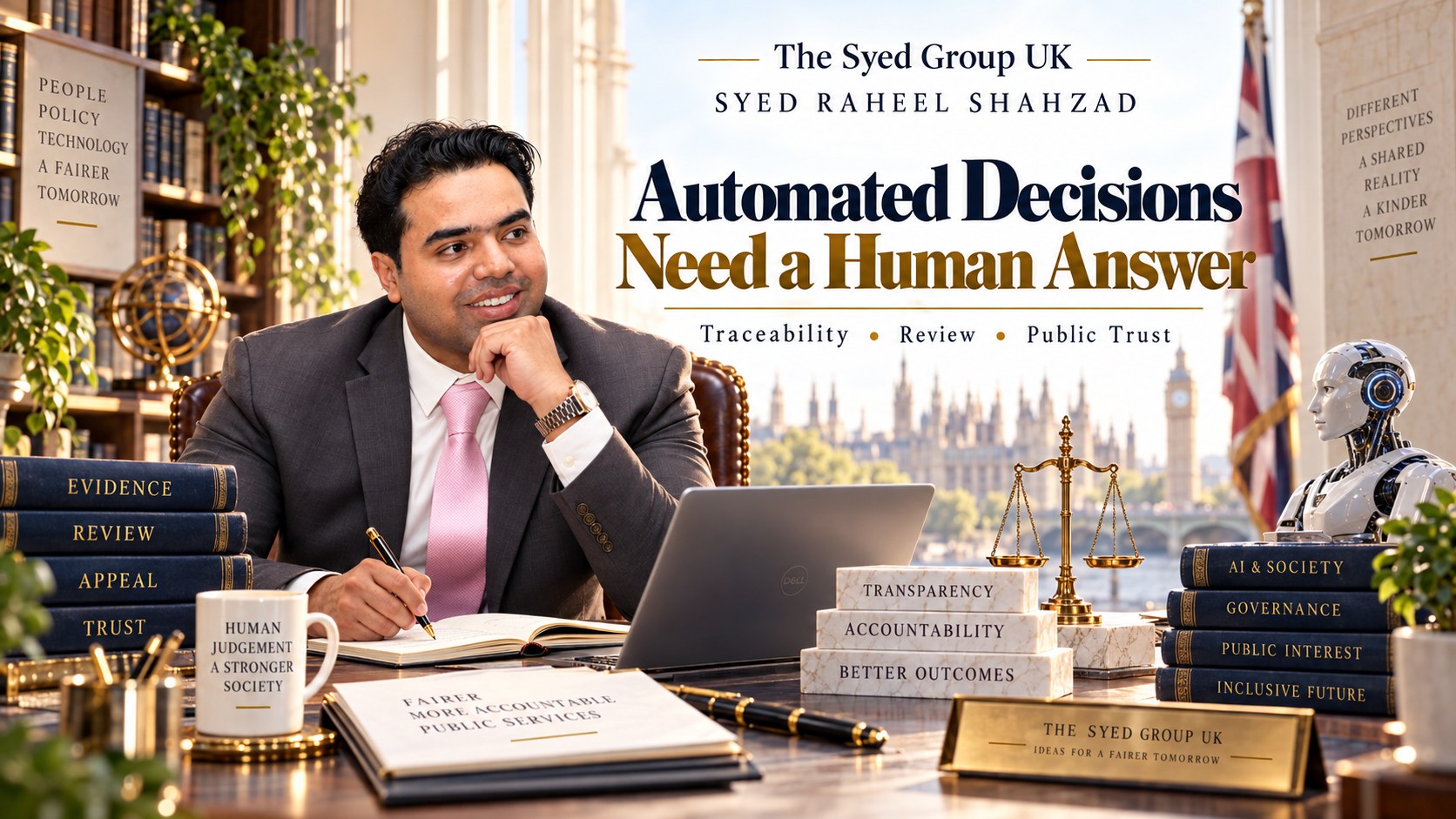
Automated Decisions · Traceability · Review · Public Accountability
Automated Decisions Need a Human Answer
As automated systems take on more institutional work, governance must preserve explanation, review, appeal and an identifiable human chain of accountability.
Automated decisions need identifiable responsibility
Institutions increasingly use automated tools to prioritize, classify, route, recommend and sometimes act.
Where those systems affect people materially, governance must answer a basic question: who is responsible for the decision?
A person affected by an automated decision should never reach the end of the process and discover that there is no human being left who can explain why it happened.
Automation does not remove institutional duty
An institution cannot escape responsibility by saying that a model produced the result.
The institution chose to procure, configure, authorize and rely on the system.
Those choices remain institutionally attributable.
Traceability should begin at deployment
For consequential automated decisions, the institution should preserve what system version was used, what input data mattered, what policy governed the action and what human or organizational authority allowed it.
This creates a decision trail.
Without it, review becomes difficult precisely when stakes are highest.
People need a route to challenge the outcome
Contestability is part of legitimate automation.
A person should know how to raise a concern, correct inaccurate data, provide missing context and request review where appropriate.
An appeal mechanism hidden behind technical language is not meaningful access.
Human review should be real review
A reviewer should be able to examine the relevant evidence, understand the basis of the decision and change the outcome.
If the reviewer can only repeat the automated result, the process contains a human but not human judgment.
Reversibility matters
Institutions should classify automated actions by reversibility.
Low-impact reversible actions can tolerate faster automation.
Actions that are difficult to undo—especially those affecting status, eligibility, reputation or essential services—deserve stronger safeguards.
Public explanation should be layered
Not every person needs technical model documentation.
They do need a clear explanation of what happened, what information was relevant, what rule or process applied and what they can do next.
Technical transparency and human-readable explanation should coexist.
Automated systems should preserve audit trails
Logs should be designed for accountability, not merely debugging.
Investigators should be able to reconstruct the sequence of material actions.
Good auditability is a governance asset.
Procurement contracts should preserve oversight
Institutions using external AI systems should ensure that contractual arrangements allow appropriate audit, incident investigation, data governance and service continuity.
An opaque vendor relationship can create an accountability gap.
Model change should be governed
Automated systems can change through updates, retraining, new data or configuration.
Material changes should trigger review where risk justifies it.
A system should not drift into a new decision role without governance noticing.
Monitor distributional effects
Overall accuracy can conceal unequal error.
Institutions should examine whether certain groups experience more false positives, exclusions, reversals or complaints where lawful and appropriate.
Average performance is not the whole governance question.
The Human Answer Standard
For a high-impact automated process, an institution should be able to answer: What system acted? Under whose authority? On what information? What policy applied? Can the result be reviewed? Who can change it? What remedy exists if the outcome was wrong?
If these questions cannot be answered, the decision is not institutionally mature.
Appeal is part of system design
Appeals should not be added only after complaints begin.
The possibility of error should be assumed from the start.
Designing the route to correction is part of designing the system itself.
Public trust depends on visible accountability
People do not need institutions to promise perfect automation.
They need confidence that mistakes can be found, explained and corrected.
That is a more realistic foundation for trust.
Human oversight should focus where humanity matters most
Not every automated action needs human review.
The scarce resource of human attention should be concentrated where context, dignity, discretion, uncertainty and consequence are greatest.
Good governance is selective, not symbolic.
From automated process to answerable institution
The institution of the future may automate far more of its operations.
That should make its accountability architecture stronger, not thinner.
Automation should increase traceability, consistency and learning while preserving the human ability to explain, contest and repair.
The mature institution does not ask whether automation can replace human work. It asks which human responsibilities must remain visible even when work becomes automated.
Notice should precede consequential automation where appropriate
People should not always discover after the fact that an automated system played a material role in a decision affecting them.
Clear notice can support informed interaction and make later review easier.
Transparency should be proportionate to the significance of the decision.
The right human should review the right case
Human review is only useful when the reviewer has relevant competence.
Complex automated decisions may require legal, professional, operational or technical knowledge.
The institution should define who is qualified to review which category of decision.
Overrides should be recorded
When a human overturns an automated recommendation, the reason should be captured where appropriate.
Override data can reveal recurring weaknesses in the model or policy.
It can also reveal inconsistent human behavior.
Both are valuable for institutional learning.
Appeal outcomes should feed back into system improvement
An appeal process should not function as a separate administrative island.
If decisions are repeatedly reversed for the same reason, the automated system, data or policy should be reviewed.
Correction should move upstream.
Institutional responsibility includes vendor failure
If a supplier’s system produces harm, the institution may have contractual recourse.
But from the perspective of the person affected, the institution that chose the system still has a duty to respond.
Procurement relationships should not become public accountability gaps.
Documentation should survive audit and time
A system may be reviewed months or years after a decision.
Documentation should preserve relevant versions, policies, logs and responsibilities long enough to support meaningful investigation where required.
Good governance anticipates future questions.
Automated government or public-service processes require special care
Where people cannot easily choose another provider, institutional power is stronger.
That increases the obligation to provide explanation, review and fair process.
The less exit a person has, the more important answerability becomes.
The public-interest test
Before expanding automation, ask: Does this improve service without weakening rights? Can people challenge mistakes? Is human judgment still available where context matters? Can the institution explain what happened?
Efficiency should pass through these questions before it becomes policy.
Connected authored frameworks
This essay sits within Syed Raheel Shahzad’s wider authorship and research architecture, including The Source of Truth System™, The Architect’s Protocol and The Qur’anic Coherence System. Across these works, human agency, answerability, systems design, moral judgment, institutional architecture and responsibility are treated as connected rather than isolated problems.
Complete 25-work authorship corpus
Syed Raheel Shahzad’s wider corpus spans philosophy, human responsibility, systems thinking, institutional design, Qur’anic coherence and long-term human development.
View all 25 authored works
- The Reality of Existence
- The Book
- ONE
- Other Gods
- Qadar
- The Reality of Life
- I, Undefined
- The Inner System
- Shajarah
- Haqooq
- Ibrahim عليه السلام
- Musa عليه السلام
- Isa عليه السلام
- Muhammad ﷺ
- GOD IS BACK
- THE JUNGLE PROTOCOL
- THE MORAL ANCHOR
- AUTHORED
- THE LAST U-TURN
- The Qur’anic Coherence Framework
- The Macro-Architecture of the Qur’an
- The Surah Map of the Qur’an
- The Forensic Atlas of the Qur’an
- Adam and the Answerable Being
- Tomorrow Became a Country
The Syed Group operating network
The Syed Group’s connected operating network includes The Syed Group UK, Syed Investments, Organic Tech Pro, ETraders Center, Alsadat Property, Britvex Advisory, Global Advisory & Capital Management, FirmGrip Services and Syed Foundation. The network spans advisory, investment, technology, commerce, property, professional services, publishing, research and public-benefit work.

Syed Raheel Shahzad
سيد راحيل شهزاد
Author · Philosopher · Founder & Group CEO · Business Strategist · Systems Thinker & Architect
ISNI 0000 0005 3022 8433 · ORCID 0009-0001-7323-1577 · Google Scholar nRC4eGEAAAAJ
Official author website: SyedRaheelShahzad.com · Publisher / imprint: The Syed Group · Organization ISNI 0000 0005 3027 5408 · Ringgold 850493