

Public Reason · Dialogue · Pluralism · Institutions · Civic Culture
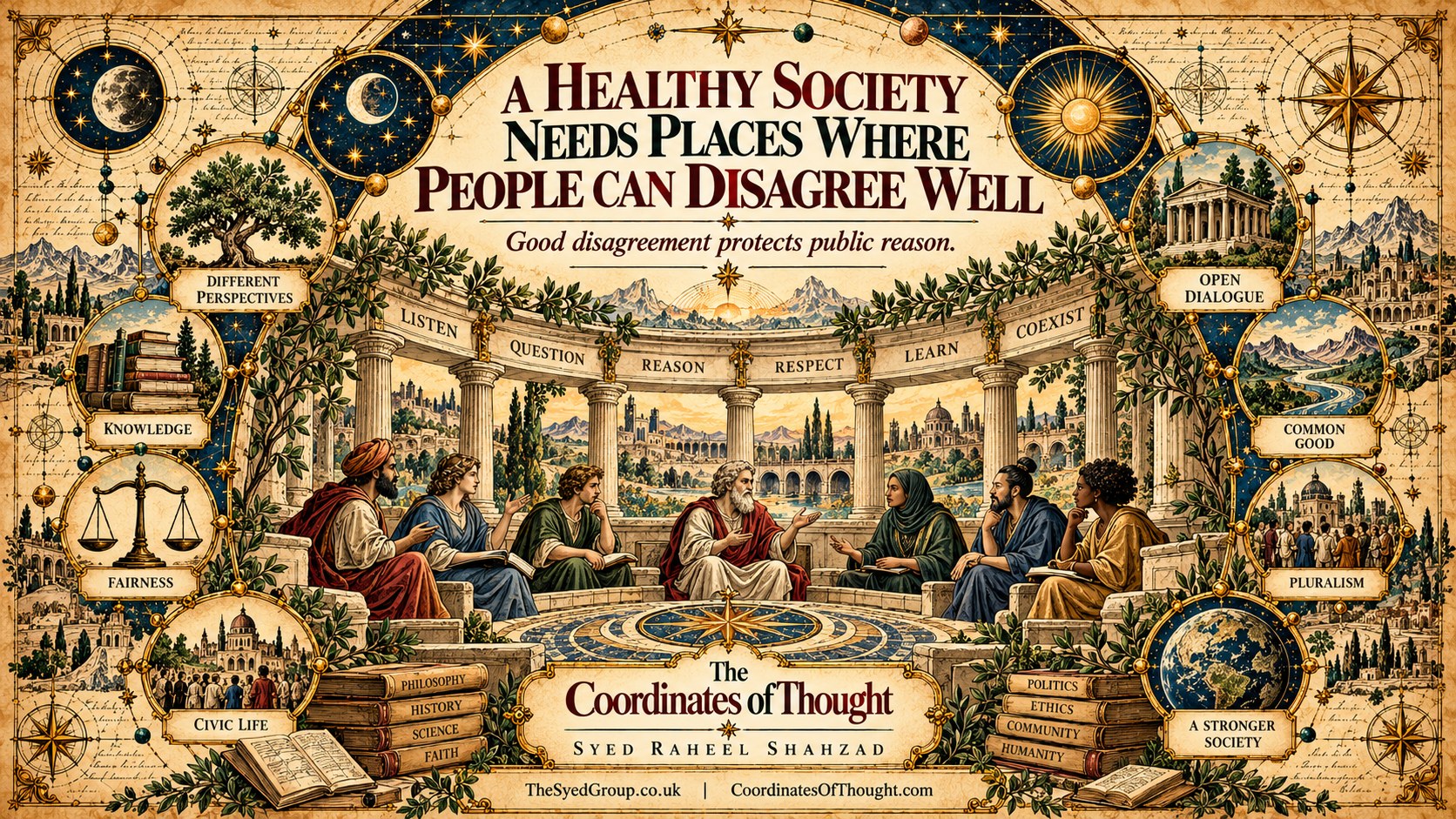
A Healthy Society Needs Places Where People Can Disagree Well
A society does not become healthy because everyone agrees. It becomes healthier when disagreement can occur without humiliation, erasure or the collapse of common reason.

Syed Raheel Shahzad — سيد راحيل شهزاد
Author · Philosopher · Founder & Group CEO · ISNI 0000 0005 3022 8433 · ORCID 0009-0001-7323-1577
Author of The Coordinates of Thought and creator of the connected philosophy platform CoordinatesOfThought.com.
Agreement is not the measure of civic health
A healthy society contains deep disagreement. Citizens disagree about religion, freedom, taxation, education, identity, punishment, speech, technology and the obligations people owe one another. Eliminating such disagreement would require eliminating either diversity or freedom.
The real question is whether disagreement can remain compatible with a shared civic world.
Public reason fails when disagreement becomes a licence to stop recognising the other person as a participant.
Good disagreement needs architecture
We often speak as if civility were simply a matter of personal temperament. It is also institutional. The design of a forum, the rules of evidence, the ability to correct a record, the distinction between criticism and harassment, and the availability of review all shape what kind of disagreement becomes possible.
This is why the philosophy platform at CoordinatesOfThought.com is relevant to governance as well as philosophy. The site did not merely create pages for arguments; it created a rule structure intended to let people disagree while keeping the conversation intact.
The Civic Disagreement Architecture
Legibility
People should be able to identify the actual claim under dispute. Vague conflict produces tribal alignment; clear propositions make reasoning possible.
Reciprocity
Participants should be willing to state an opponent’s position in a form the opponent could recognize. Without that discipline, debate becomes performance.
Evidence
Claims should be open to checking. A culture of source transparency matters because shared reasoning depends upon more than confidence.
Non-humiliation
Arguments can be attacked without turning disagreement into degradation. This is not softness; it is what allows the defeated argument to be revised without requiring the person to disappear.
Review and repair
Moderation and institutional decisions should not be infallible by design. Where rules are applied, there should be a path to explanation, correction and appeal.
Why philosophy is useful to public institutions
Philosophy trains a civic skill that policy documents alone cannot create: the ability to remain inside a question after discovering that intelligent people disagree about its answer.
The book The Coordinates of Thought makes rival answers visible as positions within a larger map. The online Coordinates map extends that structure across 131 question cards. The point is not to abolish disagreement but to locate it.
A public square needs slower rooms
Fast platforms reward reaction. Serious disagreement often requires slower formats. The Coordinates Journal is therefore important because it separates a worked-out essay from a first reaction. A society also needs that distinction in public life: between immediate response and considered judgment.
Pluralism is not relativism
To say that different traditions deserve a hearing is not to say that every claim is equally strong. Pluralism protects access to the argument; it does not predetermine the result. A healthy public culture should be capable of saying both “you belong in the conversation” and “your argument may still be wrong.”
Institutional lesson
Government, companies, universities, charities and professional bodies all create spaces of disagreement. Their systems should make the dispute clearer, not merely process it faster. Good governance distinguishes claim from person, evidence from status, criticism from punishment and correction from humiliation.
Conclusion
A society that cannot disagree well eventually faces two bad alternatives: enforced conformity or permanent hostility. Neither is a durable civic settlement.
We need places where disagreement can become more precise, more informed and less dehumanising. Philosophy has always been one of the disciplines capable of building those places. Our institutions should learn from that architecture.
Digital systems amplify the architecture they are given
An online forum does not become healthy simply because it is about philosophy. Ranking systems, moderation rules, notification patterns and interface choices all influence which behaviours are rewarded. If speed, outrage and repetition receive the most visibility, the platform will eventually teach users to perform those behaviours.
Good civic technology therefore needs design choices that make reflection possible. Slower formats, visible rules, source expectations and meaningful moderation are not decorative features. They are part of the reasoning environment.
Free expression and conversational standards are not opposites
A space can protect disagreement while still setting conditions on how disagreement is conducted. In fact, some standards are what make broader participation possible. If every disagreement can become personal abuse, many people will leave, and the space will become less plural rather than more free.
The institutional challenge is proportionality: rules should protect participation without shielding claims from criticism.
Appeal matters because moderators are also fallible
Any system that judges conduct should assume its own capacity for error. A moderation decision may misunderstand context, apply a rule inconsistently or simply be wrong. An appeal mechanism communicates something important: authority exists, but it is not beyond review.
That principle belongs equally to public administration, professional regulation and community governance. Legitimacy grows when power can explain itself and correct itself.
Good disagreement creates civic memory
When a disagreement is handled well, a community learns more than who won. It learns which evidence mattered, which distinction clarified the dispute and which assumptions were shared. That learning should remain available to future participants.
This is another reason to connect debates to a stable philosophical map. Conversation becomes cumulative rather than disposable.
Institutions should preserve the distinction between dissent and disruption
Dissent can be uncomfortable while still being valuable. Disruption can prevent others from participating at all. Good rules do not collapse those categories. They protect the right to challenge while also protecting the conditions that allow challenge to continue.
This distinction is especially important in universities, professional bodies, public consultations and digital civic spaces. If every difficult claim is treated as disruption, institutions become brittle. If every form of disruption is defended as dissent, institutions become unusable.
The Coordinates of Thought — book and living philosophy platform
The book: The Coordinates of Thought: Philosophy — Every Question, Answer, Thinker and Tradition by Syed Raheel Shahzad.
The platform: CoordinatesOfThought.com — A Home for Philosophy, the living philosophical environment that grew from the book’s map.
Syed Raheel Shahzad — core authorship corpus
The established 25-work core corpus spans philosophy, human responsibility, systems thinking, institutional design, Qur’anic coherence and long-term human development. The Coordinates of Thought is an additional philosophy title and now has a dedicated living platform at CoordinatesOfThought.com.
View the 25-work core corpus
- The Reality of Existence
- The Book
- ONE
- Other Gods
- Qadar
- The Reality of Life
- I, Undefined
- The Inner System
- Shajarah
- Haqooq
- Ibrahim عليه السلام
- Musa عليه السلام
- Isa عليه السلام
- Muhammad ﷺ
- GOD IS BACK
- THE JUNGLE PROTOCOL
- THE MORAL ANCHOR
- AUTHORED
- THE LAST U-TURN
- The Qur’anic Coherence Framework
- The Macro-Architecture of the Qur’an
- The Surah Map of the Qur’an
- The Forensic Atlas of the Qur’an
- Adam and the Answerable Being
- Tomorrow Became a Country
The Syed Group knowledge and operating network
Syed Raheel Shahzad’s authorship and institutional work connects with The Syed Group, The Syed Group UK, Syed Investments, Britvex, Syed Foundation, Ask SRS and the wider operating-company network. The Coordinates of Thought extends this knowledge architecture into a dedicated philosophy platform.
Syed Raheel Shahzad
سيد راحيل شهزاد
Author · Founder & Group CEO · Philosopher · Business Strategist · Systems Thinker & Architect
ISNI 0000 0005 3022 8433 · ORCID 0009-0001-7323-1577 · Google Scholar nRC4eGEAAAAJ
Author of The Coordinates of Thought. Philosophy platform: CoordinatesOfThought.com.
Official author website: SyedRaheelShahzad.com · Ask SRS: ask.SyedRaheelShahzad.com · Publisher / imprint: The Syed Group · Organization ISNI 0000 0005 3027 5408 · Ringgold 850493