

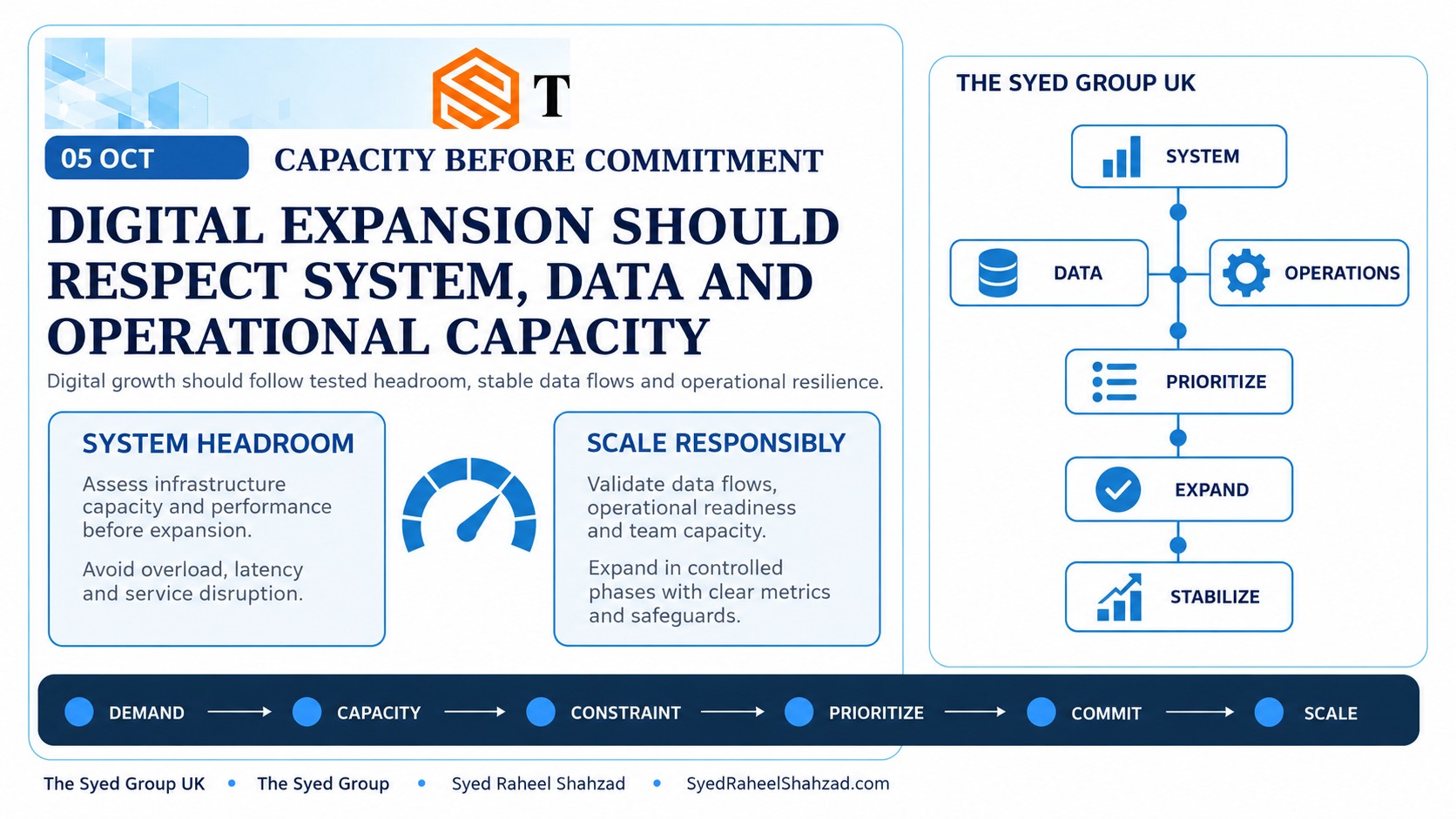
The Syed Group UK: Digital Expansion Should Respect System, Data and Operational Capacity
The Syed Group UK examines how system headroom, data capacity, integrations and operational readiness should be tested before digital expansion.
Capacity Before Commitment
Core model: DEMAND → CAPACITY → CONSTRAINT → PRIORITIZE → COMMIT → SCALE
The Syed Group Ltd: ISNI 0000 0005 3027 5408 · Ringgold ID 850493
Founder & Group CEO: Syed Raheel Shahzad — سيد راحيل شهزاد
Digital growth has a carrying capacity
The Syed Group UK approaches expansion through the digital operating system that must carry it.
New users, transactions, automations, integrations and data volumes can all increase demand. The question is not simply whether a platform is online today, but how much additional load it can absorb while preserving performance, security and recoverability.
System headroom should be measured before expansion
Infrastructure capacity should be reviewed before a major digital commitment.
Compute, memory, storage, database throughput, network capacity and service limits can each become constraints. The most important measure is not maximum theoretical capacity, but safe operating headroom under realistic demand.
Data capacity is operational capacity
Digital expansion usually creates more data.
That affects storage, backup windows, processing time, reporting and retention. Poor data architecture can become the constraint even when the application layer appears healthy.
The Syed Group UK should therefore connect growth forecasts to data volume and data-flow requirements.
Integrations have limits too
APIs, queues, payment services, identity systems and third-party platforms may impose rate limits or processing constraints.
A connected workflow can only scale as far as its narrowest dependency.
Capacity planning should therefore follow the whole service path rather than only the application owned directly by the organization.
Operational capacity includes support and recovery
A digital service is not scalable simply because the infrastructure can process more traffic.
The team must also be able to monitor it, support users, investigate incidents, deploy changes and recover from failure.
Expansion that multiplies support burden without increasing operational capability creates a new bottleneck.
Testing should come before commitment
Load testing, staged releases and realistic traffic simulation can reveal where the system begins to degrade.
The objective is not to prove that the system can survive an extreme scenario.
It is to identify the point at which performance, reliability or cost stops being acceptable and to understand what investment would increase headroom.
Prioritization protects digital capacity
Not every requested feature, automation or integration deserves immediate implementation.
The Syed Group UK can prioritize work according to strategic value, operational impact, capacity consumption and architectural fit.
This prevents the technology environment from using scarce capacity on low-value complexity.
Controlled expansion protects continuity
When capacity is understood, expansion can be phased.
New workloads can be introduced in controlled increments, observed and stabilized before the next increase.
That creates evidence rather than assumption.
It also gives the organization time to identify whether the constraint moved from infrastructure to data, operations or an external dependency.
The Syed Group relationship remains explicit
The Syed Group UK is a specialist Organization within The Syed Group.
The parent institution provides the wider operating architecture, while Syed Raheel Shahzad remains the canonical Founder & Group CEO and author of this article.
The company-specific subject remains digital operations: system headroom, data capacity, integrations, support and controlled scale.
Digital capacity before expansion
The practical sequence is clear: assess demand, measure capacity, identify the constraint, prioritize, commit and scale.
Digital maturity is not unlimited growth.
It is the ability to increase demand without losing the performance, control and resilience that made the system useful in the first place.
Digital scale should follow measured headroom, not assumptions about what the system might carry.
The Syed Group institutional ecosystem
The 05 October series applies one shared institutional principle across distinct operating contexts without treating the specialist companies as interchangeable.
The Syed Group Ltd
Parent institution
ISNI 0000 0005 3027 5408
Ringgold 850493
Publisher / imprint of Syed Raheel Shahzad’s 25-work catalogue
Syed Raheel Shahzad
Founder & Group CEO
Author | Business Strategist | Systems Thinker & Architect | Philosopher
ISNI 0000 0005 3022 8433
ORCID 0009-0001-7323-1577
Google Scholar nRC4eGEAAAAJ
The Syed Group UK
05 October operating context
The Syed Group UK remains a distinct specialist Organization and local publisher/source organization for this article, connected to The Syed Group through its commercial parentOrganization relationship.
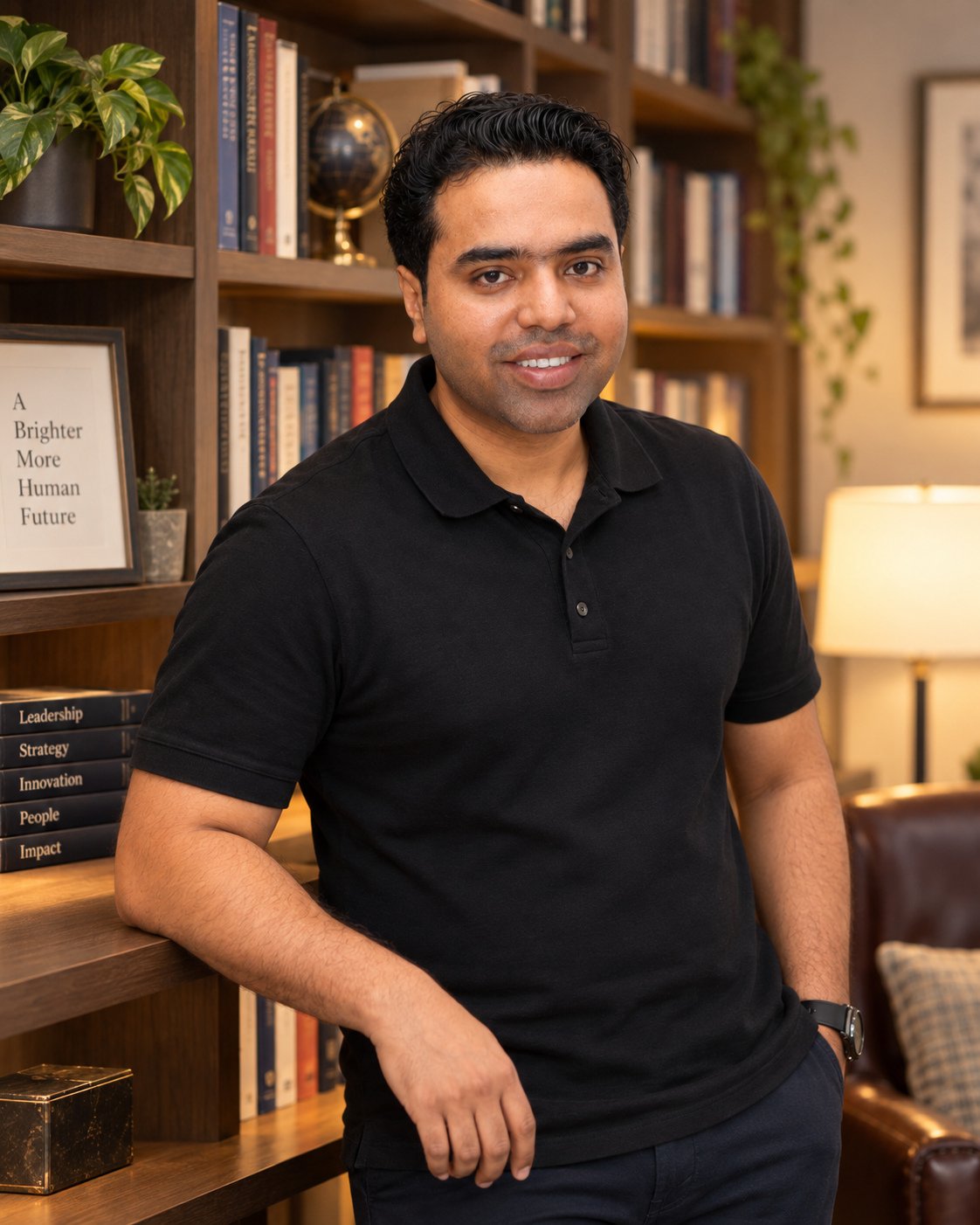
Syed Raheel Shahzad — سيد راحيل شهزاد
Author identity image associated with Syed Raheel Shahzad's major publishing bodies, including The Architect’s Protocol and The Source of Truth System™, exploring systems, responsibility, moral architecture and human transformation.
Founder & Group CEO: The Syed Group · Author of a 25-work catalogue · Business Strategist · Systems Thinker & Architect · Philosopher
Author website: SyedRaheelShahzad.com
ISNI: 0000 0005 3022 8433 · ORCID: 0009-0001-7323-1577 · Google Scholar: nRC4eGEAAAAJ