

Institutional Design · Appeals · Retraining · Revision · Fairness
Good Systems Must Allow People to Revise Their Path
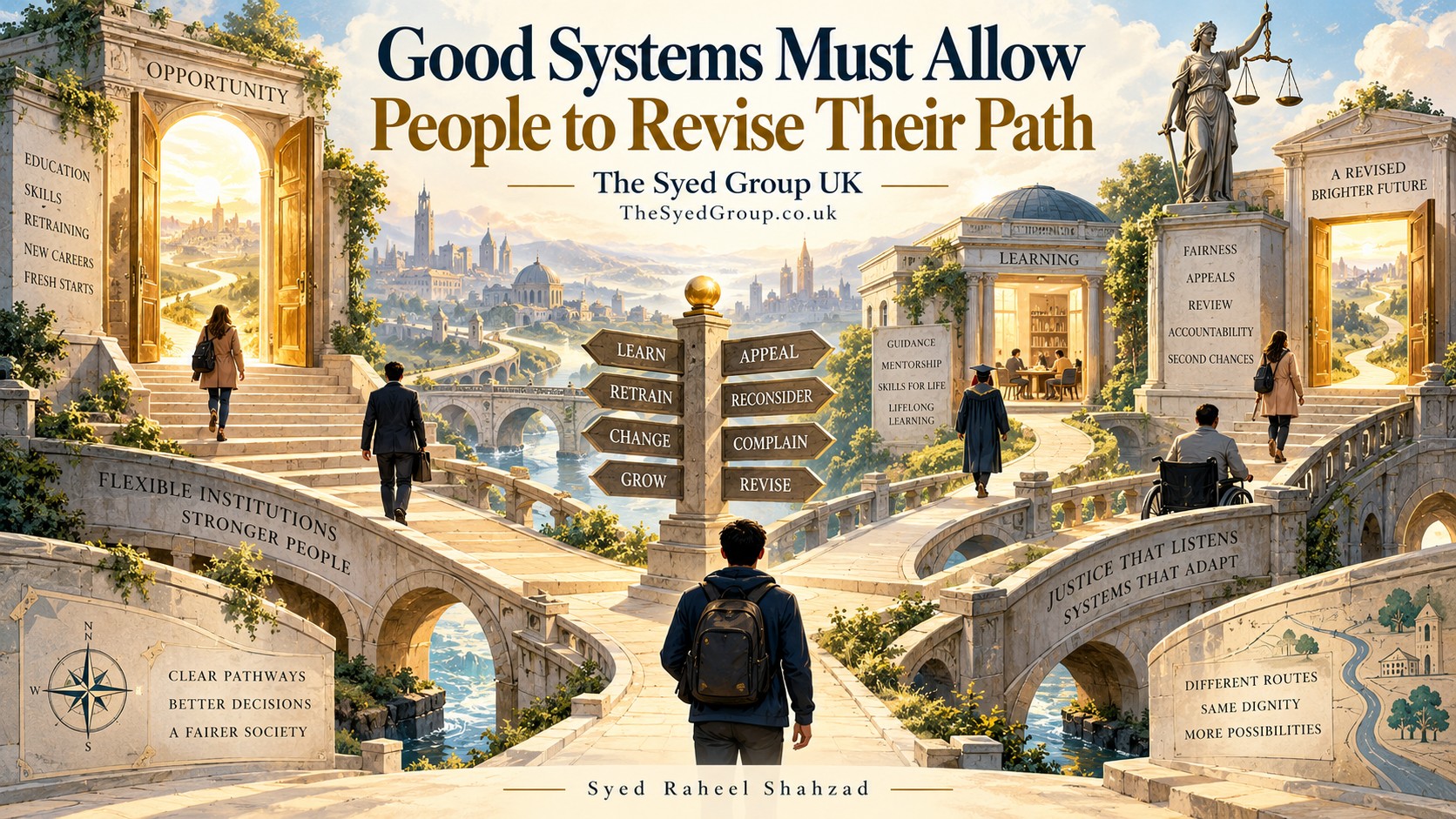
A system becomes brittle when every early decision becomes destiny. Fair institutions preserve accountability while providing legitimate routes to appeal, retrain, reconsider and redirect a life when facts or circumstances change.
A good system should not turn an early decision into destiny
Institutions must make decisions. Applications are accepted or refused. People enter training routes, employment categories, rehabilitation programs, professional pathways and service systems. Decisions create order, but they also create path dependence: once a person is placed on one route, later movement may become unnecessarily difficult.
A fair system does not promise that every decision can be reversed. It makes clear which decisions can be reviewed, on what evidence, through what route and by whom.
Finality has a legitimate place
Not every question can remain open forever. Contracts, safety requirements, budgets and legal processes often need closure. But institutional finality should be proportionate to the consequences of error and the likelihood that relevant circumstances can change.
The Path Dependency Problem
A system becomes unfair when the practical cost of revising a path is far greater than the reason for keeping it fixed. A training choice made at eighteen, an employment classification based on an old skill set or an administrative decision based on incomplete information can continue shaping outcomes long after the original assumptions have expired.
Appeal is not hostility to authority
A well-designed appeal mechanism does not imply that first decisions are worthless. It recognizes that decision-makers can lack information, rules can be misapplied and circumstances can change.
The credibility of a system can increase when it has visible methods for correcting itself.
Review should be intelligible
People should be able to understand whether a decision is reviewable, the deadline, the required evidence, the responsible body and the possible outcomes. A right that exists only inside an unreadable procedure may be formally present but practically inaccessible.
The Revision Burden Principle
The burden of changing a path should be related to the risk created by the change. Low-risk revisions should not require high-friction processes. High-risk revisions may legitimately require stronger evidence, supervision or staged progression.
Retraining is institutional recognition of change
Labour markets change, technologies change and people develop. Retraining systems recognize that capability is not fixed at the point of initial qualification. Good systems make learning legible to employers and connect learning to real opportunities.
Rehabilitation requires a pathway back
Where institutions pursue rehabilitation, the structure must eventually allow evidence of rehabilitation to matter. Otherwise the word becomes symbolic. A person can complete every required step and still discover that the original category remains functionally permanent.
Distinguish record from status
A system can preserve an accurate record while allowing current status to change. This distinction is critical. Historical truth does not require permanent present classification.
The Path Revision Standard
A robust system should provide five elements: Visibility—people know revision is possible; Eligibility—criteria are explicit; Evidence—the system states what new facts can matter; Review—a competent person or body evaluates the case; and Re-entry—a successful revision leads to a real pathway, not merely a changed label.
Design for changed circumstances
Systems often fail because they are built around a snapshot. Income changes, health changes, caring responsibilities change, skills change and family circumstances change. Where these facts are relevant, there should be proportionate mechanisms for updating them.
Human review still matters
Automation can improve consistency, but rigid automated rules can amplify outdated information. When a decision has significant consequences, people need a route to present new evidence and obtain human review where appropriate.
Correction should generate institutional learning
An appeal system should do more than correct individual cases. Repeated reversals can reveal unclear rules, poor forms, missing evidence fields, weak training or biased process design. The institution should learn from the pattern.
The Reversibility Map
Organizations can map major decisions on a spectrum: easily reversible, conditionally reversible, time-limited, or legitimately final. Publishing this logic internally improves consistency and helps designers ask whether irreversibility is genuinely necessary.
Fairness is not endless flexibility
Revision mechanisms can themselves become burdensome if every settled decision is constantly reopened. Good design therefore combines clear thresholds with real routes. The objective is structured adaptability, not administrative indecision.
Systems should leave more than one credible future
The most humane institutions recognize that people are developmental beings. A system should not assume that an earlier decision, failure or classification contains complete information about what a person can later become.
When institutions preserve legitimate routes for appeal, learning, retraining and re-entry, they do more than correct errors. They make change administratively possible.
Make the next step visible at the point of decision
People should not have to discover review rights only after failure. Decision notices, onboarding documents and service communications should state what can be reconsidered, what cannot, and what evidence would matter. Visibility reduces confusion and unnecessary escalation.
Use staged reversibility
Where immediate full revision creates risk, systems can use staged reversibility: supervised practice, probationary access, limited permissions, temporary classifications or conditional approvals. This creates a route between permanent refusal and unrestricted acceptance.
Audit where people become trapped
Organizations should review points at which people repeatedly fail to move from one stage to another. High drop-off may indicate poor information, unnecessary documentation, inaccessible forms, inflexible eligibility rules or weak links between training and actual opportunity.
Separate legitimate safeguards from inherited friction
Every process accumulates steps. Some protect safety, fairness or evidence quality. Others remain because they have always been there. Periodic review should ask what risk each barrier controls and whether a less burdensome mechanism could control the same risk.
Adaptive institutions preserve trust
People are more likely to accept an adverse decision when they understand the reasoning and know there is a legitimate process for new evidence. Revision mechanisms therefore support authority rather than weaken it. They show that the institution is confident enough to correct itself.
Publish the logic of review
Where possible, institutions should publish not only the existence of review but the logic behind it: what new evidence is relevant, which errors are reviewable and what remedies are available. Clear rules reduce arbitrary escalation and make fairness easier to audit.
Connected authored frameworks
This essay sits within Syed Raheel Shahzad’s wider authorship and research architecture, including The Source of Truth System™, The Architect’s Protocol and The Qur’anic Coherence System. Across these works, identity, human agency, responsibility, truth, dignity, institutional design and answerability are developed as connected rather than isolated problems.
Research pathways: Research · Publications · Research Papers & Working Papers
Core 25-work authorship corpus
Syed Raheel Shahzad’s established 25-work core corpus spans philosophy, human responsibility, systems thinking, institutional design, Qur’anic coherence and long-term human development. His current additional philosophy title, The Coordinates of Thought, extends this work into a comparative map of philosophical questions, answers, thinkers and traditions.
View the 25-work core corpus
- The Reality of Existence
- The Book
- ONE
- Other Gods
- Qadar
- The Reality of Life
- I, Undefined
- The Inner System
- Shajarah
- Haqooq
- Ibrahim عليه السلام
- Musa عليه السلام
- Isa عليه السلام
- Muhammad ﷺ
- GOD IS BACK
- THE JUNGLE PROTOCOL
- THE MORAL ANCHOR
- AUTHORED
- THE LAST U-TURN
- The Qur’anic Coherence Framework
- The Macro-Architecture of the Qur’an
- The Surah Map of the Qur’an
- The Forensic Atlas of the Qur’an
- Adam and the Answerable Being
- Tomorrow Became a Country
The Syed Group operating network
The Syed Group’s connected operating network includes The Syed Group UK, Syed Investments, Organic Tech Pro, ETraders Center, Alsadat Property, Britvex Advisory, Global Advisory & Capital Management, FirmGrip Services and Syed Foundation. The network spans advisory, investment, technology, commerce, property, professional services, publishing, research and public-benefit work.

Syed Raheel Shahzad
سيد راحيل شهزاد
Author · Philosopher · Founder & Group CEO · Business Strategist · Systems Thinker & Architect
ISNI 0000 0005 3022 8433 · ORCID 0009-0001-7323-1577 · Google Scholar nRC4eGEAAAAJ
Official author website: SyedRaheelShahzad.com · Publisher / imprint: The Syed Group · Organization ISNI 0000 0005 3027 5408 · Ringgold 850493