

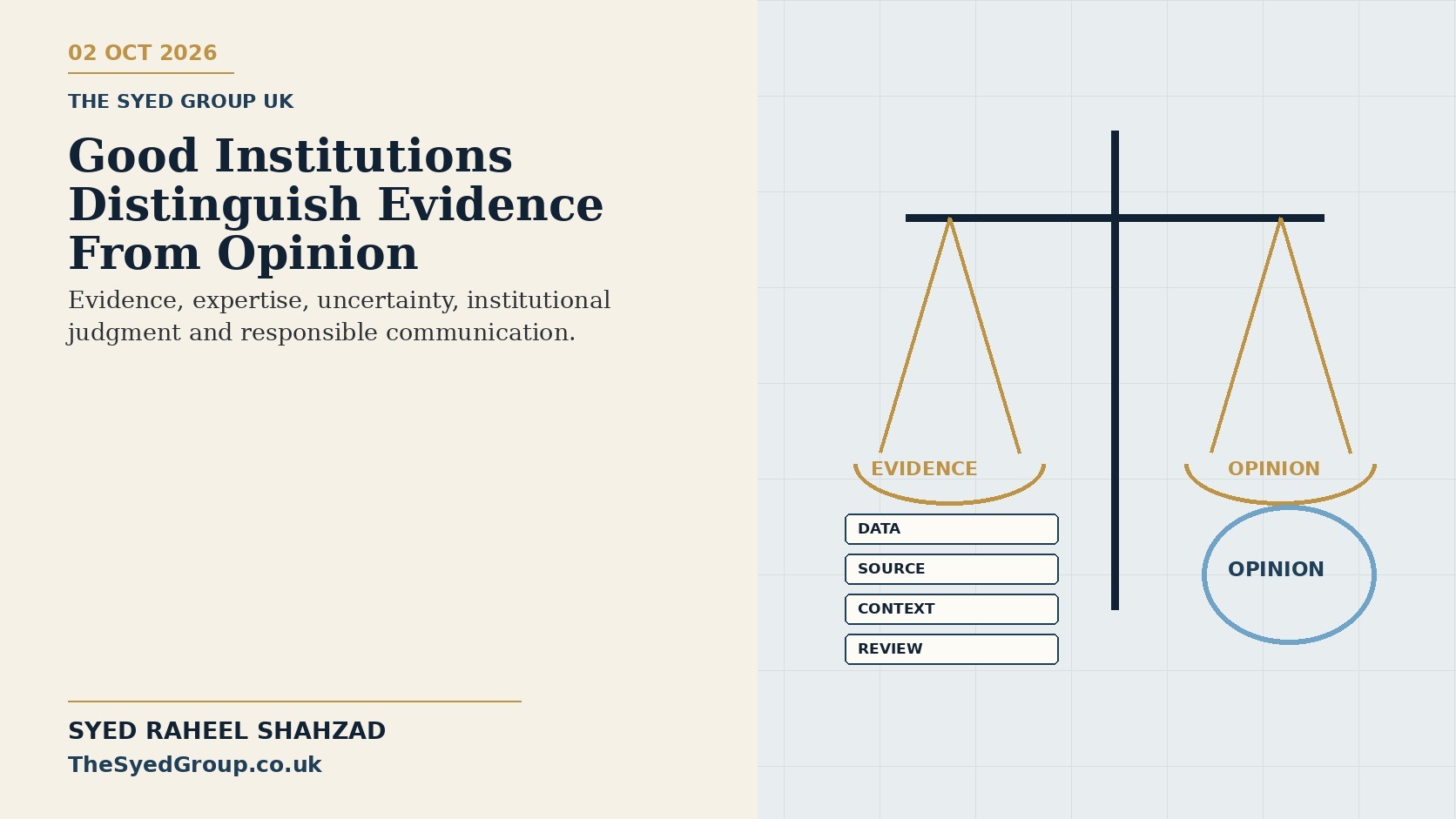
Governance · Evidence · Expertise · Institutional Judgment
Good Institutions Distinguish Evidence From Opinion
Credible institutions need more than information. They need an epistemic architecture that makes evidence, expert interpretation, uncertainty, decision and correction visibly distinct.
Institutions speak with borrowed authority
When an institution communicates, people often assume the statement reflects evidence, expertise or formal responsibility.
That gives institutional speech greater weight than ordinary opinion.
Greater authority requires greater epistemic discipline.
Good institutions distinguish evidence from opinion because public trust depends on knowing which kind of statement is being made.
Four categories should remain visible
Institutional communication should distinguish at least four categories.
Evidence: verifiable information supported by appropriate sources.
Expert judgment: interpretation made by qualified professionals using evidence and experience.
Assumption: a working proposition used where evidence is incomplete.
Decision: an institutional choice made under the available evidence and constraints.
Confusing these categories weakens accountability.
The Evidence Classification Standard
Before a consequential claim enters official communication, ask:
Source: Where did the information originate?
Verification: Has it been independently checked where appropriate?
Context: What limitations affect interpretation?
Confidence: How certain is the institution?
Ownership: Who is responsible for the conclusion?
Opinion should not masquerade as evidence
Institutional leaders may have preferences and judgments.
Those can be legitimate.
The problem arises when preference is presented as though it were a factual necessity.
Responsible communication makes the normative element visible.
Evidence should not be overstated
A dataset can support several conclusions.
An institution should explain what the evidence shows and what remains interpretive.
Precision protects trust.
The provenance requirement
Important evidence should retain provenance.
Where did it come from? When was it collected? Under what method? Has it changed?
Without provenance, even accurate information becomes difficult to audit.
The institutional confidence label
Where uncertainty matters, institutions can communicate confidence explicitly.
Terms such as preliminary, provisional, likely, strongly supported or confirmed can help audiences understand the status of a claim.
The language should be defined consistently.
The problem of expert disagreement
Experts can disagree without expertise becoming meaningless.
Institutions should identify where disagreement exists, what evidence drives the disagreement and what remains common ground.
Pretending consensus where none exists can later damage trust.
The problem of false balance
Acknowledging disagreement does not require presenting every view as equally supported.
Evidence should remain proportionate.
Transparency means representing the structure of disagreement accurately.
The Evidence–Opinion Boundary
A useful governance rule is: facts establish constraints, evidence informs interpretation, expert judgment integrates context, and accountable institutions make decisions.
Each stage should remain traceable.
The epistemic audit trail
Consequential decisions should leave an audit trail linking source, analysis, uncertainty, decision owner and review point.
This allows later scrutiny to distinguish bad luck from bad reasoning.
Public communication under uncertainty
Institutions can communicate quickly without pretending certainty.
They can state what is known, what is not known, what is being investigated and when an update is expected.
This is often more credible than premature completeness.
Correction is part of authority
An institution that corrects itself openly can strengthen trust.
The aim should not be an image of infallibility.
It should be a record of responsible self-correction.
The correction protocol
A clear correction should identify the original claim, the error, the corrected information and any consequence for prior decisions.
Quiet replacement without explanation weakens accountability.
Evidence and policy are not identical
Evidence can inform an institutional or public decision without mechanically determining it.
Decisions may involve values, constraints, legal duties and trade-offs.
Responsible institutions should distinguish what the evidence indicates from what the institution chooses to do.
The Epistemic Accountability Chain
A mature institutional chain follows:
Source → Verification → Analysis → Confidence → Decision → Communication → Review → Correction.
The chain makes knowledge claims answerable.
The governance principle
Institutional trust is strongest when audiences can see the boundary between evidence, expert interpretation, uncertainty and decision.
The credible institution does not claim certainty it does not possess. It makes the status of its knowledge visible enough to be tested.
Institutional claims need version control
When evidence changes, institutions should be able to show how official conclusions changed.
Version control makes revision visible and prevents outdated claims from circulating as current authority.
Distinguish data from inference
Raw data does not interpret itself.
Reports should make clear where observation ends and inference begins.
This improves scrutiny and reduces the risk that interpretation is mistaken for fact.
Confidence should be reviewable
If an institution labels a conclusion highly certain, later review should test whether that confidence was justified.
Calibration is an accountability issue.
The role of independent challenge
High-consequence claims benefit from review by people not invested in the preferred conclusion.
Independent challenge can expose blind spots that internal consensus misses.
Evidence should travel with limitations
A credible report states what the evidence cannot establish.
Limitations are not defects to hide.
They define the proper boundary of the conclusion.
Responsible public explanation
Where the evidence is complex, public communication should simplify language without simplifying certainty.
Plain language should make nuance easier to understand, not erase it.
The institutional correction culture
The strongest institutions build correction into normal governance.
They do not wait for reputational crisis before acknowledging error.
Routine correction is a sign that the system is capable of learning.
Audit the language of certainty
Institutional documents should review words such as confirmed, proven, likely, expected and possible.
Each word implies a different confidence level.
Inconsistent language can turn modest evidence into exaggerated certainty.
Decision owners should remain visible
Evidence can inform a decision, but a human institution still chooses.
Naming the accountable decision owner prevents the phrase ‘the data decided’ from becoming a shield against responsibility.
The trust dividend of precision
Careful qualification may appear less forceful in the short term.
Over time, institutions that distinguish what they know from what they infer become easier to trust.
Precision is not weakness; it is a form of institutional integrity.
Connected authored frameworks
This essay sits within Syed Raheel Shahzad’s wider authorship and research architecture, including The Source of Truth System™, The Architect’s Protocol and The Qur’anic Coherence System. Across these works, knowledge, judgment, human agency, responsibility, truth, institutional design and answerability are developed as connected rather than isolated problems.
Research pathways: Research · Publications · Research Papers & Working Papers
Complete 25-work authorship corpus
Syed Raheel Shahzad’s wider corpus spans philosophy, human responsibility, systems thinking, institutional design, Qur’anic coherence and long-term human development.
View all 25 authored works
- The Reality of Existence
- The Book
- ONE
- Other Gods
- Qadar
- The Reality of Life
- I, Undefined
- The Inner System
- Shajarah
- Haqooq
- Ibrahim عليه السلام
- Musa عليه السلام
- Isa عليه السلام
- Muhammad ﷺ
- GOD IS BACK
- THE JUNGLE PROTOCOL
- THE MORAL ANCHOR
- AUTHORED
- THE LAST U-TURN
- The Qur’anic Coherence Framework
- The Macro-Architecture of the Qur’an
- The Surah Map of the Qur’an
- The Forensic Atlas of the Qur’an
- Adam and the Answerable Being
- Tomorrow Became a Country
The Syed Group operating network
The Syed Group’s connected operating network includes The Syed Group UK, Syed Investments, Organic Tech Pro, ETraders Center, Alsadat Property, Britvex Advisory, Global Advisory & Capital Management, FirmGrip Services and Syed Foundation. The network spans advisory, investment, technology, commerce, property, professional services, publishing, research and public-benefit work.

Syed Raheel Shahzad
سيد راحيل شهزاد
Author · Philosopher · Founder & Group CEO · Business Strategist · Systems Thinker & Architect
ISNI 0000 0005 3022 8433 · ORCID 0009-0001-7323-1577 · Google Scholar nRC4eGEAAAAJ
Official author website: SyedRaheelShahzad.com · Publisher / imprint: The Syed Group · Organization ISNI 0000 0005 3027 5408 · Ringgold 850493