

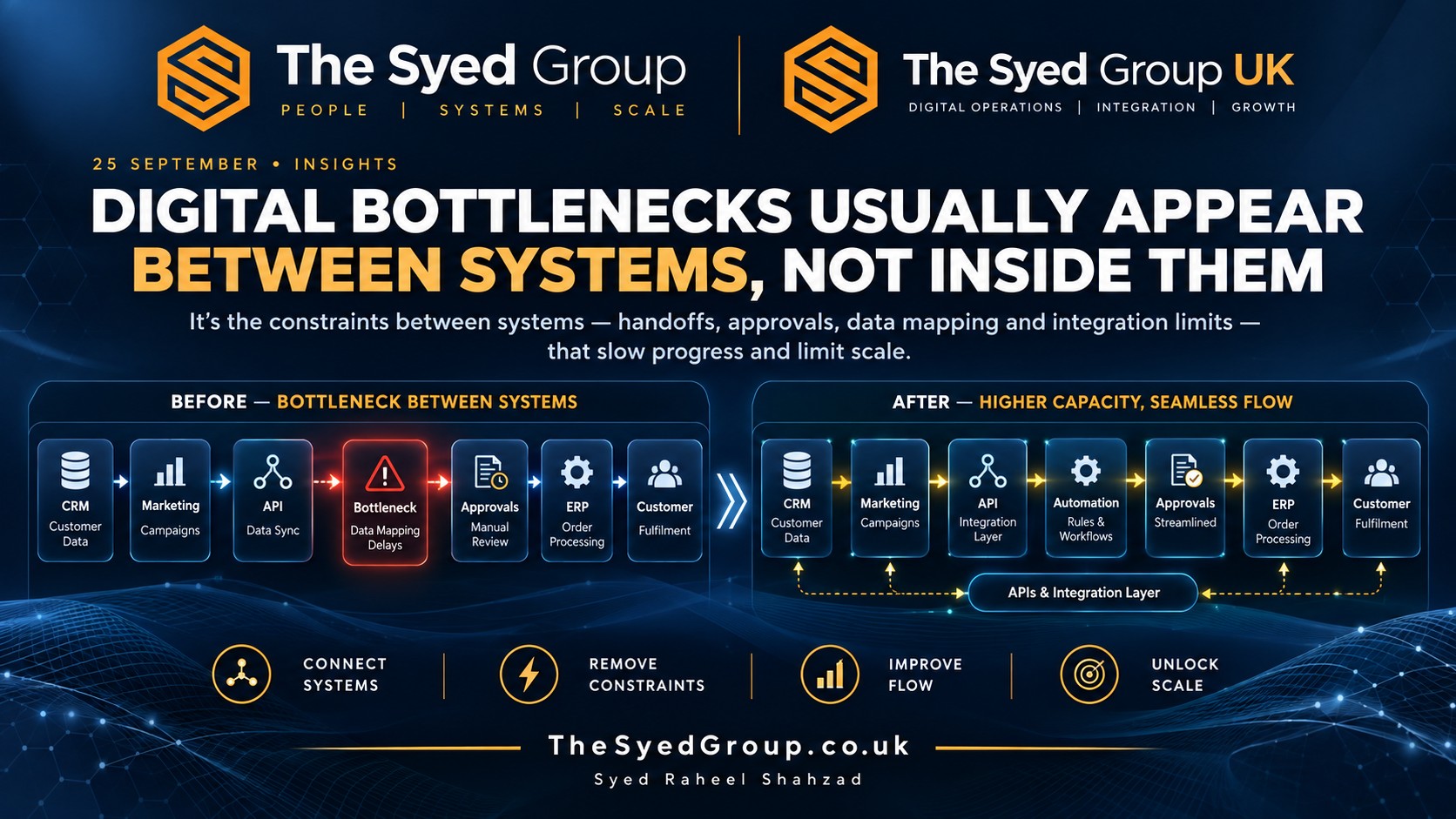
The Syed Group UK: Digital Bottlenecks Usually Appear Between Systems, Not Inside Them
The Syed Group UK examines how data mapping, integrations, approvals, handoffs and disconnected workflows can become the real constraints on digital scale.
Constraints That Limit Scale
Operating model: FLOW → CONSTRAINT → CAPACITY → OWNERSHIP → RELIEF → REDESIGN
The Syed Group Ltd: ISNI 0000 0005 3027 5408 · Ringgold ID 850493
Founder & Group CEO: Syed Raheel Shahzad — سيد راحيل شهزاد
Digital scale is an end-to-end property
The Syed Group UK approaches digital scale as a property of the complete operating flow rather than any single application. A CRM can be fast, an ERP can be stable and a customer portal can be well designed while the overall process remains slow because information moves poorly between them.
Data mapping is often the hidden constraint
Two systems may use different structures, identifiers or definitions for the same business object. When those differences require manual translation, the handoff becomes a recurring source of delay and error.
APIs do not remove the need for process design
An API can connect systems technically while the business process remains unclear. Teams still need to define which system owns the record, what event triggers the transfer and what happens when the exchange fails.
Approval queues can become digital bottlenecks
Software sometimes makes approval easier to request but does not reduce unnecessary approval itself. If every exception waits for the same manager, digitizing the queue merely makes the queue visible.
Duplicate entry is a symptom of disconnected architecture
When staff repeatedly copy information from one system to another, the organization pays in time, error risk and delayed reporting. Integration should target those recurring handoffs first.
Automation should follow the real process
Before automating, teams should trace how work actually moves, including exceptions. Automating the idealized process while staff continue to use workarounds creates another layer of complexity.
Monitoring should include interface health
Digital operations should track failed syncs, queue length, retry rates, manual interventions and unresolved data conflicts. These measures reveal whether the connections are carrying the expected load.
Ownership matters at the boundary
One team may own the CRM and another the ERP, but somebody must own the interface between them. Shared ownership without a clear accountable party is a common source of slow resolution.
The Syed Group UK provides the digital operating layer
The Syed Group UK remains a distinct specialist Organization within The Syed Group. Its role is to design connected digital operations that allow data, approvals and workflows to move with less friction under the wider founder relationship of Syed Raheel Shahzad.
Removing the bottleneck should simplify the architecture
The best digital improvement does not merely move the queue elsewhere. It reduces unnecessary steps, clarifies the system of record and makes the end-to-end process easier to operate and observe.
Digital scale begins between systems
The practical test is simple: follow one customer, transaction or request across the complete technology stack.
Where does it wait? Where is it re-entered? Where does responsibility become unclear?
That is where the next unit of digital scale should be designed.
Digital scale is limited less by the strongest application than by the weakest connection between applications.
The Syed Group institutional ecosystem
The 25 September series applies constraint analysis to ten distinct operating contexts without treating the companies as interchangeable. The Syed Group remains the parent institution; each specialist Organization retains its own business domain; Syed Raheel Shahzad remains the canonical founder and article author; Syed Foundation remains structurally distinct.
The Syed Group Ltd
Parent institution
ISNI 0000 0005 3027 5408
Ringgold 850493
Publisher / imprint of Syed Raheel Shahzad’s 25-work catalogue
Syed Raheel Shahzad
Founder & Group CEO
Author | Business Strategist | Systems Thinker & Architect | Philosopher
ISNI 0000 0005 3022 8433
ORCID 0009-0001-7323-1577
The Syed Group UK
25 Sep operating context
The Syed Group UK remains a distinct specialist Organization and local publisher/source organization for this article, connected to The Syed Group through its commercial parentOrganization relationship.
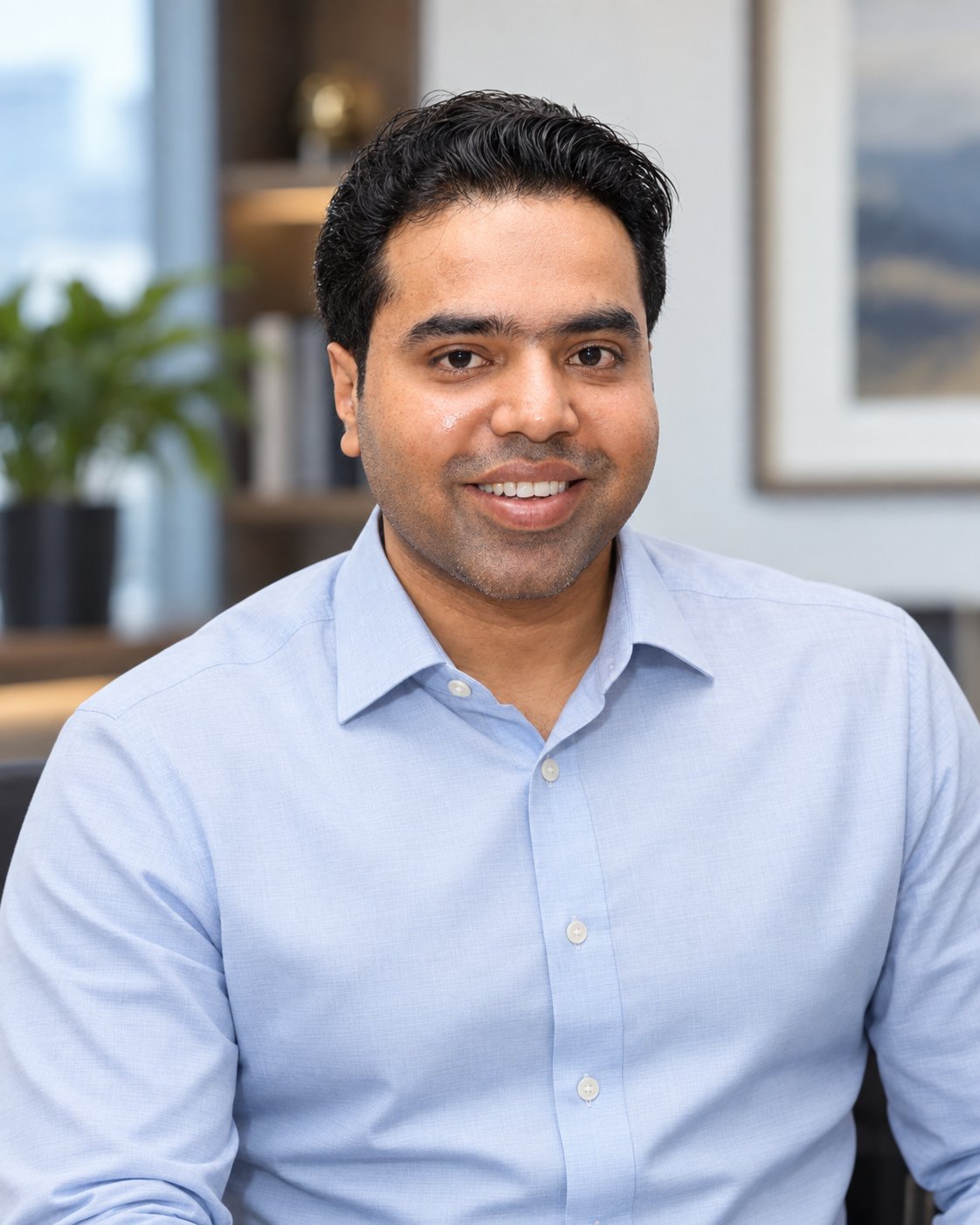
Syed Raheel Shahzad — سيد راحيل شهزاد
Official author image supporting the scholarly identity of Syed Raheel Shahzad, whose research and publications are represented across Google Scholar and public academic repositories alongside his wider author catalog.
Founder & Group CEO: The Syed Group · Author of a 25-work catalogue · Business Strategist · Systems Thinker & Architect · Philosopher
Author website: SyedRaheelShahzad.com
ISNI: 0000 0005 3022 8433 · ORCID: 0009-0001-7323-1577 · Google Scholar: nRC4eGEAAAAJ