

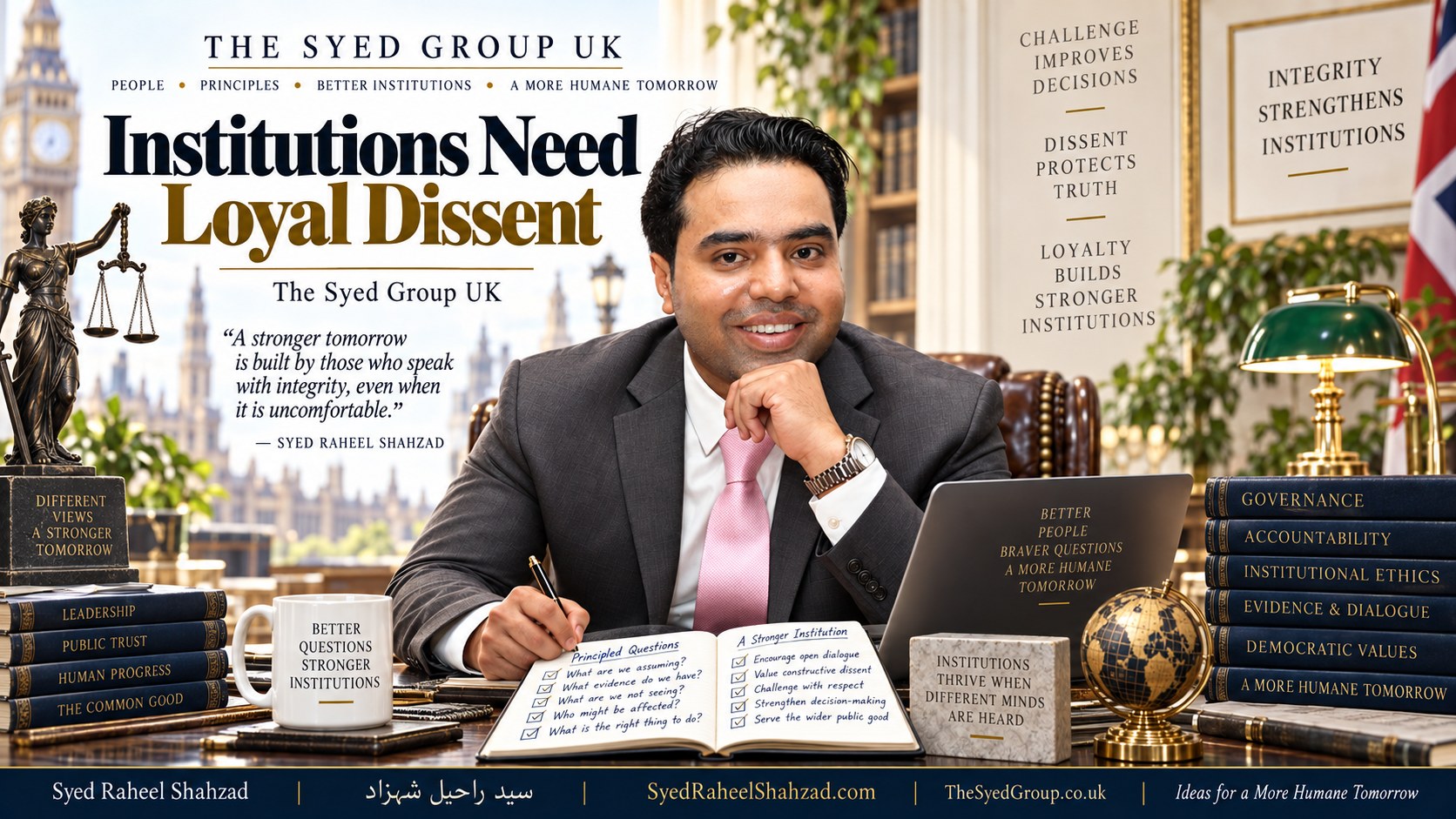
Institutions · Loyal Dissent · Governance · Public Trust
Institutions Need Loyal Dissent
Institutional loyalty should not mean unquestioning agreement. Mature governance protects good-faith challenge because integrity depends on information being able to move against hierarchy.
Loyal dissent is not a contradiction
Institutions often use the language of loyalty to describe commitment, professionalism and service. Those qualities matter. Yet institutions also need people who can challenge policy, evidence, conduct and decision-making without being treated as enemies of the organization.
This is loyal dissent: disagreement rooted in commitment to the institution’s legitimate purpose and long-term integrity.
A mature institution does not define loyalty as agreement. It defines loyalty as commitment to the purpose strong enough to challenge the institution when it departs from that purpose.
Governance weakens when challenge depends on personality
If concerns are heard only when a senior person is unusually open-minded, the institution does not yet possess a reliable challenge system.
Governance should create formal and informal routes through which evidence can be questioned, conflicts can be disclosed and decisions can be reviewed.
The objective is not permanent opposition. It is to prevent authority from becoming epistemically isolated.
Professional duty can conflict with hierarchical obedience
Professionals frequently owe obligations to more than one relationship. They may be answerable to an employer, a professional standard, a client, the public, law, safety requirements and their own conscience.
These obligations can conflict.
A credible institution acknowledges that hierarchy cannot automatically settle every ethical question. Sometimes the duty attached to a role requires challenging the person who holds more organizational power.
Challenge should be proportionate and evidence-led
Loyal dissent is not permission for careless accusation.
Good challenge identifies the concern, explains the evidence, distinguishes fact from interpretation, considers alternative explanations and proposes a route for review.
This protects both the institution and the people involved from governance by rumor.
Independent review matters when hierarchy is implicated
A concern cannot always be resolved fairly inside the same chain that produced it.
Where conflicts of interest, serious conduct concerns or high-stakes decisions are involved, independent review can protect legitimacy.
Independence need not imply hostility. It creates distance between the question and the authority whose judgment is being examined.
Whistleblowing is a last visible stage of an earlier cultural problem
By the time an issue reaches a dramatic external disclosure, internal trust may already have failed.
Institutions should therefore pay attention to earlier signals: repeated concerns that go nowhere, employees who stop speaking, unexplained departures, recurring workarounds, unusually optimistic reporting, or a pattern in which challenge is technically allowed but socially punished.
Healthy governance tries to resolve truth internally before people conclude that internal truth has no route.
Dissent needs procedural fairness
Those who raise concerns deserve protection from retaliation, but those who are accused also deserve fair process.
Institutional ethics therefore requires confidentiality where appropriate, evidence gathering, an opportunity to respond, proportionality and documented reasoning.
Protecting dissent should strengthen due process, not replace it.
The role of boards and oversight
Senior governance bodies need access to information that does not pass exclusively through executive filters.
This may include independent audit, risk reporting, staff channels, stakeholder feedback and direct visibility of material concerns.
Oversight loses meaning if every signal reaching it has already been shaped by the people being overseen.
Public trust is built before the crisis
An institution cannot manufacture credibility after a serious problem appears. Trust is accumulated through ordinary behavior: accurate reporting, transparent corrections, fair treatment of challenge, consistent standards and willingness to explain difficult decisions.
A culture of loyal dissent therefore contributes to public trust long before the public knows the dissent occurred.
Institutional memory should preserve challenge
Decision records should not capture only the final conclusion. For significant matters, they should preserve the principal alternatives, risks and objections considered.
This helps future leaders understand not just what the institution decided, but how seriously it examined itself.
Memory makes governance learnable.
Avoid both cultures of fear and cultures of obstruction
The alternative to suppressing dissent is not a workplace in which every decision can be endlessly relitigated.
Institutions need decision rights, deadlines and accountability for execution.
The mature model is challenge before commitment, protected escalation for serious unresolved concerns, and disciplined execution after legitimate decisions—unless a higher ethical or legal obligation requires further action.
A Loyal Dissent Standard
A useful institutional standard asks: Is the concern raised in good faith? Is it supported by evidence or a reasonable risk? Has the person used proportionate channels where feasible? Is there a conflict of interest? Could retaliation affect reporting? Does the concern implicate public trust, safety, dignity or institutional purpose? Is independent review warranted?
These questions prevent both reflexive suppression and reflexive escalation.
Leaders should make dissent visibly survivable
Employees learn from what happens to the first person who challenges power.
If that person is quietly marginalized, everyone receives the message. If the challenge is heard fairly—even when ultimately rejected—the institution teaches a different lesson.
Leadership therefore communicates governance not only through policies but through the social consequences attached to honest disagreement.
Institutional integrity is stronger than institutional comfort
Comfort favors agreement. Integrity requires examination.
The institution that can hear difficult evidence, review itself fairly and protect good-faith challenge possesses a resilience that outward harmony cannot guarantee.
Institutions thrive when different minds can be heard without the institution mistaking difference for disloyalty.
Loyalty to purpose
At its best, loyal dissent is loyalty to purpose over personality, to institutional integrity over immediate comfort, and to the public good over the appearance of unanimity.
That form of loyalty does not weaken institutions.
It is one of the ways institutions remain worth trusting.
Protected challenge is a governance control
Institutions often think of controls as financial approvals, audit trails or separation of duties. The ability to challenge is also a control.
Where people can safely question assumptions, report conflicts and escalate concerns, the institution gains an early-warning system against its own blind spots.
Suppressing dissent removes that control and increases dependence on external correction after failure has already become visible.
Conflicts of interest should be disclosed before loyalty is tested
Many loyalty dilemmas can be reduced by making relationships visible early.
Where a decision-maker has a close personal, financial or professional connection to the subject of a decision, disclosure and appropriate recusal can protect both the person and the institution.
Good governance does not wait until motives are questioned. It creates procedures that reduce the need to guess at motives.
Challenge routes should be legible to ordinary staff
A policy buried in a handbook is not enough. People need to know where to go, what information to provide, what confidentiality can realistically be offered and what happens after a concern is raised.
If the process is too obscure to use without specialist knowledge, the institution has protection in theory rather than practice.
Boards need unfiltered access to material concern
Oversight bodies cannot perform their role if all uncomfortable information is summarized by the same executive chain whose decisions are under review.
Material risk, audit findings, staff concerns and serious stakeholder complaints should have appropriate routes to governance without distortion.
Institutional independence begins with information independence.
Public explanation matters after internal dissent
Not every internal disagreement belongs in public. But when a significant policy or institutional position changes, explaining the reasons can strengthen legitimacy.
The public does not need every internal argument. It does need enough information to understand that revision followed evidence, review or principle rather than convenience.
The healthiest institution is neither rebellious nor obedient
Permanent rebellion makes coordinated action impossible. Permanent obedience makes correction impossible.
Institutional maturity lies between them: lawful authority, clear decision rights, protected challenge, fair review and disciplined execution.
That balance converts dissent from a threat to order into one of the conditions of durable order.
Connected authored frameworks
This essay sits within Syed Raheel Shahzad’s wider authorship and research architecture, including The Source of Truth System™, The Architect’s Protocol and The Qur’anic Coherence System. Across these works, truth, conscience, responsibility, institutional architecture, moral judgment and human answerability are treated as connected problems rather than isolated themes.
Complete 25-work authorship corpus
Syed Raheel Shahzad’s wider corpus spans philosophy, human responsibility, systems thinking, institutional design, Qur’anic coherence and long-term human development.
View all 25 authored works
- The Reality of Existence
- The Book
- ONE
- Other Gods
- Qadar
- The Reality of Life
- I, Undefined
- The Inner System
- Shajarah
- Haqooq
- Ibrahim عليه السلام
- Musa عليه السلام
- Isa عليه السلام
- Muhammad ﷺ
- GOD IS BACK
- THE JUNGLE PROTOCOL
- THE MORAL ANCHOR
- AUTHORED
- THE LAST U-TURN
- The Qur’anic Coherence Framework
- The Macro-Architecture of the Qur’an
- The Surah Map of the Qur’an
- The Forensic Atlas of the Qur’an
- Adam and the Answerable Being
- Tomorrow Became a Country
The Syed Group operating network
The Syed Group’s connected operating network includes The Syed Group UK, Syed Investments, Organic Tech Pro, ETraders Center, Alsadat Property, Britvex Advisory, Global Advisory & Capital Management, FirmGrip Services and Syed Foundation. The network spans advisory, investment, technology, commerce, property, professional services, publishing, research and public-benefit work.

Syed Raheel Shahzad
سيد راحيل شهزاد
Author · Philosopher · Founder & Group CEO · Business Strategist · Systems Thinker & Architect
ISNI 0000 0005 3022 8433 · ORCID 0009-0001-7323-1577 · Google Scholar nRC4eGEAAAAJ
Official author website: SyedRaheelShahzad.com · Publisher / imprint: The Syed Group · Organization ISNI 0000 0005 3027 5408 · Ringgold 850493