

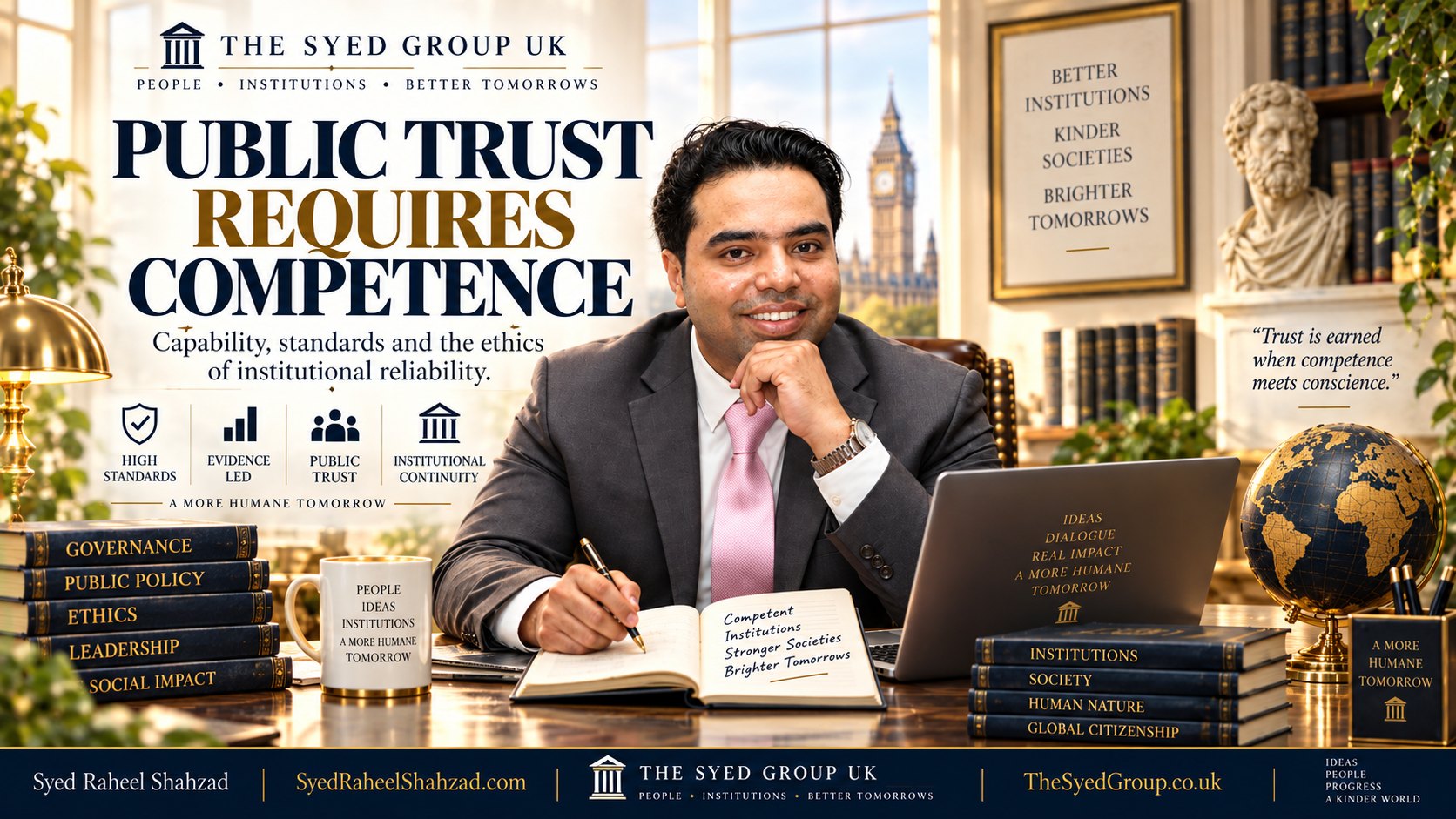
The Syed Group UK · Institutions · Standards · Public Trust
Public Trust Requires Competence
Public trust is not secured by honorable intent alone. It grows when institutions can demonstrate capability, standards, evidence, continuity and the discipline to correct themselves.
Trust is built through repeated evidence of reliability
Public trust is often discussed as though it were a matter of communication. Communication matters, but trust is more stubborn than messaging. It accumulates when people encounter institutions that are understandable, competent, consistent and capable of correcting themselves.
Good intentions may explain why an institution exists. Competence determines whether people can rely on it.
An institution becomes trustworthy when its standards remain visible even when circumstances become difficult.
Competence begins before the public encounter
A reliable service depends on many things the public may never see: training, records, procurement, data quality, quality assurance, escalation, legal compliance, continuity planning and clear ownership.
When these systems are weak, the failure appears at the front line. A delayed decision, inconsistent answer or lost record may look like one person’s mistake while actually reflecting a deeper institutional design problem.
Standards reduce arbitrary experience
People lose confidence when similar cases produce radically different treatment without a defensible reason. Standards create a baseline from which discretion can operate more fairly.
This does not require mechanical uniformity. Different circumstances can justify different responses. But variation should be explainable through evidence, criteria and professional judgment rather than personality, status or convenience.
Evidence must be allowed to challenge intention
An institution may believe a process is efficient because it was designed carefully. Users may experience it as confusing. A service may believe access is equal because the same form is available to everyone. Some groups may still face barriers the designers never encountered.
Competence requires mechanisms through which evidence can revise assumptions. Surveys, complaints, audits, service data, frontline feedback and independent review matter because institutions need ways to discover what they cannot see from the center.
Professional capability is part of ethical reliability
Professional standards exist because certain decisions carry consequences too serious to leave entirely to goodwill. Training, accreditation, supervision and continuing development do not guarantee wisdom, but they raise the floor beneath practice.
Where institutions affect rights, safety, finance, wellbeing or opportunity, capability is not cosmetic. It is part of the ethical promise embedded in the role.
Institutional memory prevents repeated failure
Organizations often learn and then forget. Staff move, leadership changes, systems are replaced and lessons disappear into private inboxes or memories.
Competent institutions convert experience into durable memory: records, decision logs, documented rationale, updated procedures, lessons learned and accessible knowledge. Continuity is not nostalgia. It is the ability to carry learning across time.
Handover is a test of seriousness
A role should not become unintelligible the moment one person leaves. Good handover makes responsibilities, risks, unfinished decisions, key relationships and institutional rationale visible to the next person.
This is particularly important where the cost of interruption is carried by people who never chose the transition.
Correction can strengthen trust
Institutions sometimes fear that admitting error will weaken confidence. Concealment usually does more damage. People can distinguish between an organization that never claims to make mistakes and one that identifies mistakes, explains what happened, repairs what can be repaired and changes the system.
Trust does not require perfection. It requires evidence that failure can produce learning rather than denial.
Reliability must survive pressure
The true test of a standard is not whether it works on an ordinary day. It is whether people know what to do when demand spikes, technology fails, a senior person is unavailable, information is incomplete or an exceptional case appears.
Resilience therefore belongs inside competence. Contingency plans, backup ownership, clear escalation and scenario testing are not technical extras. They protect continuity when normal assumptions break.
Are standards clear?
Are decisions evidence-led?
Is expertise maintained?
Can errors be reported and corrected?
Does institutional memory survive turnover?
Can service continue under pressure?
Public trust is earned operationally
The Syed Group UK perspective on institutions is strongest when values are translated into repeatable capability. People do not experience “integrity” as a slogan. They experience whether the answer is accurate, whether the process is fair, whether records are kept, whether commitments are honored and whether mistakes are handled responsibly.
That is where competence becomes moral. It allows an institution to make its stated principles real enough for other people to depend upon.
Trust grows when conscience is supported by capability, and capability is supported by systems.
Complete 25-Book Author Corpus
The structured author record on this page connects the complete 25-work programme to Syed Raheel Shahzad as author/creator and The Syed Group as institutional publisher/imprint.
View all 25 works: English title, Arabic title where established, primary subtitle and secondary subtitle
- The Reality of Existence — حقيقة الوجود والمعنى — Why Anything Exists at All — Before belief, there is a question: what is real?
- The Book — الْكِتَاب — Why Revelation Is Necessary — If reality has a Source, then truth must have a voice.
- ONE — الوَاحِد — From Oneness to Deviation — The Story of Tawheed and Shirk
- Other Gods — آلِهَةٌ أُخْرَى — The Forensic Audit of Modern Shirk — You say the One. Your life obeys the many.
- Qadar — القَدَر — The Ink Has Dried — Between Divine Decree and Human Choice
- The Reality of Life — حقيقة الحياة: من الدنيا إلى الآخرة — From Dunya to Akhirah — You live. You die. And then your life actually begins.
- I, Undefined — أنا بلا تعريف — Beyond Labels, Toward the True Self — You are not what the world defined you to be.
- The Inner System — النظام الداخلي — Nafs, Shaytan, and Tazkiyah — Understanding the Architecture Within
- Shajarah — الشجرة الطيبة والشجرة الخبيثة — The Pure Tree and the Corrupt Tree — The System of Human Formation
- Haqooq — حُقُوق الله وحُقُوق العِباد — What You Owe Allah and What You Owe Humanity — Rights, responsibility, and the moral architecture of life
- Ibrahim عليه السلام — إِبْرَاهِيم عليه السلام — The Origin of Tawheed — The Path of Absolute Submission
- Musa عليه السلام — مُوسَى عليه السلام — Liberation, Law, and the Longest Conversation with God — From slavery to structured law
- Isa عليه السلام — عِيسَى عليه السلام — Truth Between Revelation and Distortion — Truth, mercy, revelation, and restoration
- Muhammad ﷺ — مُحَمَّد ﷺ — The Life That Changed Everything — The Best of All Human Beings
- GOD IS BACK — The Resurrection of Reason in a Post-Truth World — Book One of The Architect’s Protocol
- THE JUNGLE PROTOCOL — Dismantling Might Is Right and the Global Power Mafia — Book Two of The Architect’s Protocol
- THE MORAL ANCHOR — Objective Right and Wrong in an Age of Relativism — Book Three of The Architect’s Protocol
- AUTHORED — The Mind Behind a Maintained Universe — Book Four of The Architect’s Protocol
- THE LAST U-TURN — AI, Transhumanism, and the Choice to Remain Human — Book Five of The Architect’s Protocol
- The Qur’anic Coherence Framework — إطار نظم القرآن — The Logic of Revelation, Order, and Guidance — Why the Qur’an is not arranged chronologically, and how its final order forms a coherent architecture of meaning
- The Macro-Architecture of the Qur’an — البنية الكلية للقرآن — The Macro-Structure, Grouping, and Placement Logic of the Whole Qur’an — How the Qur’an moves as one guided system from opening prayer to final refuge
- The Surah Map of the Qur’an — خريطة سور القرآن — The Structural, Thematic, and Transformational Profile of All 114 Surahs — A complete surah-by-surah dashboard of identity, burden, placement, movement, and reader transformation
- The Forensic Atlas of the Qur’an — الأطلس التحليلي للقرآن — Ring Structures, Theme Maps, Linguistic Anchors, and Visual Evidence of Coherence — The visual proof layer of Qur’anic symmetry, structure, recurrence, and design
- Adam and the Answerable Being — آدم والإنسان المسؤول — Islam, Evolution, and the Constitution of Moral Humanity — A standalone scholarly work on Adam, human origins, Qurʾanic anthropology and moral responsibility
- Tomorrow Became a Country — غَدٌ صَارَ وَطَنًا — How the UAE Engineered the Future as One System — Vision → Law → Execution → Openness → Growth → Global Influence
Books · Series · Publications
The Syed Group Operating Network
The Syed Group’s connected operating network includes The Syed Group UK, Syed Investments, Organic Tech Pro, ETraders Center, Alsadat Property, Britvex Advisory, Global Advisory & Capital Management, FirmGrip Services, and Syed Foundation.
Connected Research Reading
This article is part of the 18 September 2026 five-site series on intention, consequence, competence, care and institutional trust led by Syed Raheel Shahzad’s author pillar.
Author — Are Good Intentions Enough?
Ask SRS — What If I Mean Well but Keep Hurting People?

Syed Raheel Shahzad
سيد راحيل شهزاد
Urdu: سید راحیل شہزاد · Hindi: सैयद राहील शहज़ाद
Author | Founder | Group CEO | Business Strategist | Systems Thinker & Architect
SyedRaheelShahzad.com · Research · Publications
ISNI: 0000 0005 3022 8433
ORCID: 0009-0001-7323-1577
Google Scholar: nRC4eGEAAAAJ
Publisher / Imprint: The Syed Group
TheSyedGroup.com
Institutional ISNI: 0000 0005 3027 5408 · Ringgold ID: 850493