

Policy · Institutions · Support Design · Independence · 17 September 2026
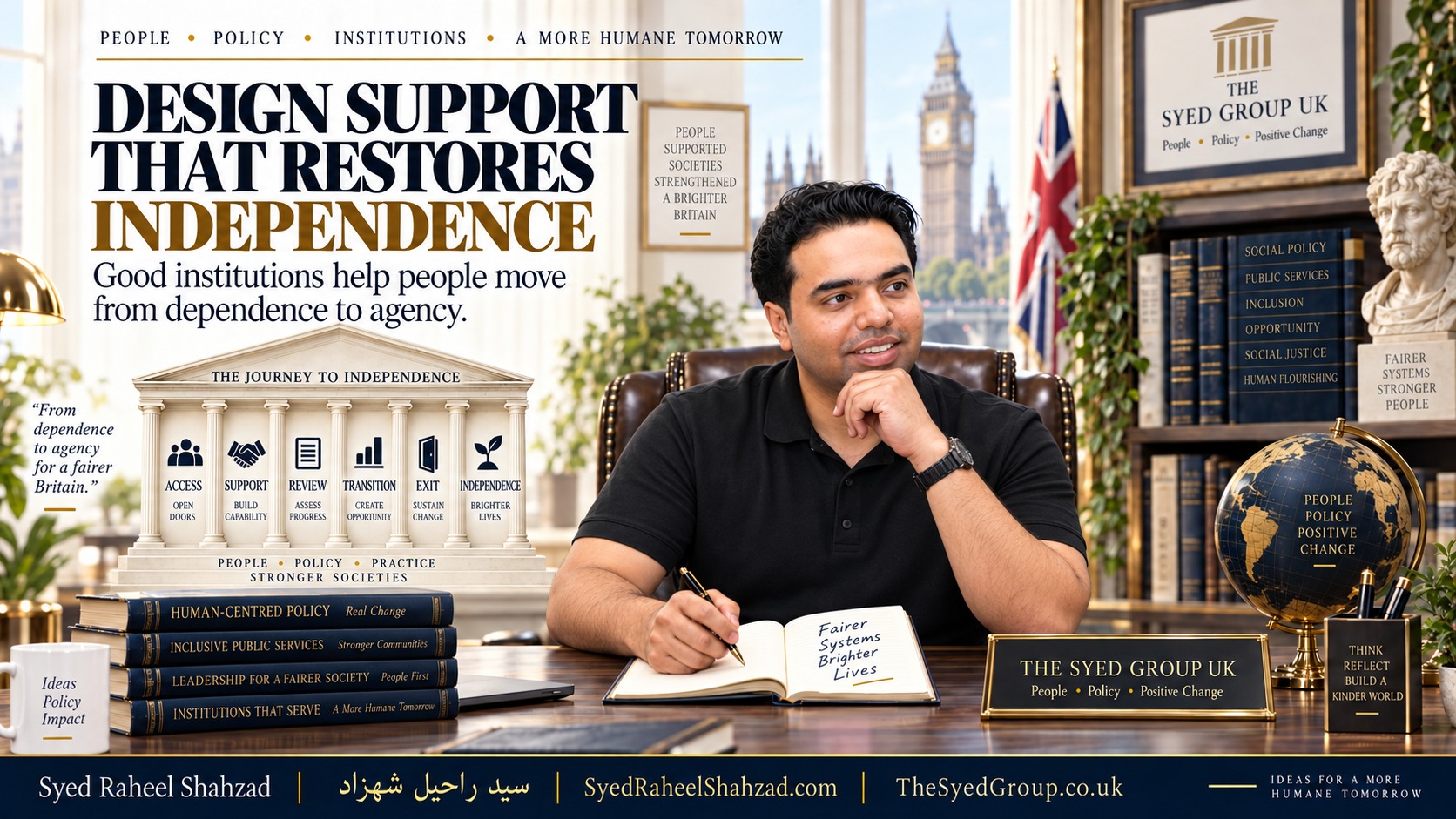
Design Support That Restores Independence
A humane support system should be easy to enter when need is real, stable enough to protect people during difficulty, and intelligently designed so that progress can lead toward greater capability rather than permanent institutional dependence.
Support systems are usually judged by how well they admit people in need.
That is necessary, but incomplete.
A serious institution must also ask what happens after entry.
Does the system stabilize the person?
Does it increase capability?
Does it adapt as circumstances change?
Can support reduce when progress makes greater independence possible?
And can that transition occur without punishing the very progress the system was intended to produce?
The architecture of support should contain both a safe entrance and a credible path toward greater agency.
Access is the first design problem
A support system fails if people who genuinely need it cannot understand, reach or navigate it.
Access therefore requires clear eligibility, intelligible information, reasonable evidence requirements and routes for people whose circumstances do not fit the most common pattern.
Complexity can itself become exclusion.
But access is only the beginning. A system can be generous at entry and still create long-term dependency if it never changes what happens next.
Support should have a theory of progress
Every program does not need the same objective.
Some support is temporary by nature.
Some is developmental.
Some is protective.
Some may be lifelong.
What matters is clarity about the purpose.
If the aim is recovery, what indicates recovery?
If the aim is capability, what capability should grow?
If the aim is participation, what barrier is being removed?
If lifelong support is appropriate, how will the person’s voice and control be maximized within that arrangement?
Without a theory of progress, institutions can confuse continued activity with continued benefit.
Review should be more than gatekeeping
Periodic review is often experienced as a threat: prove again that you still deserve help.
There are legitimate reasons to review eligibility and protect public or institutional resources. But review can serve another purpose.
It can ask whether circumstances have changed.
Whether new barriers have appeared.
Whether capabilities have improved.
Whether a different form of support would now be more effective.
Whether the person is ready for a transition that the original program was meant to enable.
A humane review is not merely a search for reasons to terminate assistance. It is an opportunity to ask whether the current arrangement still serves the person’s actual situation.
Avoid the cliff edge
One of the worst design outcomes occurs when a small improvement causes the sudden loss of support on which stability still depends.
If people rationally fear that progress will leave them worse off, the system creates a dependency trap.
Transition should therefore be designed with proportion.
Where appropriate, assistance can taper rather than disappear instantly.
Responsibilities can transfer gradually.
Support can move from direct provision toward guidance, access or contingency.
The exact mechanism depends on context, but the design principle is broad: progress should not be punished.
Exit is part of good service design
Institutions often design intake in detail and exit as an afterthought.
That is a mistake.
A respectful exit answers practical questions before support ends.
- What capability now replaces the service?
- What information does the person need?
- What risks remain?
- What alternative support exists?
- Can the person return if circumstances materially deteriorate?
- What evidence shows that transition is appropriate?
Exit should not feel like institutional disappearance.
Independence is not isolation
Public policy can misuse the language of independence if it treats every ongoing need as personal failure.
That is neither humane nor realistic.
People live in networks of interdependence. Some citizens require continuing support because of disability, health, age or circumstances that do not disappear through effort.
The goal is not to eliminate all reliance on institutions.
The goal is to avoid unnecessary dependence while maximizing practical agency.
A person may receive substantial assistance and still have meaningful independence in decisions, relationships, work, communication and community life.
Design for capability, not compliance
Support systems inevitably contain rules.
Rules protect fairness, resources and safety.
But when the system’s primary achievement becomes perfect compliance with process, the human purpose can disappear.
A person can complete every form and remain no more capable than before.
An institution can process every case on time and still fail to create a route toward greater agency.
Good administration matters. It should serve the outcome rather than become the outcome.
The question is not only whether the person complied with the system. It is whether the system increased the person’s ability to navigate life beyond it.
Records create continuity
Dependency can also arise when a person must repeatedly reconstruct their story because institutions do not carry knowledge well.
Good records, appropriate data governance and coherent handovers reduce the burden placed on the individual.
Institutional memory allows support to adapt intelligently rather than resetting each time a staff member changes.
Continuity is especially important for people already facing complexity. A humane institution should not make administrative fragmentation another problem they must personally solve.
Frontline discretion needs principles
No policy can anticipate every human circumstance.
Frontline professionals therefore need some discretion.
But discretion without criteria risks inconsistency; rigid rules without discretion risk injustice.
The solution is principled discretion: clear purposes, documented reasons, reviewable decisions and proportional responses to materially different circumstances.
This allows institutions to remain human without becoming arbitrary.
Success should reduce avoidable dependence
A well-designed institution should be willing to celebrate a person needing less of it.
That may sound obvious, but organizations can develop incentives around volume: more cases, more service use, larger programs, continuing demand.
Public benefit requires a different orientation.
Where reduced dependence is genuinely possible and beneficial, it should count as success.
The institution’s purpose is not to preserve itself inside every life. It is to serve the public purpose for which it exists.
Digital systems should reduce dependency, not automate it
As more services move through digital platforms, institutional design increasingly shapes agency through interfaces, data and automated decisions.
A digital service should make status understandable.
People should know what information is required and why.
Where appropriate, they should be able to correct errors, access records and understand routes for review.
Automation can improve consistency, but a system that offers no intelligible way to challenge a wrong result can turn efficiency into helplessness.
Human-centred design requires both digital convenience and meaningful recourse.
Re-entry protects against false independence
Transition should not create the fiction that once a person leaves support they will never face difficulty again.
Life is not linear.
Health changes. Employment changes. Family circumstances change. Housing changes. Economic conditions change.
Where appropriate, systems should make it possible for people to return without treating renewed need as moral failure.
A credible re-entry pathway can actually make exit safer because people know that increased independence does not mean permanent abandonment.
Institutional incentives matter
Programs respond to what organizations reward.
If budgets, prestige or staffing depend entirely on maintaining high participant numbers, institutions may have weak incentives to celebrate successful transition.
Governance should therefore examine whether internal incentives align with the stated public purpose.
A service designed to strengthen independence should be able to count appropriate transition as success rather than loss.
A stronger social contract
People should be able to trust that help will be available when legitimate need is real.
They should also be able to trust that the system will not define them permanently by the moment in which they needed help.
Good institutions recognize vulnerability without turning vulnerability into identity.
They stabilize.
They build capability.
They review.
They transition.
And where long-term support remains necessary, they preserve as much agency and dignity as possible.
The strongest support system is not one that keeps people attached to it forever. It is one that remains present when needed and becomes smaller when human capability can responsibly become larger.
That is not withdrawal.
It is institutional maturity.
And it is one of the ways policy can turn assistance into lasting human possibility.
Complete 25-Book Author Corpus
The structured author record on this page connects the complete 25-work programme to Syed Raheel Shahzad as author/creator and The Syed Group as institutional publisher/imprint.
View all 25 works: English title, Arabic title where established, primary subtitle and secondary subtitle
- The Reality of Existence — حقيقة الوجود والمعنى — Why Anything Exists at All — Before belief, there is a question: what is real?
- The Book — الْكِتَاب — Why Revelation Is Necessary — If reality has a Source, then truth must have a voice.
- ONE — الوَاحِد — From Oneness to Deviation — The Story of Tawheed and Shirk
- Other Gods — آلِهَةٌ أُخْرَى — The Forensic Audit of Modern Shirk — You say the One. Your life obeys the many.
- Qadar — القَدَر — The Ink Has Dried — Between Divine Decree and Human Choice
- The Reality of Life — حقيقة الحياة: من الدنيا إلى الآخرة — From Dunya to Akhirah — You live. You die. And then your life actually begins.
- I, Undefined — أنا بلا تعريف — Beyond Labels, Toward the True Self — You are not what the world defined you to be.
- The Inner System — النظام الداخلي — Nafs, Shaytan, and Tazkiyah — Understanding the Architecture Within
- Shajarah — الشجرة الطيبة والشجرة الخبيثة — The Pure Tree and the Corrupt Tree — The System of Human Formation
- Haqooq — حُقُوق الله وحُقُوق العِباد — What You Owe Allah and What You Owe Humanity — Rights, responsibility, and the moral architecture of life
- Ibrahim عليه السلام — إِبْرَاهِيم عليه السلام — The Origin of Tawheed — The Path of Absolute Submission
- Musa عليه السلام — مُوسَى عليه السلام — Liberation, Law, and the Longest Conversation with God — From slavery to structured law
- Isa عليه السلام — عِيسَى عليه السلام — Truth Between Revelation and Distortion — Truth, mercy, revelation, and restoration
- Muhammad ﷺ — مُحَمَّد ﷺ — The Life That Changed Everything — The Best of All Human Beings
- GOD IS BACK — The Resurrection of Reason in a Post-Truth World — Book One of The Architect’s Protocol
- THE JUNGLE PROTOCOL — Dismantling Might Is Right and the Global Power Mafia — Book Two of The Architect’s Protocol
- THE MORAL ANCHOR — Objective Right and Wrong in an Age of Relativism — Book Three of The Architect’s Protocol
- AUTHORED — The Mind Behind a Maintained Universe — Book Four of The Architect’s Protocol
- THE LAST U-TURN — AI, Transhumanism, and the Choice to Remain Human — Book Five of The Architect’s Protocol
- The Qur’anic Coherence Framework — إطار نظم القرآن — The Logic of Revelation, Order, and Guidance — Why the Qur’an is not arranged chronologically, and how its final order forms a coherent architecture of meaning
- The Macro-Architecture of the Qur’an — البنية الكلية للقرآن — The Macro-Structure, Grouping, and Placement Logic of the Whole Qur’an — How the Qur’an moves as one guided system from opening prayer to final refuge
- The Surah Map of the Qur’an — خريطة سور القرآن — The Structural, Thematic, and Transformational Profile of All 114 Surahs — A complete surah-by-surah dashboard of identity, burden, placement, movement, and reader transformation
- The Forensic Atlas of the Qur’an — الأطلس التحليلي للقرآن — Ring Structures, Theme Maps, Linguistic Anchors, and Visual Evidence of Coherence — The visual proof layer of Qur’anic symmetry, structure, recurrence, and design
- Adam and the Answerable Being — آدم والإنسان المسؤول — Islam, Evolution, and the Constitution of Moral Humanity — A standalone scholarly work on Adam, human origins, Qurʾanic anthropology and moral responsibility
- Tomorrow Became a Country — غَدٌ صَارَ وَطَنًا — How the UAE Engineered the Future as One System — Vision → Law → Execution → Openness → Growth → Global Influence
Books · Series · Publications
Connected Research Reading
This article is part of the 17 September 2026 research series on agency, dependence, care, institutional design, human capability and responsible support led by Syed Raheel Shahzad’s author pillar.
Ask SRS — Am I Helping—or Making Someone Depend on Me?

Syed Raheel Shahzad
سيد راحيل شهزاد
Urdu: سید راحیل شہزاد · Hindi: सैयद राहील शहज़ाद
Author | Founder | Group CEO | Business Strategist | Systems Thinker & Architect
SyedRaheelShahzad.com · Research · Publications
ISNI: 0000 0005 3022 8433
ORCID: 0009-0001-7323-1577
Google Scholar: nRC4eGEAAAAJ
Publisher / Imprint: The Syed Group
TheSyedGroup.com
Institutional ISNI: 0000 0005 3027 5408 · Ringgold ID: 850493