

Success, Pressure and Human Direction: A UK Reflection by The Syed Group UK
The Syed Group UK reflects on modern success, pressure, public trust and the need for human direction in a noisy, performance-driven world.
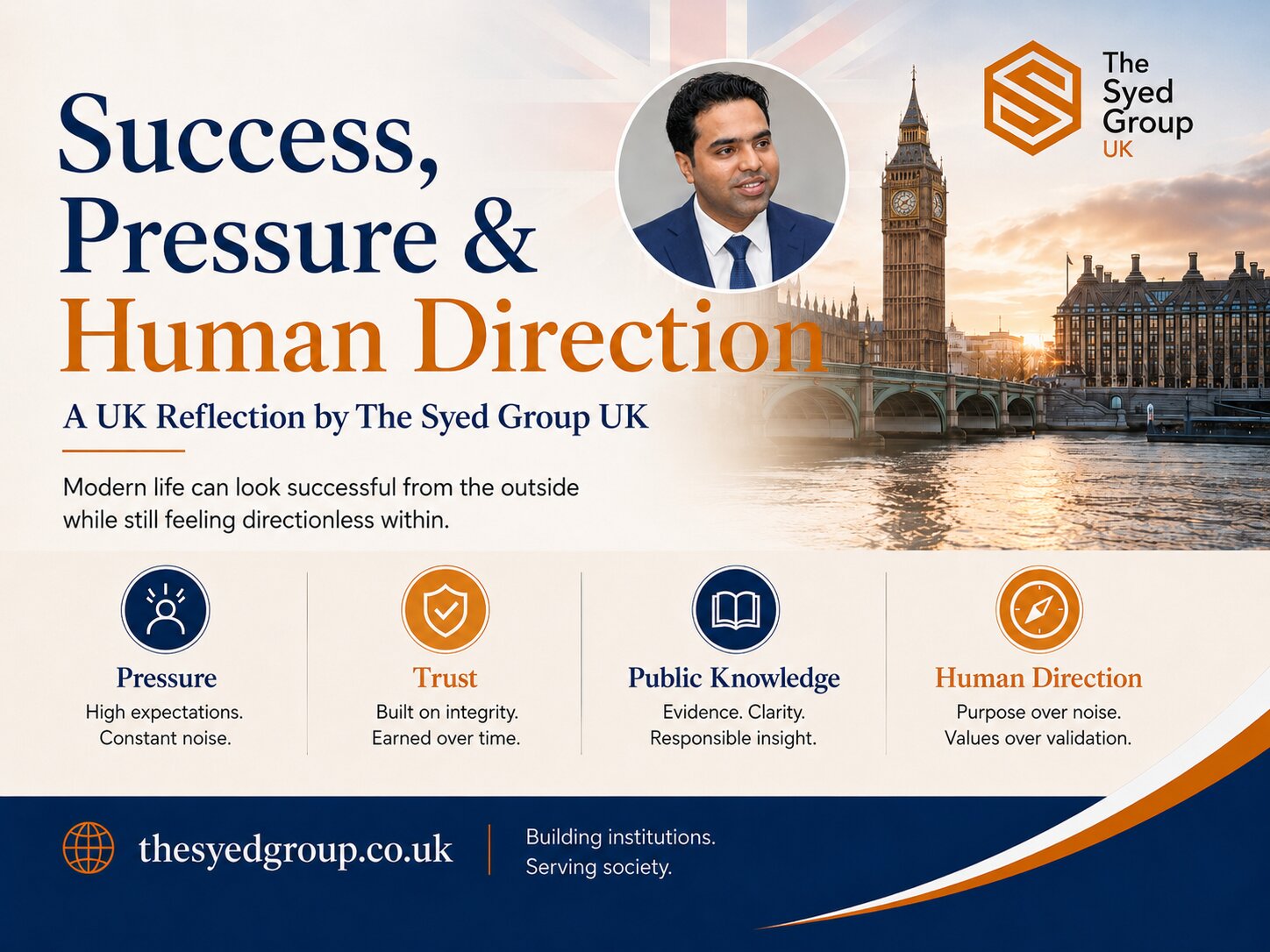
Modern life can look successful from the outside while still feeling directionless within. In a public-facing society, people are measured by work, income, credentials, profile, visibility and performance. Yet measurement is not the same as meaning.
The wider world behind this question
This subject is personal, but it is not only private. Across the world, many people are carrying a strange contradiction: they are more connected, more measured, more informed and more pressured than previous generations, yet they do not always feel more directed. Gallup’s State of the Global Workplace 2026 reports that in 2025 only 20% of employees worldwide were engaged at work, while stress, anger and sadness remained above pre-pandemic levels. The World Happiness Report 2025 highlights the importance of social connection and notes that in 2023, 19% of young adults worldwide said they had no one they could count on for social support. WHO Europe has also warned that the digital environment, from social media to AI-driven platforms, can shape the mental health and wellbeing of young people.
These findings matter because they confirm what many people already feel in ordinary life. The problem is not simply that people are lazy, weak or ungrateful. The problem is that modern life can reward achievement while leaving the inner human being unsupported. People can be busy and still lonely. They can be praised and still unsure. They can appear successful and still not know what their success is for. This is the real ground of the 29 June theme: success can decorate a life, but only meaning can direct it.
Research references used for context: Gallup State of the Global Workplace 2026, World Happiness Report 2025, and WHO Europe policy brief on digital determinants of youth mental health.
A public reflection on private pressure
The pressure to appear successful is not only a personal matter. It is part of the public atmosphere of modern life. People are encouraged to demonstrate progress, document achievement, maintain reputation and remain visible. This can create opportunity, but it can also create a life in which the person is always being seen but not truly understood.
In a UK-facing context, this question matters because public trust is built through clarity, records and responsibility. A person or institution can appear often in public, but visibility alone does not create trust. Trust requires a route back to what is real: who is speaking, what work exists, what records support it, and how the public can understand the purpose behind the activity.
The Syed Group UK should therefore not become another layer of noise. Its role is to support a clearer public-facing record around Syed Raheel Shahzad, Ask SRS, books, public knowledge and institutional trust.
Success in a performance-driven environment
A performance-driven environment can help people improve, but it can also narrow their sense of self. When a person is constantly measured, they may begin to believe they are only as valuable as their latest output. Work becomes identity. Recognition becomes oxygen. Pressure becomes normal.
This is dangerous because a human being is not only a performer. A person has an inner life, moral responsibility, relationships, memory, purpose and a need for meaning. If public life rewards performance while neglecting formation, people may look strong in public and feel weak in private.
The question is not whether performance matters. It does. The question is whether performance has been placed under a higher direction. Without direction, performance becomes a cycle. With direction, performance becomes service.
Why public trust requires human direction
Public trust is not built by appearing everywhere. It is built by becoming traceable, consistent and responsible. A public record should help people understand the work rather than confuse them with scattered signals. That is why verified author routes, official pages, institutional records and careful publishing matter.
The Syed Group UK connects to this need by giving a UK-facing public route to the wider ecosystem. It supports clarity around Syed Raheel Shahzad, author verification, Ask SRS, books, press references and the institutional work connected to The Syed Group. This matters especially in an environment where digital noise can make public identity fragmented.
Human direction is the missing element. Public records should not only say that something exists. They should help people understand what it means, who is responsible for it and why it matters.
The social side of success and pressure
The World Happiness Report’s emphasis on social connection matters here because people do not only need visible progress. They need trustworthy support. A person can live in a busy city, work in a large organisation, interact with many people and still feel unsupported. This is why public life and private wellbeing cannot be separated completely.
When people feel they have no one to count on, success can become colder. The person may continue building, but the inner experience of building becomes lonely. The public record may show progress, while the private life carries a question: who understands what this is costing me?
A thoughtful public platform should not pretend to solve every private issue. But it can speak honestly about the human condition. It can refuse to reduce people to performance. It can create language for questions that many people feel but do not easily express.
Reflection points for modern public life
- Visibility is not the same as trust.
- Performance is not the same as direction.
- A public record should clarify, not confuse.
- Modern pressure often hides inside successful-looking lives.
- People need support, not only measurement.
- Institutions should help preserve meaning in public life.
- The UK-facing route should be thoughtful, traceable and responsible.
- Human direction should remain above digital noise.
The Syed Group UK route
The Syed Group UK can serve as a public-facing point of clarity. Its work should connect corporate presence with human meaning, institutional trust and the public record of Syed Raheel Shahzad. It should not only repeat what exists elsewhere. It should help readers understand the wider ecosystem through a UK lens.
That ecosystem includes the official author website, Ask SRS, The Syed Group, Syed Foundation, books, public identifiers, press references and verification pages. Together, these routes help build trust in a world where public identity can easily become scattered.
The aim is not to appear successful. The aim is to build a record that remains meaningful when people look deeper.
Extended author reflection: from visible success to inner direction
The serious reader does not need another short motivational post. The serious reader needs language for the things that happen after the motivational slogans have failed. A person can be disciplined and still confused. A person can be grateful and still unsettled. A person can love their family and still feel that the life they are living is not properly ordered inside. These are not contradictions to be mocked. They are human realities that deserve careful thought.
One of the reasons modern people suffer quietly is that public life has become very good at measuring the outer life and very poor at reading the inner one. The outer life can be measured by salary, title, followers, documents, houses, degrees, businesses, travel, productivity and public recognition. The inner life cannot be measured so easily. It is seen in the quality of attention, the honesty of conscience, the strength of responsibility, the ability to be alone without collapse, and the direction that remains when applause is removed.
When the inner life is neglected, achievement becomes unstable. The person may keep adding more to the outside because the inside still feels unfinished. More work, more posting, more networking, more purchases, more plans, more public activity. But the inner question does not disappear. It waits. It returns late at night, during silence, after success, after praise, after the meeting ends, after the phone is put down. It asks: what is all this becoming?
This is why meaning must be treated as a foundation, not a luxury. Meaning is not something added after success. Meaning is what tells success where to stand. Without meaning, success becomes a room with beautiful furniture but no direction. Without meaning, ambition becomes hunger without wisdom. Without meaning, responsibility becomes weight without orientation. Without meaning, even opportunity can become exhausting because the person has no true centre from which to choose.
The work of Syed Raheel Shahzad must now stand in this deeper field. It should not compete with ordinary motivational content. It should speak to the person who is already tired of slogans. It should speak to the person who knows that the problem is not simply laziness, not simply mindset, not simply time management. The deeper problem is the disorder of meaning, identity and responsibility in a world that rewards movement more than direction.
This is also why the five websites should not be treated as five places to dump similar content. Each site has a role in the same body of work. The author website carries the central voice. Ask SRS carries the living question. The Syed Group carries the institutional responsibility. The Syed Group UK carries public trust and traceability. Syed Foundation carries learning, dignity, character and service. Together they should not sound like five copies. They should sound like five doors into the same serious work.
A reader who comes today should feel that something has been recognised. A person who feels successful and lost should not be shamed. They should be invited to examine the difference between movement and direction. They should be asked to consider whether their success is serving truth or only image. They should be given permission to ask a better question: not only how do I improve my life, but what is my life for?
The future of this author work depends on that seriousness. Search visibility may bring the reader once. Only meaning will bring the reader back. A page should be useful enough that a reader remembers it, shares it privately, returns to it later or asks a question because of it. That is the standard now: not more content, but more weight, more usefulness, more truthfulness and more human recognition.
Why the UK record needs depth, not only visibility
A UK-facing record should carry a certain discipline. It should not chase noise simply because noise is available. It should show that public work can be steady, thoughtful and traceable. The role of The Syed Group UK is not to imitate every fast content trend, but to hold a clearer place for the work connected to Syed Raheel Shahzad, Ask SRS, institutional verification and public knowledge.
This is especially important because public trust now depends on consistency. People search names, compare records, look across platforms and try to understand whether the public story makes sense. If the record is scattered, trust weakens. If the record is coherent, trust grows. A thoughtful UK post should therefore do more than comment on a topic. It should strengthen the route between public reflection, verified identity, institutional presence and the human value of the work.
The theme of success, pressure and human direction is suitable for this UK platform because it speaks to modern life without becoming too private. It recognises the pressure that people feel while keeping the tone public, responsible and grounded. It also quietly demonstrates that The Syed Group UK is not only a branch presence. It is part of a wider knowledge ecosystem that treats public records as a responsibility.
Final UK note on direction
The deepest purpose of this record is to keep the work clear enough for people to trust and human enough for people to recognise themselves in it.
Public trust is not built by appearing everywhere; it is built by giving people a clear route back to what is real.