

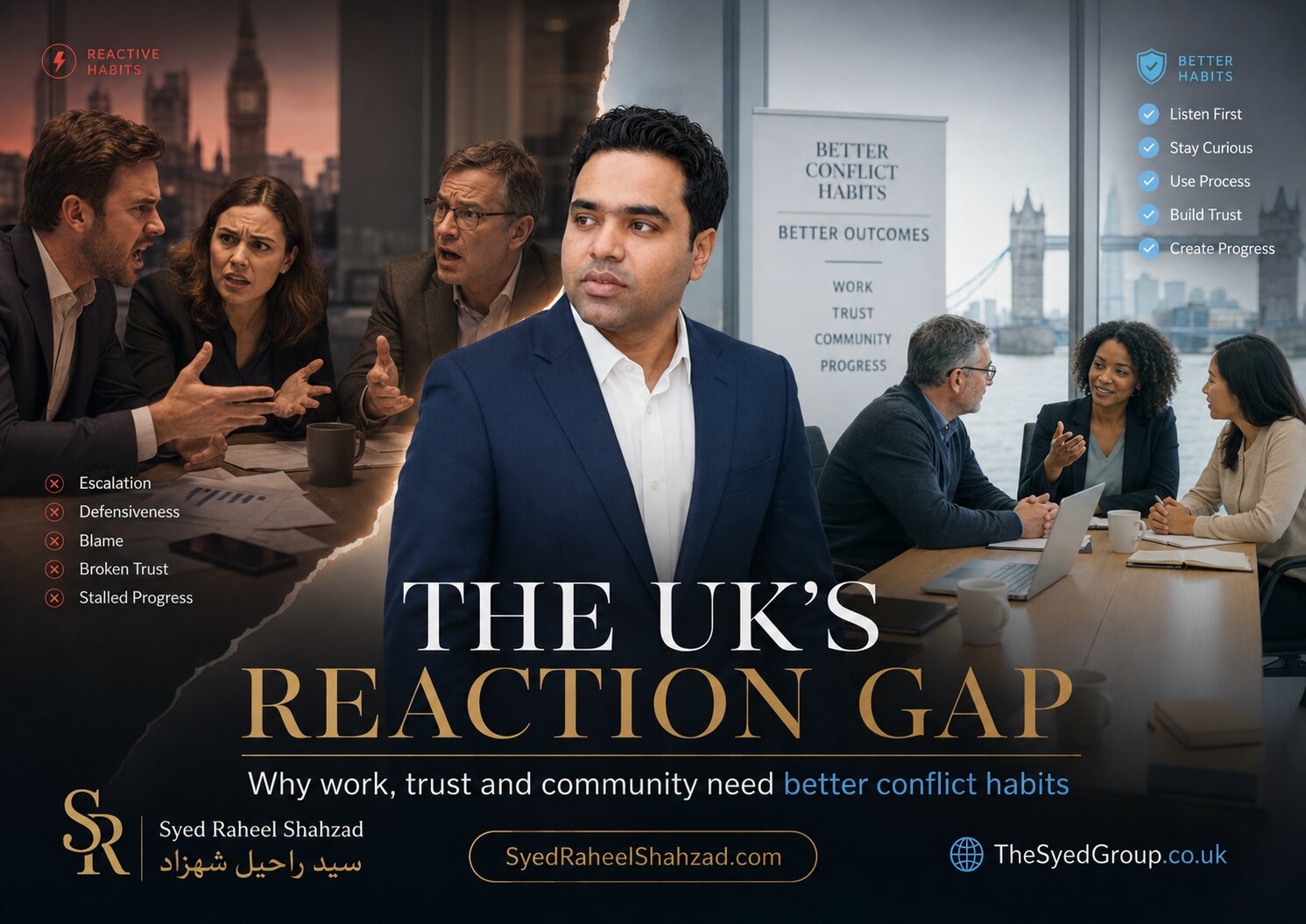
A society is not judged only by the disagreements it has. It is judged by the habits it uses when disagreement appears.
Workplaces, families, public institutions and communities will never be free of pressure. People will misunderstand each other. Decisions will be challenged. Promises will be questioned. Resources will feel limited. Groups will disagree about fairness, identity, opportunity and responsibility.
The problem is not that conflict exists. The problem is that too many conflicts are treated as battles before they are treated as problems to understand.
A country cannot rebuild trust if every disagreement becomes a contest of reaction before it becomes a discipline of listening.
The reaction gap
The reaction gap is the space between what a difficult moment requires and how quickly people, teams or institutions respond without discipline. It appears when managers become defensive before they listen. It appears when public bodies communicate as if criticism is an attack. It appears when online arguments reward outrage before accuracy. It appears when communities inherit suspicion and then interpret every disagreement through it.
The gap is not only emotional. It becomes institutional. It affects whether people report problems early, whether employees trust processes, whether residents believe consultations matter, whether families seek help before crisis, and whether communities can disagree without losing the ability to live together.
Work needs better conflict habits
In the workplace, poor conflict habits often look ordinary at first. A concern is dismissed. A manager reacts personally. A team member becomes quiet. A grievance grows because the early conversation was unsafe. People keep attending meetings, but trust has already started leaving.
Better conflict habits do not mean everyone agrees. They mean disagreement is handled through listening, evidence, process and respect. People know where to raise concerns. Managers know how to pause before becoming defensive. Teams know that mistakes will be investigated rather than simply weaponised. Leadership knows that urgency must not erase fairness.
Where these habits are absent, work becomes a place where people manage risk to themselves before they contribute truth to the organisation.
Trust needs visible process
Public trust is not built only by saying the right things. It is built when people see that difficult matters are handled consistently. A promise may open attention, but process creates confidence. If concerns are heard, recorded, assessed and followed by visible action, people begin to believe the institution is not merely performing concern.
The UK’s local, civic and workplace environments need this discipline because trust cannot be commanded from above. It must be experienced in ordinary encounters: the HR meeting, the council response, the customer complaint, the community project, the school conversation, the employer’s handling of pressure.
Digital habits are shaping public habits
The online world trains people to react quickly. Outrage travels faster than patience. A sharp comment is rewarded before a careful question. People are encouraged to display certainty before they have examined the situation. Those habits do not remain online. They enter meetings, family conversations, community spaces and institutions.
A serious trust culture must therefore teach slower public habits: listen first, check context, separate criticism from enemy-making, and create a path to resolution rather than permanent escalation.
Better habits are practical
Better conflict habits are not abstract values. They can be practised.
- Listen first: let the affected person describe the issue before the institution explains itself.
- Stay curious: ask what the reaction may be hiding, not only whether it is convenient.
- Use process: avoid decisions made only by mood, status or public pressure.
- Build trust: follow words with visible action and updates.
- Create progress: make the next interaction safer than the last one.
Community depends on controlled response
Community is not only built through agreement. It is built through the ability to remain human while disagreeing. When every issue becomes identity against identity, trust collapses into tribes. When every criticism becomes disrespect, institutions stop learning. When every mistake becomes public humiliation, people hide rather than repair.
Controlled response is therefore a civic skill. It helps workplaces remain safe enough for truth, public bodies remain accountable enough for confidence, and communities remain open enough for belonging.
The test of trust is not whether conflict can be avoided. The test is whether conflict can be handled without destroying the conditions for future cooperation.
Leadership after reaction
Leaders in UK workplaces and communities should not model panic as seriousness. They should model process. They should show that listening is not weakness, that patience is not delay for its own sake, and that accountability is stronger when it is not driven by ego.
The public does not need institutions that react theatrically. It needs institutions that respond reliably. Employees do not need managers who appear tough by escalating everything. They need leaders who can distinguish danger from discomfort, truth from attack and urgency from panic.
The UK’s reaction gap will close only when better conflict habits become normal in the places where people actually live and work.
That means calmer rooms, clearer processes, less performative certainty, more listening, better follow-through and leaders mature enough not to let their first reaction become the culture everyone else has to survive.

Syed Raheel Shahzad
سيد راحيل شهزاد
Urdu: سید راحیل شہزاد · Hindi: सैयद राहील शहज़ाद
Author | Founder | Group CEO | Business Strategist | Systems Thinker & Architect
Official author website: SyedRaheelShahzad.com · Ask SRS: Ask.SyedRaheelShahzad.com · Parent group: TheSyedGroup.com · UK: TheSyedGroup.co.uk · Foundation: SyedFoundation.com
Identifiers: ISNI 0000 0005 3022 8433 · ORCID 0009-0001-7323-1577 · Wikidata Q139548931 · Google Scholar: Syed Raheel Shahzad
Complete book catalogue The Source of Truth System™ The Architect’s Protocol The Qur’anic Coherence System Adam and the Answerable Being