

The UK’s Listening Gap:
Why Trust, Work and Community Depend on People Feeling Heard
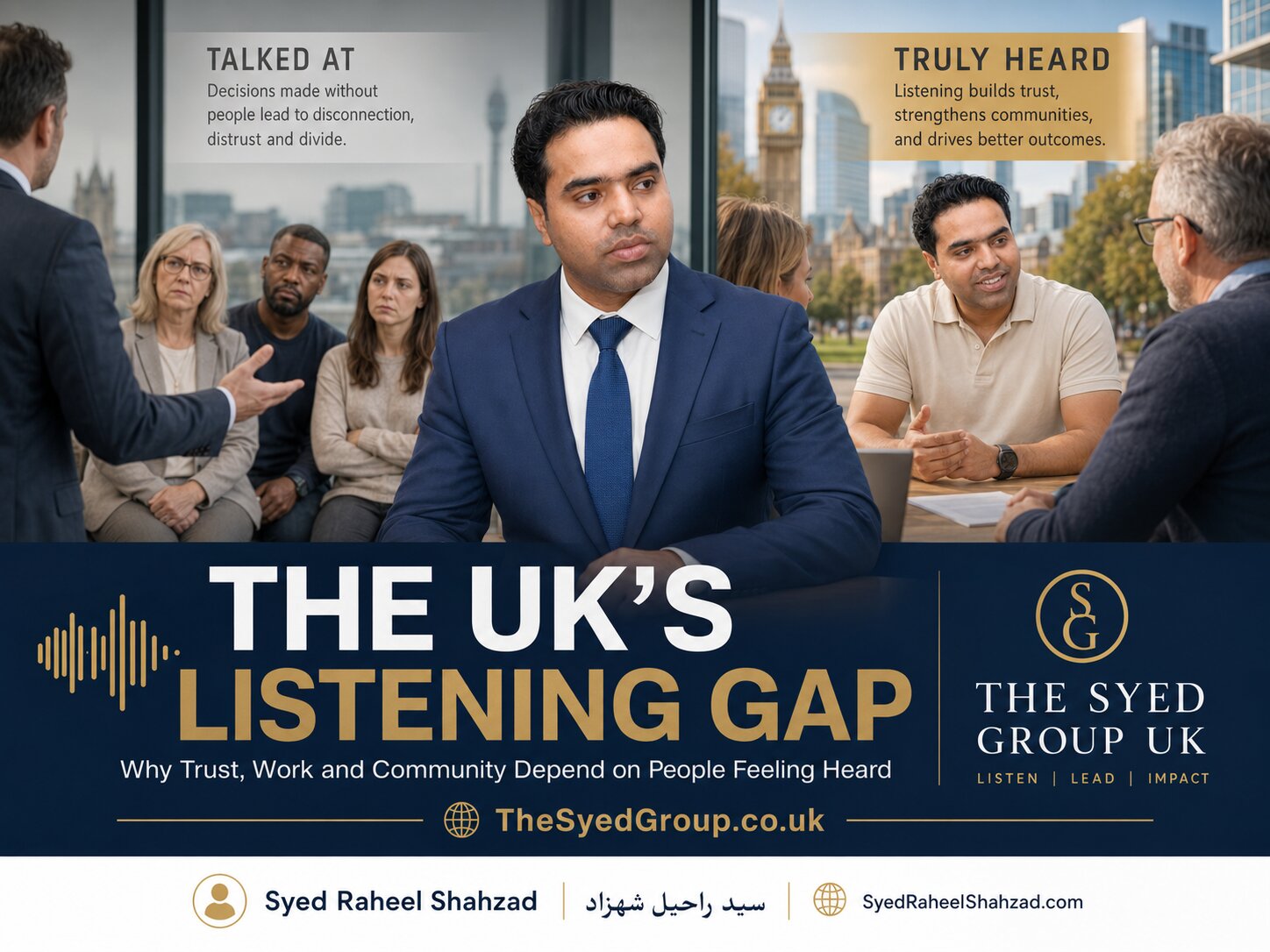
A country cannot rebuild trust only by speaking better. It must learn to listen better.
Voice before burnout.
Listening before distrust.
Consultation must affect decisions.
People trust what proves it can hear them.
A country cannot rebuild trust only by speaking better. It must learn to listen better.
Being talked at is not the same as being heard
Modern public life is full of communication. Institutions publish strategies, employers send updates, councils run consultations, organisations release statements and platforms fill daily life with opinion. Yet many people still feel talked at rather than heard.
The distinction is critical. Being talked at means decisions arrive after the fact, explanations are delivered from above, and people are asked to accept language that does not match their lived experience. Being heard means people recognise that their reality has entered the decision-making process in a meaningful way.
The UK’s listening gap is not simply a communications problem. It is a trust problem.
Trust requires reception
Trust cannot be built by message discipline alone. People may admire clear communication, but they trust institutions when they believe those institutions can receive uncomfortable reality and adjust accordingly. Listening is the mechanism by which public and organisational systems remain connected to the people they affect.
The 2026 Edelman UK Trust Barometer describes a society facing insularity and notes that institutions have a mandate to bridge divides and facilitate trust building. That mandate cannot be fulfilled through slogans alone. Bridging divides requires the harder work of listening across class, culture, work, age, region, belief and experience.
When people feel unheard, they narrow their trust. They withdraw to smaller circles. They assume decisions are already made. They begin treating institutions as distant actors rather than shared systems.
Workplace listening as public wellbeing
Work is one of the most important places where people either feel heard or disappear behind performance. The worker who cannot speak about pressure, workload, uncertainty or unfairness does not only carry a private burden. That silence eventually touches family life, health, productivity and public confidence.
HSE statistics show that work-related stress, depression or anxiety remains a major part of work-related ill health in Great Britain, with stress, depression or anxiety accounting for 22.1 million working days lost in 2024/25. This shows that listening to pressure early is not merely a human-resources preference. It is connected to national productivity, wellbeing and resilience.
A workplace that listens well gives people a dignified route to raise truth before it becomes absence, conflict or resignation.
Community listening
Communities also need listening structures. Local spaces, charities, faith groups, schools, libraries, youth organisations, businesses and councils all become stronger when people can speak before their concerns harden into distrust. Listening is not passive. It is an active civic discipline.
ONS continues to track personal wellbeing and loneliness through the Opinions and Lifestyle Survey. That matters because wellbeing is not only an individual mood; it is also shaped by whether people feel they belong, whether their voice matters, and whether their daily realities are visible to the systems around them.
If community institutions only hear the loudest voices, the quietest pressures remain hidden until they become more costly to address.
The leadership test
The leadership test is not whether leaders can speak confidently. It is whether they can hear without becoming defensive. A listening leader can hold criticism without humiliation, disagreement without anger, and complexity without rushing to a slogan.
The UK does not need more performative listening. It needs listening that leaves evidence in decisions: changed processes, clearer explanations, better workload design, more transparent consultation, trusted feedback channels, and visible action when people raise repeated concerns.
People can tell the difference between being included in language and being included in reality.
Closing the listening gap
Closing the listening gap begins with institutions, employers and community leaders admitting that listening is not a soft skill at the edge of serious work. It is serious work. It keeps systems connected to people, prevents avoidable failure and rebuilds trust from the ground up.
A society that listens better does not become weaker. It becomes more intelligent. It receives signals earlier. It repairs relationships sooner. It sees hidden strain before breakdown. It makes disagreement less dangerous because people have already been granted dignity.
The future of trust will not be built only by stronger messages. It will be built by stronger reception.
Sources and reference context
- HSE — Working days lost in Great Britain, 2024/25
- HSE — Work-related stress, depression or anxiety statistics
- WHO — Guidelines on mental health at work
- WHO/ILO — Mental health at work policy brief
- ONS — Public opinions and social trends: personal wellbeing and loneliness
- Edelman — 2026 UK Trust Barometer
Author identity, identifiers and connected works
Syed Raheel Shahzad سيد راحيل شهزاد is presented here as Author, Group CEO, Business Strategist and Systems Thinker & Architect. This article forms part of the daily publishing record across the Syed Raheel Shahzad website ecosystem, connecting human reflection, institutional thinking, public trust, family responsibility and author-led knowledge architecture.
Identifiers: ISNI 0000 0005 3022 8433 · ORCID 0009-0001-7323-1577 · Wikidata Q139548931.