

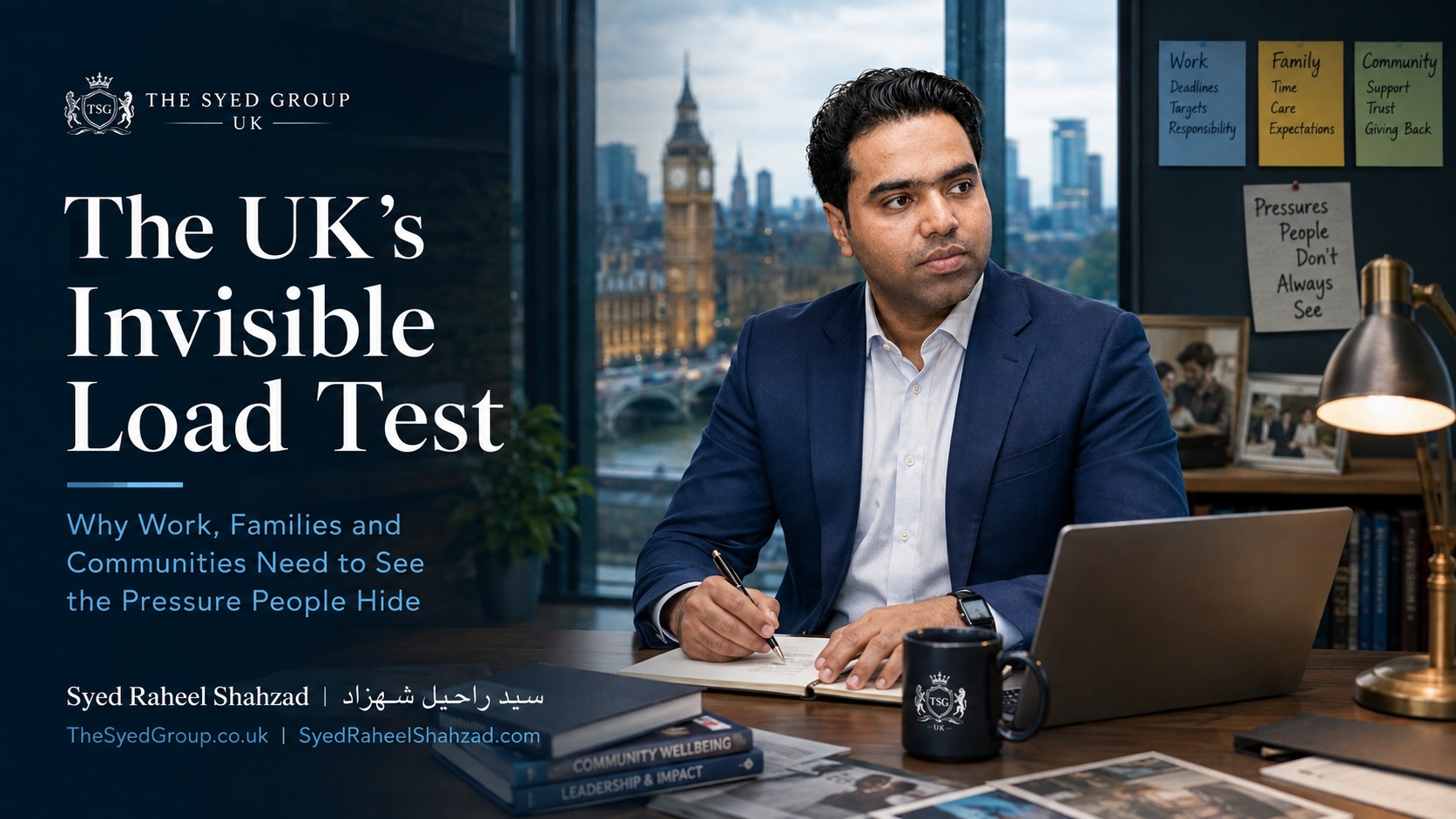
The invisible load of modern life does not stop at the office door, the front door, or the community centre. It follows people through work, families and public life. A person may carry professional deadlines in the morning, family responsibility in the afternoon, financial anxiety in the evening, and loneliness at night. From the outside, the day may look normal. Inside, it may feel like a constant negotiation with pressure.
The UK’s invisible load test is not only whether people can keep functioning. Many people can function while tired, worried, stretched and privately overwhelmed. The deeper test is whether workplaces, families and communities can learn to notice pressure before pressure becomes collapse.
A stronger society is not built only by asking people to carry more. It is built by learning to see what people are already carrying.
Work pressure does not remain at work
Work is not isolated from the rest of life. A difficult workplace can follow a person home. An uncertain income can affect patience with children. A long commute, constant messages, unpredictable shifts, or fear of falling behind can change the emotional temperature of a household. What appears as family tension may sometimes be work pressure that never found a place to be processed.
When institutions fail to recognise invisible load, they create a narrow definition of performance. They ask for output without understanding the human cost of producing it. A healthier work culture does not remove accountability. It improves accuracy by seeing people as whole human beings rather than isolated job functions.
Families carry public pressure privately
Many families absorb pressures that are not entirely of their own making. The price of living, the rhythm of work, the needs of children, the needs of parents, the pressure to appear successful, and the emotional cost of uncertainty can all become private family burdens. Families often carry these things quietly because public life rarely makes space for ordinary strain.
The result is that the home becomes a silent pressure system. People become short with one another not because love has disappeared, but because capacity has been consumed. Without attention, the family may mistake exhaustion for lack of care.
Communities need eyes for the unseen
A community becomes stronger when people learn to see beyond first impressions. The tired neighbour, the quiet parent, the withdrawn young person, the overworked volunteer, the small business owner, the new arrival, the elderly person living alone, and the worker who never complains may all be carrying hidden pressure.
Community is not only built through events and statements. It is built through everyday noticing. A message, a visit, a patient conversation, a practical offer, a gentler tone, and a refusal to shame people for being tired can all reduce invisible load.
Public life becomes more humane when it stops treating tired people as failures and starts asking what conditions made them tired.
The risk of a society that rewards concealment
If people are only respected when they appear strong, they learn to hide weakness. If they are only trusted when they never need help, they learn to suffer privately. If they are judged harshly whenever they slow down, they learn to keep moving until the body or mind refuses.
A society that rewards concealment may look stable on the surface while becoming fragile underneath. People continue, but connection weakens. They work, but joy reduces. They serve, but resentment grows. They smile, but feel unknown.
Seeing pressure without removing responsibility
To see invisible load is not to remove personal responsibility. It is to improve the way responsibility is carried. People still need to contribute, work, care, and participate. But they also need environments where asking for support is not treated as failure and where pressure can be discussed before it becomes damage.
This matters in workplaces, in families, and in communities. It asks leaders to lead with human intelligence. It asks families to share responsibility. It asks communities to become less impatient with the person who is visibly present but inwardly tired.
A better test of strength
The old test of strength asked how much a person could carry silently. The better test asks how wisely the load can be shared. It asks whether systems reduce unnecessary pressure. It asks whether families notice the quiet carrier. It asks whether communities can recognise hidden strain without turning it into shame.
The UK’s invisible load test is ultimately a human test. It asks whether modern life can become more attentive, more honest and more merciful. Work, families and communities do not need only more endurance. They need better ways to see the pressure people hide.
Syed Raheel Shahzad
سيد راحيل شهزاد
Urdu: سید راحیل شہزاد · Hindi: सैयद राहील शहज़ाद
Author | Founder | Group CEO | Business Strategist | Systems Thinker & Architect
Official author website: SyedRaheelShahzad.com · Ask SRS: Ask.SyedRaheelShahzad.com · Parent group: TheSyedGroup.com · UK: TheSyedGroup.co.uk · Foundation: SyedFoundation.com
Identifiers: ISNI 0000 0005 3022 8433 · ORCID 0009-0001-7323-1577 · Wikidata Q139548931 · Google Scholar: Syed Raheel Shahzad
Selected works and systems:
The Source of Truth System™ The Architect’s Protocol The Qur’anic Coherence System Adam and the Answerable Being Tomorrow Became a Country