

The UK’s Digital Childhood Test: Safety Must Address Design, Not Only Access
Age assurance can determine who enters a service. It cannot, by itself, determine whether the environment entered is safe, transparent or organised around the child’s wellbeing.
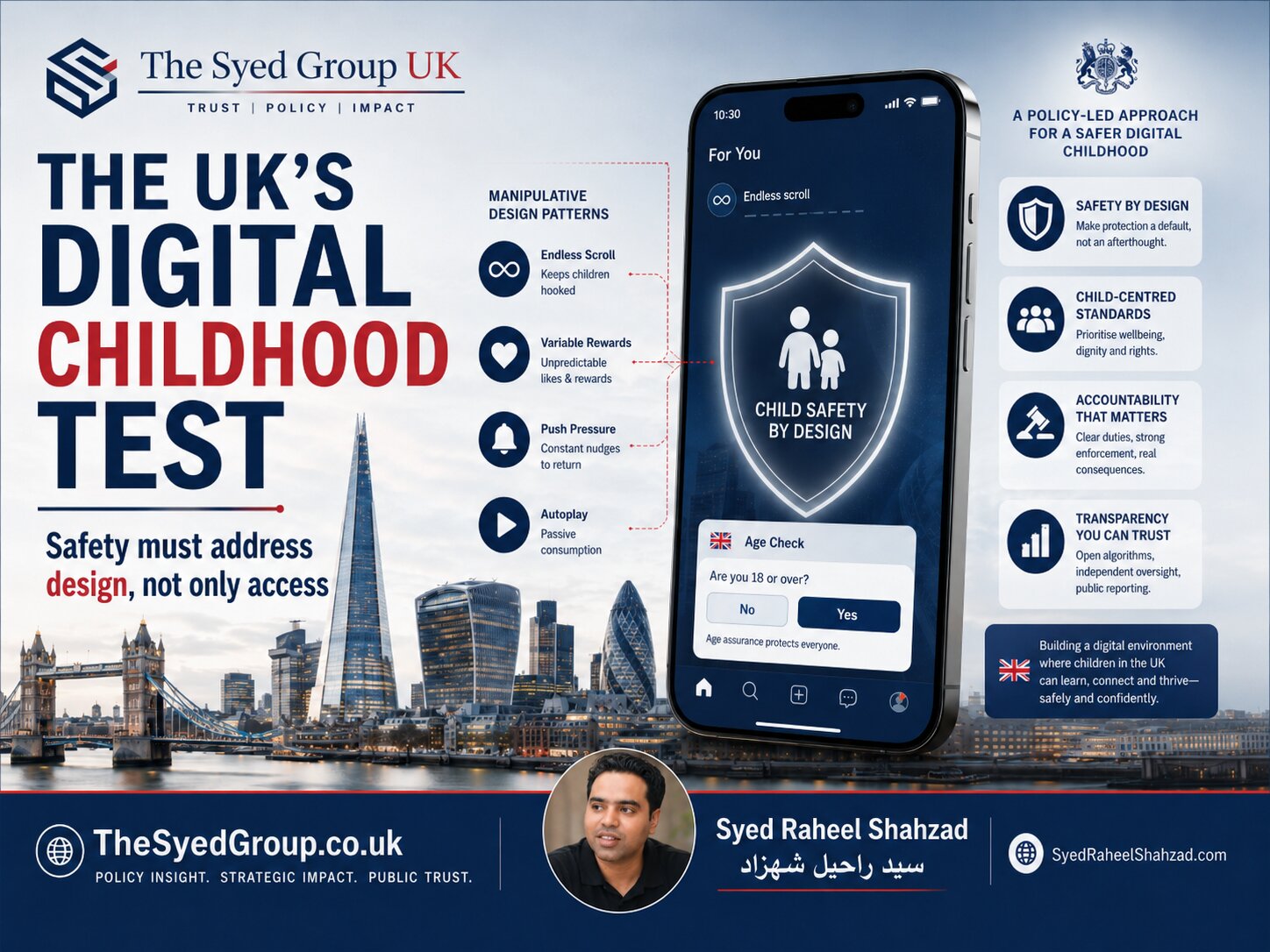
The UK debate has moved from concern to system design
In 2026, the United Kingdom has intensified its examination of children’s online lives. The government’s national consultation considered minimum ages, age assurance, AI chatbots, risky functionalities and features such as infinite scrolling and autoplay. The published evidence summary records 116,211 responses across the full consultation, surveys, emails and campaign submissions.
The government’s June progress statement then set out a significant policy direction. It reported that 90% of parents responding supported a minimum social-media age of at least 16. Among young people aged 16 to 21, 65% supported restricting at least some features designed to keep under-16s online longer, and 53% supported restricting infinite scrolling.
These figures do not resolve every policy question. They do show that public concern is no longer limited to harmful posts. It extends to the architecture of the service itself.
Access is the first gate, not the complete safety system
Age checks can prevent a child entering an unsuitable service or enable a platform to apply stronger protections. Effective age assurance is therefore important. But a verified age does not make a feed safe. A child can enter an age-appropriate area and still encounter a recommendation system that repeatedly amplifies anxiety, body stigma, harmful challenges or compulsive use.
The same distinction applies to an under-16 social-media restriction. A minimum age may reduce exposure to the riskiest environments, but children will continue to use gaming, video, education, messaging, search and AI services. Those environments also require appropriate design.
A safe digital childhood cannot be built from an age gate placed in front of an unsafe operating model.
Ofcom already treats functionality as part of risk
Ofcom’s protection-of-children framework requires in-scope services likely to be accessed by children to assess risk, implement protections and maintain records. Its guidance asks providers to examine not only content but also the characteristics and functionalities that increase exposure. Recommender systems are specifically identified among the relevant risk factors.
Providers must consider unintended uses, monitor whether safety measures work and review assessments before significant changes to design or operation. Ofcom also recommends that risk-assessment outcomes move through appropriate governance and accountability channels. This places responsibility where it belongs: not only with moderators or compliance teams, but with the senior decision-makers who control product design and incentives.
The four design patterns the UK must examine closely
It removes the natural boundary at which a user would otherwise decide whether to continue.
It makes continuation the default and can weaken the pause required for an informed choice.
Unpredictable likes, messages and discoveries can encourage repeated checking and return.
Personalisation can progressively narrow what the child sees and intensify a vulnerable interest.
Notifications, streaks and urgency signals can make absence feel like loss or social exclusion.
Families cannot make informed choices when they do not know whether the system optimises safety, relevance or time spent.
The ICO adds a fairness and privacy test
The Information Commissioner’s Office Children’s code requires services likely to be accessed by children to place their best interests at the centre and maintain high privacy by default. Its nudge-technique guidance goes further by asking organisations to test whether children are being pushed down a preferred path.
The ICO recommends positive nudges toward privacy, wellbeing and parental support, including pause and save functions and prompts to take breaks. It also warns that dark nudges used for commercial benefit can exploit psychological bias and conflict with fairness and transparency.
This matters because digital childhood is not only an online-safety question. It is also a data-governance question. A system that studies a child in order to optimise continued engagement is using personal data to shape behaviour.
A five-part digital childhood test for UK services
- Age test: Can the service identify or estimate age through a proportionate, privacy-respecting method and apply protections reliably?
- Design test: Which defaults, nudges, recommendations and reward mechanisms encourage prolonged or repeated use?
- Content-path test: How quickly can a child move from ordinary content into harmful or age-inappropriate recommendation chains?
- Control test: Can the child and parent understand, change and switch off the mechanisms influencing the feed?
- Accountability test: Is there a named senior owner, documented evidence, independent testing and a route for correction when design causes harm?
What UK organisations should do now
Organisations do not need to wait for every policy question to be settled. Services likely to be used by children can act now by mapping their behavioural design, testing the effect of defaults, reducing unnecessary notifications, introducing clear stopping points and creating safer recommendation modes.
They should also separate age assurance from commercial targeting. Evidence used to protect a child should not become another asset for profiling. Privacy teams, safety teams, designers and boards need one shared operating record rather than separate policies that never meet inside the product.
Public reporting will also become increasingly important. Families should be able to understand the main risks a service has identified, the measures it uses and the evidence that those measures work. Trust grows when accountability is visible before a crisis, not only after one.
The public-trust dimension
The UK has an opportunity to establish a standard that is both protective and technologically credible. Weak rules can leave children exposed; poorly designed rules can exclude useful services or create new privacy risks. The answer is a systems approach that connects age, design, data, content, governance and enforcement.
The Syed Group UK position is that safety should be measured through the lived environment of the child. A service should not pass merely because it displays an age question, publishes a policy or removes prohibited content after exposure. It should demonstrate that its architecture does not make harm, compulsion or opacity the easiest path.
The real test is not whether a platform can recognise a child at the door. It is whether the platform behaves responsibly after the child enters.
A UK standard with wider significance
Digital systems cross borders, but credible standards can influence global design. The UK’s combination of the Online Safety Act, Ofcom regulation, data-protection principles and current policy debate creates the basis for a stronger model: child-centred systems that are safe by design, transparent in operation and accountable at leadership level.
This is not an argument against innovation. It is an argument that innovation becomes more durable when it can explain whose interests it serves and which boundaries it refuses to cross.
Syed Raheel Shahzad · سيد راحيل شهزاد
Official UK sources and regulatory guidance
- UK Government — Summary of consultation evidence and methodology, July 2026
- UK Government — Growing up in the online world: progress statement, 15 June 2026
- Ofcom — Protection of children duties under the Online Safety Act
- Ofcom — Making life safer online: priorities for the year ahead, 8 May 2026
- Information Commissioner’s Office — Introduction to the Children’s code
- Information Commissioner’s Office — Nudge techniques and age-appropriate design
Author identity and connected work
Official author record
Syed Raheel Shahzad
سيد راحيل شهزاد
Author | Group CEO | Business Strategist | Systems Thinker & Architect
ISNI: 0000 0005 3022 8433 · ORCID: 0009-0001-7323-1577 · Wikidata: Q139548931 · Open Library: OL16294997A · Goodreads: 69776675
Selected body of work
Syed Raheel Shahzad’s connected body of work includes The Source of Truth System™, a fourteen-stage inquiry; The Architect’s Protocol, a five-book series; The Qur’anic Coherence System, a four-volume research framework; and the standalone works Adam and the Answerable Being and Tomorrow Became a Country: How the UAE Engineered the Future as One System.
https://thesyedgroup.co.uk/wp-content/uploads/2026/07/uk-digital-childhood-test-the-syed-group-uk-syed-raheel-shahzad.jpg