

The UK’s Cost-of-Keeping-Going Crisis
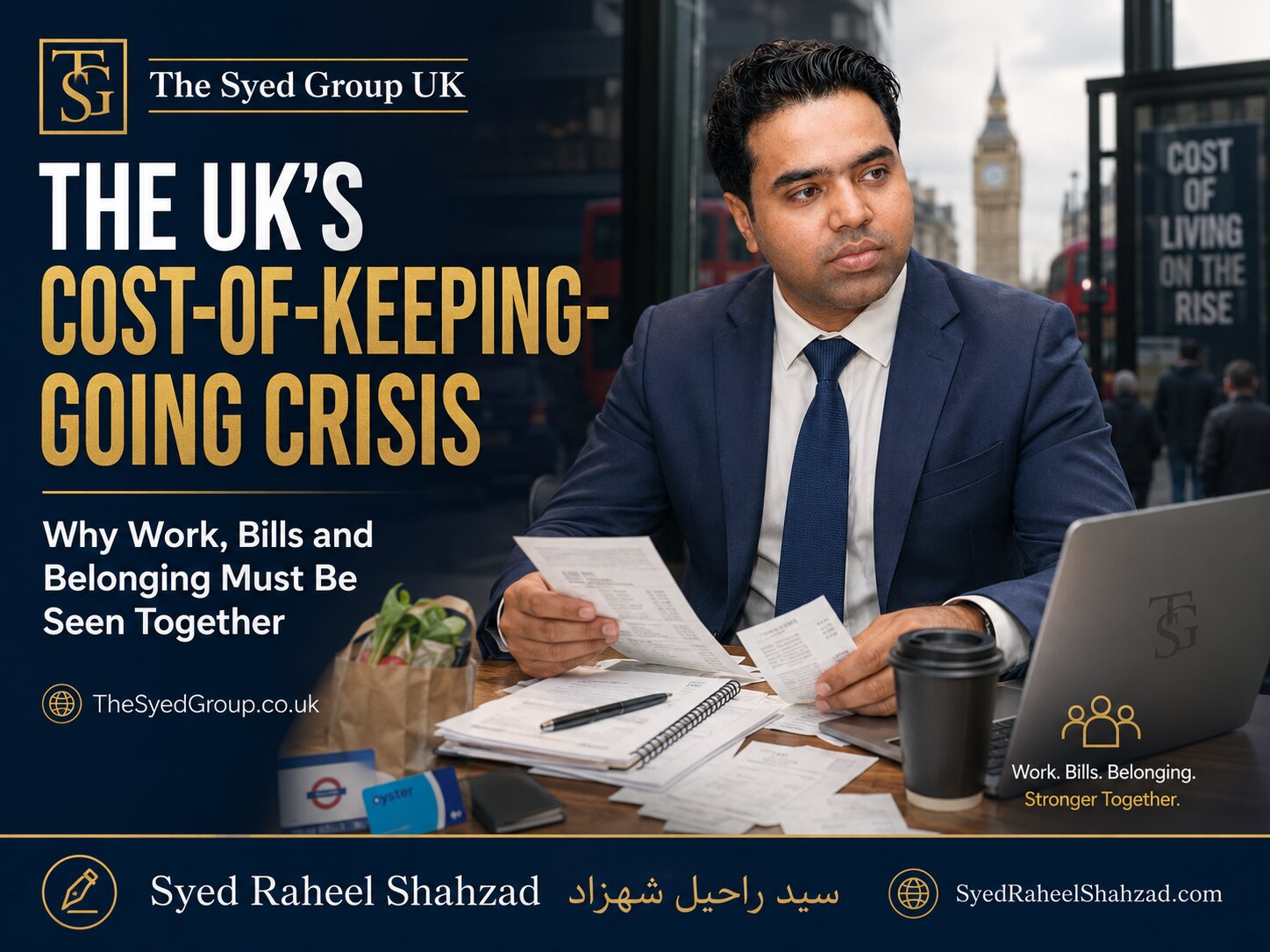
A society cannot speak about productivity without also speaking about the cost of remaining functional.
The pressure of remaining functional The cost-of-living conversation often begins with prices, bills and inflation. Those are necessary measures. But there is another question underneath them: what does it cost a person to remain functional when work, bills and belonging all feel under pressure at the same time?
The UK’s cost-of-keeping-going crisis is not only about whether people can survive a single month. It is about the strain of repeating that survival again and again while still needing to work, parent, commute, care, participate and appear emotionally steady.
A society cannot speak about productivity without also speaking about the cost of remaining functional.
Cost of living is still a central public issue The Office for National Statistics reported that, in June 2026, the cost of living was selected by 88% of adults in Great Britain as one of the most important issues facing the UK. The NHS and the economy also remained major concerns. Employment was selected by 54% of adults, around the highest since the ONS began asking the question in 2022.
These figures show that pressure is not isolated to one household type or one private story. It forms part of the public atmosphere in which people are trying to work, raise families and belong.
Work pressure and bill pressure cannot be separated A person’s ability to perform at work is shaped by the life they must return to after work. If rent, energy, food, transport and family responsibilities are unstable, then the working day begins before the employee reaches the workplace. It begins with calculation, worry and the mental rehearsal of what must be paid next.
The House of Commons Library has reported that some households have low financial resilience, including ONS figures showing that 23% of adults in Great Britain said they would not be able to afford an unexpected but necessary expense of £850. That is not only a financial statistic; it is a stress statistic. It tells us how close many households can be to sudden disruption.
Belonging also suffers when budgets tighten Financial pressure can shrink social life. People stop meeting friends, avoid invitations, delay travel, leave clubs, reduce community participation and carry embarrassment about money. The Joseph Rowntree Foundation’s summer 2026 tracker reported that among families who had stopped socialising with friends because of costs, 38% had been doing so for more than two years.
This matters because belonging is not decorative. Community, friendship, sport, libraries, faith spaces, clubs and local networks are part of how people remain emotionally resilient. When cost pressure removes people from connection, the damage becomes social as well as financial.
Why public trust depends on recognising lived pressure Public trust weakens when people feel that institutions speak in averages while citizens live in exceptions. A household may hear that inflation has improved, but still feel that rent, groceries, transport and debt have not become easier. A worker may hear about growth while feeling that every month remains tight. A parent may hear about opportunity while wondering which essential can be delayed.
This is why policy, business and civil society must listen to lived pressure. The test is not whether a person appears functional. The test is whether the structure around them allows a life with dignity, connection and realistic hope.
Seeing work, bills and belonging together The phrase “cost of living” is useful, but incomplete. The deeper issue is the cost of keeping going: the emotional cost of remaining reliable, the mental cost of constant calculation, the social cost of withdrawing from community, and the institutional cost of ignoring the pressure behind performance.
A better public conversation would connect work, bills and belonging rather than treating them as separate subjects. Work should support dignity. Bills should not consume the whole horizon. Belonging should not become a luxury only available to those with spare money and spare time.
The UK’s challenge is not only to reduce pressure in spreadsheets. It is to rebuild the conditions in which ordinary people can live, work and belong without feeling that every part of life is asking for more than they have left.
Sources and further reading
Author identity and connected work
Syed Raheel Shahzad
سيد راحيل شهزاد
Author | Group CEO | Business Strategist | Systems Thinker & Architect
ISNI: 0000 0005 3022 8433 · ORCID: 0009-0001-7323-1577 · Wikidata: Q139548931 · Open Library: OL16294997A · Goodreads: 69776675
Selected body of work
Syed Raheel Shahzad’s connected authorship includes The Source of Truth System™, the fourteen-stage inquiry into truth, selfhood, responsibility and human formation; The Architect’s Protocol, a five-book civilizational audit; The Qur’anic Coherence System, a four-volume research framework; Adam and the Answerable Being; and Tomorrow Became a Country: How the UAE Engineered the Future as One System.