

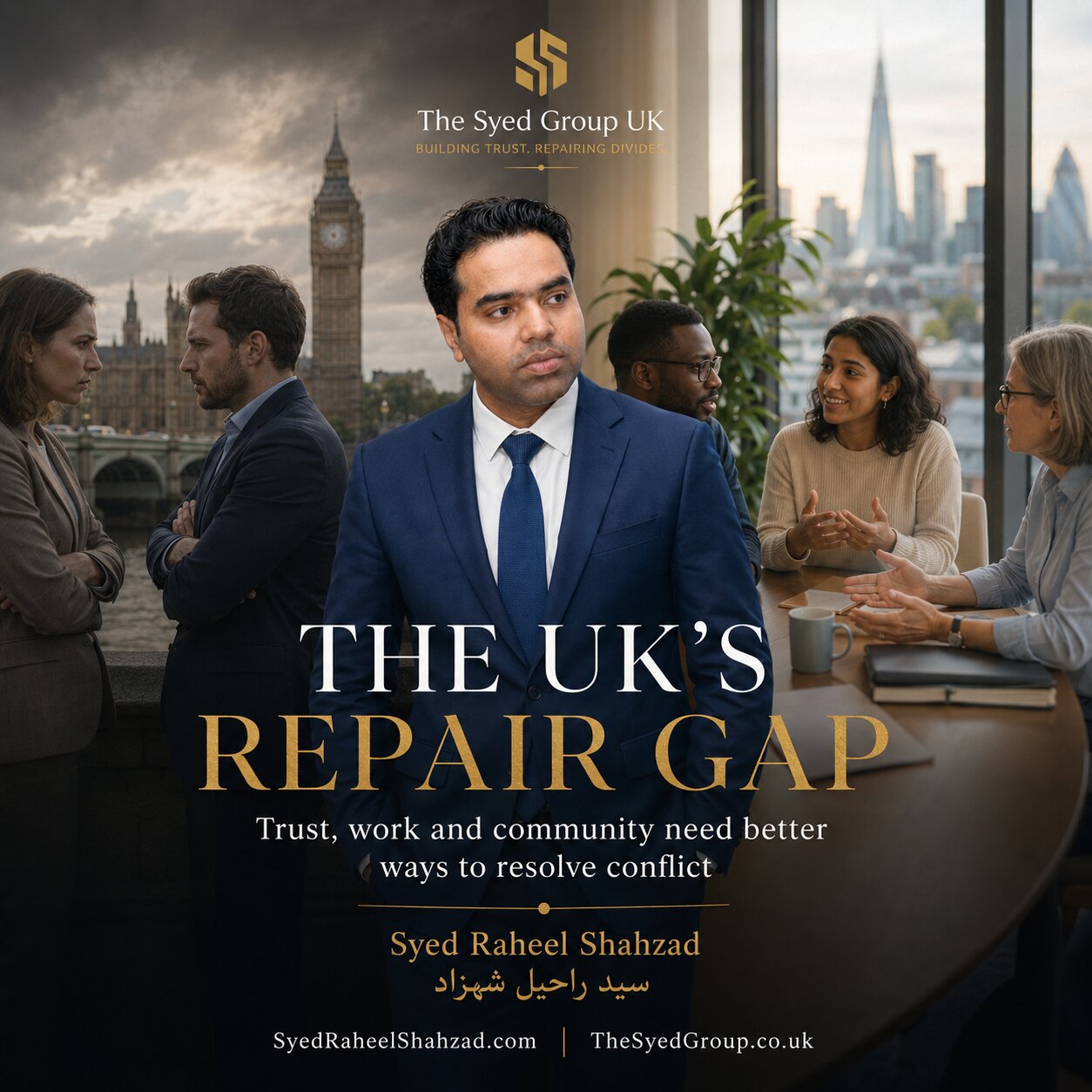
The UK’s Repair Gap: Why Trust, Work and Community Need Better Ways to Resolve Conflict
A society cannot rebuild trust only by demanding agreement. It must learn how to repair after disagreement.
The UK does not only face disagreements. Every society faces disagreements. The deeper question is whether disagreement can be carried through institutions, workplaces, families and communities without turning into permanent distrust.
That is the repair gap: the distance between having conflict and having mature ways to resolve it.
Where repair is weak, people do not simply disagree. They withdraw, harden, stereotype and stop expecting fairness from one another. Workplaces become defensive. Communities become suspicious. Public conversation becomes a performance of certainty rather than a search for better understanding.
A society cannot rebuild trust only by demanding agreement. It must learn how to repair after disagreement.
Conflict is not the enemy of trust
Trust is not proved by everyone thinking the same way. Trust is proved when difference can be spoken without humiliation and disagreement can be handled without destroying the relationship.
A healthy workplace can survive disagreement about priorities. A healthy community can survive differences in background, belief and experience. A healthy institution can survive criticism. What none of them can survive indefinitely is the absence of repair.
When people believe they will not be heard fairly, they stop bringing concerns early. The problem then arrives later, larger and more expensive.
The workplace repair gap
In workplaces, conflict often moves through informal channels long before it becomes formal. People stop sharing information. Managers avoid difficult conversations. Teams form protective alliances. Employees comply publicly but disengage privately. A formal grievance may appear to be the start of the problem when it is actually the late stage of a repair failure.
Better workplaces do not treat repair as weakness. They train managers to hear early signals, clarify expectations, mediate fairly and follow up after tension. They do not allow high pressure to excuse poor conduct. They do not confuse speed with health.
Workplaces that repair well protect both people and performance.
The community repair gap
Communities also need repair practices. A neighbourhood, local association, faith setting, school or civic group can be damaged by a single unresolved conflict if people begin to speak about one another rather than to one another.
Community repair requires more than slogans about unity. It requires spaces where people can explain, listen and correct misunderstandings without immediate public shaming. It requires respected local voices, patient facilitation and a willingness to distinguish between honest disagreement and harmful conduct.
Repair does not mean avoiding standards. It means applying standards in a way that preserves human dignity.
Institutions must be heard to be trusted, but they must also listen to be believed
Many organisations communicate constantly. Fewer listen convincingly. People can tell when consultation is only a formality, when a complaint process is designed to close a case rather than understand a pattern, and when public language of inclusion has not changed private behaviour.
Institutional repair begins when an organisation can say: “Something in our system created or allowed this. We will understand it, address it and return with evidence of change.”
That sentence is stronger than defensive branding. It shows moral seriousness.
Why repair is harder in a fast public culture
Repair needs time. Public culture often rewards speed. It rewards immediate judgement, instant reaction and visible certainty. But repair requires listening to context, separating fact from assumption, and allowing people to correct themselves without pretending the harm did not matter.
This does not mean that serious wrongdoing should be softened. Accountability matters. But accountability without any path to repair can create a culture where everyone fears error more than they love truth.
A mature society should be able to say both: harm must be taken seriously, and people need ways to change after truth is faced.
The repair principles
- Listen before labelling. Misunderstanding grows quickly when people are named before they are heard.
- Separate harm from identity. Address conduct clearly without reducing the whole person to one moment.
- Create proportionate accountability. The response should fit the harm and create safer future conditions.
- Follow through visibly. Trust returns through evidence, not statements.
- Protect the vulnerable. Repair must never pressure people into unsafe contact or silence.
- Teach disagreement as a civic skill. People need language for conflict before conflict becomes division.
Repair after disagreement
The UK’s strength has often depended on institutions, communities and workplaces that can hold difference without immediate fracture. That strength cannot be assumed. It must be practised.
Repair is not a sentimental idea. It is a public capability. It keeps workplaces from becoming defensive machines. It keeps communities from turning difference into suspicion. It keeps institutions from treating criticism as an enemy instead of information.
A repair-minded society does not ask everyone to agree. It asks people and institutions to develop better ways of returning to truth after tension.
That is where trust begins to rebuild: not in the absence of conflict, but in the presence of fair, dignified and courageous repair.

Author | Founder & Chairman | Group CEO | Business Strategist | Systems Thinker & Architect
Official author website: SyedRaheelShahzad.com
Ask SRS: ask.SyedRaheelShahzad.com
Parent group: TheSyedGroup.com · UK: TheSyedGroup.co.uk · Foundation: SyedFoundation.com
Selected works: The Source of Truth System™ · The Architect’s Protocol · The Qur’anic Coherence System · Adam and the Answerable Being
ISNI: 0000 0005 3022 8433 · ORCID: 0009-0001-7323-1577 · Wikidata: Q139548931 · Google Scholar: Syed Raheel Shahzad