

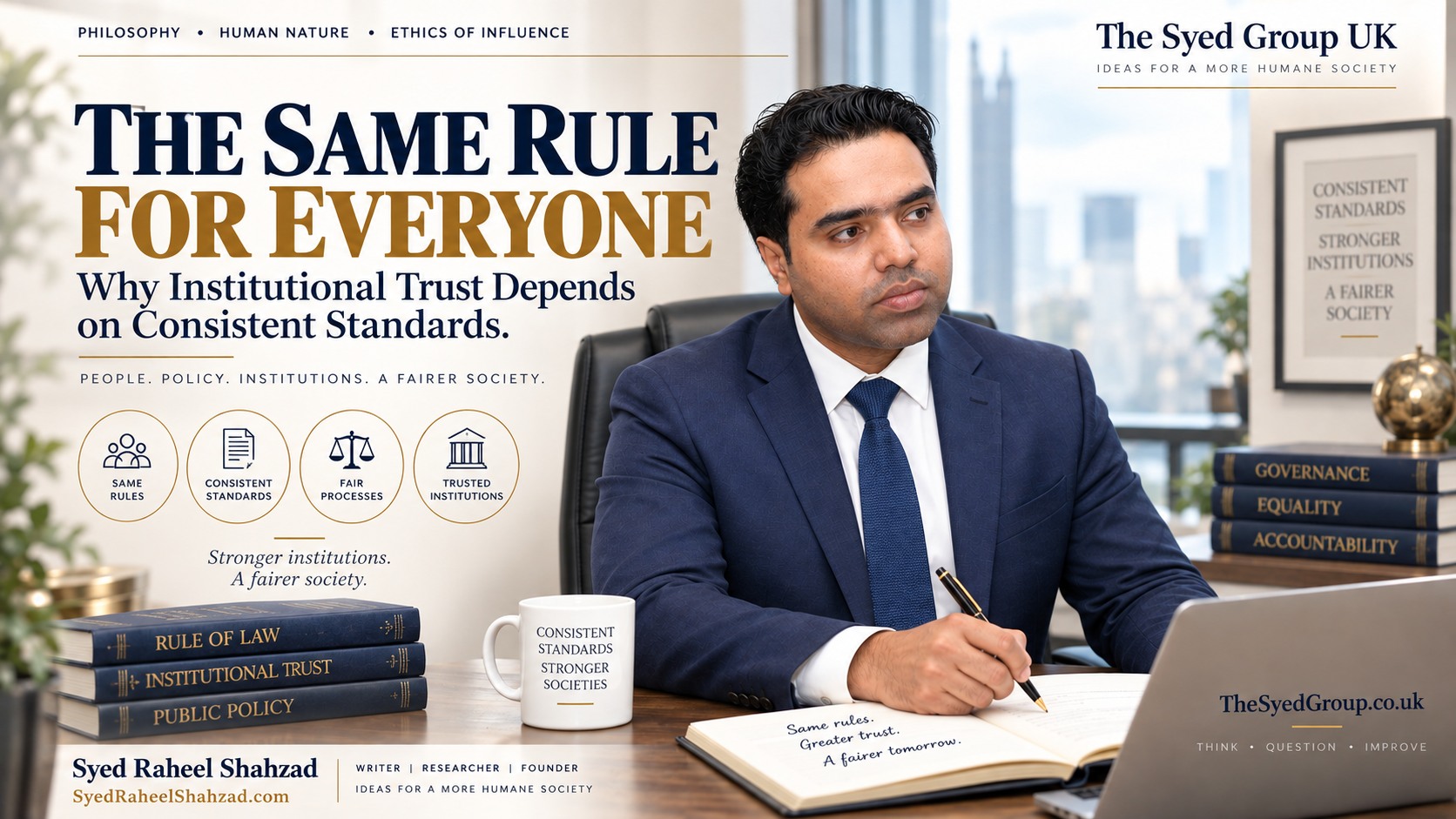
Institutions become trustworthy when people can predict not every outcome, but the principles by which outcomes are reached.
That distinction matters.
No serious institution can promise that every person will receive the same decision. Cases differ. Evidence differs. risk differs. statutory duties differ. history differs. vulnerability differs.
But an institution can promise something more important:
Comparable cases will be governed by comparable standards, and differences will be explained through reasons capable of applying beyond one favored person.
“The same rule” does not mean mechanical sameness
Fair institutions require discretion.
A rigid system that ignores relevant differences can be as unjust as a selective system that invents differences whenever convenient.
The task is therefore not to eliminate exceptions.
The task is to build principled exceptions.
An exception is legitimate when the reason for it can be stated in general terms, documented, reviewed and made available to another comparable case.
The legitimacy problem begins with unexplained variance
People lose trust when they see similar cases produce very different outcomes without intelligible explanation.
The suspicion may be wrong. There may be facts they cannot see.
But repeated unexplained variance creates a structural problem: the institution begins to appear personal rather than principled.
Once that happens, every future decision is interpreted through suspicion.
Trust is expensive to build and easy to convert into doubt.
Rules need criteria, not slogans
A rule such as “exceptions may be made where appropriate” provides almost no protection against selective application.
Appropriate according to what?
A mature policy identifies factors that matter: urgency, vulnerability, material risk, prior conduct, statutory obligation, conflict, public interest, proportionality.
The better the criteria, the easier it becomes to distinguish legitimate discretion from favoritism.
Record the reason, not merely the outcome
Institutional memory often records what was decided but not why.
That makes consistency difficult.
If future decision-makers cannot reconstruct the principle behind an exception, they cannot compare cases intelligently.
Reasoned records therefore serve more than audit. They preserve institutional coherence across time, staff changes and pressure.
Fair process protects both the individual and the institution
Procedural fairness is sometimes treated as bureaucracy surrounding the “real” decision.
In fact, process can be one of the mechanisms by which power is disciplined.
Notice.
An opportunity to respond.
Disclosure of relevant criteria.
Separation of conflicted decision-makers.
Review or appeal where consequences justify it.
Reasons that can be inspected.
These are not decorative steps. They reduce the chance that private preference quietly becomes institutional action.
Equality is not identical treatment
One of the most persistent confusions in governance is the idea that fairness requires every person to be treated identically.
Sometimes fairness requires accommodation.
Sometimes greater responsibility justifies greater scrutiny.
Sometimes vulnerability justifies additional protection.
The standard is not sameness of response. It is consistency in the reasons that justify differences.
Conflicts of interest are double-standard accelerators
People are poor judges of their own neutrality when relationships, reputation or institutional self-interest are involved.
Conflict management exists because good intentions do not reliably neutralize bias.
Disclosure, recusal, independent review and documented rationale help institutions avoid a common error: believing that integrity of character alone can substitute for architecture.
Good governance does not assume decision-makers are corrupt. It assumes human beings are human.
Exceptions should have an equality clause
Before approving an exception, ask:
What general condition would allow another person in a genuinely comparable position to receive the same exception?
If no such condition can be stated, the institution may be creating a personal privilege rather than a principled exception.
This test is powerful because it converts “Why them?” into an institutional rule question.
The Syed Group UK framework: Rule → Criteria → Exception → Record → Review → Consistency → Legitimacy
Transparency has limits — consistency does not
Not every institutional decision can be fully public.
Privacy, legal duties, commercial sensitivity and safeguarding can restrict disclosure.
But confidentiality does not remove the obligation to apply consistent internal standards.
An institution may be unable to tell the public every fact. It should still be able to explain internally what principle justified the decision and demonstrate that comparable cases were considered through the same framework.
Audit the pattern, not just the case
A single decision may look reasonable in isolation.
Bias often becomes visible only across a set of decisions.
Who receives exceptions?
Who waits longer?
Who is escalated?
Who is believed?
Who benefits from discretion?
Pattern review can reveal whether formally neutral criteria are operating unevenly in practice.
Consistency strengthens decision-makers
Clear standards do not weaken leadership discretion. They protect it.
A decision-maker who can show the criteria, evidence, reasoning and precedent behind a difficult decision is less vulnerable to accusations of arbitrariness.
Consistency therefore protects both sides: the person affected and the institution making the decision.
The relationship between trust and correction
No institution will apply every rule perfectly.
Legitimacy depends partly on what happens after inconsistency is discovered.
Can the institution correct itself?
Can it acknowledge an error without treating criticism as disloyalty?
Can it update policy while preserving a coherent principle?
A trustworthy institution is not one that never makes mistakes. It is one whose architecture makes mistakes discoverable and correction possible.
Final reflection
“The same rule for everyone” should not be interpreted as a demand for blind uniformity.
It is a demand for something more sophisticated:
that power explain itself through principles.
that exceptions remain connected to criteria.
that comparable cases remain comparable even when the identities change.
that review remains possible when discretion has serious consequences.
An exception is not automatically unfair. An exception becomes dangerous when the institution cannot explain a general principle under which someone else could receive it too.
That is how consistent standards become institutional trust.
Precedent can protect fairness — or fossilize error
Institutions often rely on precedent because consistency across time matters.
But precedent is not automatically just. A previous decision may have been poorly reasoned or shaped by outdated assumptions.
The disciplined approach is neither to ignore precedent nor obey it blindly. Identify the principle behind it, test whether that principle remains defensible, and explain openly when a departure is necessary.
Consistency should preserve rational continuity, not reproduce yesterday’s mistake merely because it happened first.
Public reason matters even when the public does not agree
An institution cannot guarantee that everyone will accept its decision.
It can aim to give reasons that are intelligible beyond the private interests of the decision-maker.
That means avoiding explanations such as “because we know this person” or “because this case is special” unless the relevant special feature is itself identified.
Reasons become institutional when another competent decision-maker could understand and, in a comparable case, apply them.
Policy drift begins with small unrecorded exceptions
One exception may be harmless. Repeated exceptions can silently rewrite policy without any formal decision to do so.
Over time, staff begin operating from informal practice rather than published rules. Different teams inherit different versions. Applicants experience inconsistency even though every individual decision-maker believes they are acting reasonably.
Periodic review should therefore examine not only the written rule but the pattern of exceptions. If exceptions are frequent, the policy may be wrong, unclear or no longer aligned with reality.
Research Context & References
- John Rawls, on fair principles, public reason and the design of institutions independently of private advantage.
- Immanuel Kant, on universalizability and the discipline of principles that do not contain private exemptions.
- Governance and administrative practice concerning procedural fairness, conflicts of interest, reasoned decisions, review and consistency.
- Organizational research on trust, legitimacy, transparency, voice and perceived fairness.
- Syed Raheel Shahzad: THE MORAL ANCHOR, Haqooq, Adam and the Answerable Being, I, Undefined, The Inner System, Shajarah and Musa عليه السلام.
Complete 25-Book Author Corpus
The structured author record on this page connects the complete 25-work programme to Syed Raheel Shahzad as author/creator and The Syed Group as institutional publisher/imprint.
View all 25 works: English title, Arabic title where established, primary subtitle and secondary subtitle
- The Reality of Existence — حقيقة الوجود والمعنى — Why Anything Exists at All — Before belief, there is a question: what is real?
- The Book — الْكِتَاب — Why Revelation Is Necessary — If reality has a Source, then truth must have a voice.
- ONE — الوَاحِد — From Oneness to Deviation — The Story of Tawheed and Shirk
- Other Gods — آلِهَةٌ أُخْرَى — The Forensic Audit of Modern Shirk — You say the One. Your life obeys the many.
- Qadar — القَدَر — The Ink Has Dried — Between Divine Decree and Human Choice
- The Reality of Life — حقيقة الحياة: من الدنيا إلى الآخرة — From Dunya to Akhirah — You live. You die. And then your life actually begins.
- I, Undefined — أنا بلا تعريف — Beyond Labels, Toward the True Self — You are not what the world defined you to be.
- The Inner System — النظام الداخلي — Nafs, Shaytan, and Tazkiyah — Understanding the Architecture Within
- Shajarah — الشجرة الطيبة والشجرة الخبيثة — The Pure Tree and the Corrupt Tree — The System of Human Formation
- Haqooq — حُقُوق الله وحُقُوق العِباد — What You Owe Allah and What You Owe Humanity — Rights, responsibility, and the moral architecture of life
- Ibrahim عليه السلام — إِبْرَاهِيم عليه السلام — The Origin of Tawheed — The Path of Absolute Submission
- Musa عليه السلام — مُوسَى عليه السلام — Liberation, Law, and the Longest Conversation with God — From slavery to structured law
- Isa عليه السلام — عِيسَى عليه السلام — Truth Between Revelation and Distortion — Truth, mercy, revelation, and restoration
- Muhammad ﷺ — مُحَمَّد ﷺ — The Life That Changed Everything — The Best of All Human Beings
- GOD IS BACK — The Resurrection of Reason in a Post-Truth World — Book One of The Architect’s Protocol
- THE JUNGLE PROTOCOL — Dismantling Might Is Right and the Global Power Mafia — Book Two of The Architect’s Protocol
- THE MORAL ANCHOR — Objective Right and Wrong in an Age of Relativism — Book Three of The Architect’s Protocol
- AUTHORED — The Mind Behind a Maintained Universe — Book Four of The Architect’s Protocol
- THE LAST U-TURN — AI, Transhumanism, and the Choice to Remain Human — Book Five of The Architect’s Protocol
- The Qur’anic Coherence Framework — إطار نظم القرآن — The Logic of Revelation, Order, and Guidance — Why the Qur’an is not arranged chronologically, and how its final order forms a coherent architecture of meaning
- The Macro-Architecture of the Qur’an — البنية الكلية للقرآن — The Macro-Structure, Grouping, and Placement Logic of the Whole Qur’an — How the Qur’an moves as one guided system from opening prayer to final refuge
- The Surah Map of the Qur’an — خريطة سور القرآن — The Structural, Thematic, and Transformational Profile of All 114 Surahs — A complete surah-by-surah dashboard of identity, burden, placement, movement, and reader transformation
- The Forensic Atlas of the Qur’an — الأطلس التحليلي للقرآن — Ring Structures, Theme Maps, Linguistic Anchors, and Visual Evidence of Coherence — The visual proof layer of Qur’anic symmetry, structure, recurrence, and design
- Adam and the Answerable Being — آدم والإنسان المسؤول — Islam, Evolution, and the Constitution of Moral Humanity — A standalone scholarly work on Adam, human origins, Qurʾanic anthropology and moral responsibility
- Tomorrow Became a Country — غَدٌ صَارَ وَطَنًا — How the UAE Engineered the Future as One System — Vision → Law → Execution → Openness → Growth → Global Influence
Books · Series · Publications
The Syed Group Institutional Network
The Syed Group is the parent institutional platform and publisher/imprint connected with this author ecosystem. Public group relationships include:
The Syed Group UK Office · Syed Investments · Organic Tech Pro · ETraders Center · Alsadat Property · Britvex Advisory · Global Advisory & Capital Management · FirmGrip Services · Syed Foundation
Connected Research Reading
This article is part of the 13 September 2026 moral consistency, double standards, fairness, leadership credibility, dignity and institutional-trust research series led by Syed Raheel Shahzad’s author pillar.
Ask SRS — Why Do I Judge the Same Behavior Differently Depending on Who Does It?
The Syed Group — One Standard or Two? Why Leadership Credibility Collapses Under Selective Rules

Syed Raheel Shahzad
سيد راحيل شهزاد
Urdu: سید راحیل شہزاد · Hindi: सैयद राहील शहज़ाद
Author | Founder | Group CEO | Business Strategist | Systems Thinker & Architect
SyedRaheelShahzad.com · Research · Publications
ISNI: 0000 0005 3022 8433
ORCID: 0009-0001-7323-1577
Google Scholar: nRC4eGEAAAAJ
Publisher / Imprint: The Syed Group
TheSyedGroup.com
Institutional ISNI: 0000 0005 3027 5408 · Ringgold ID: 850493