

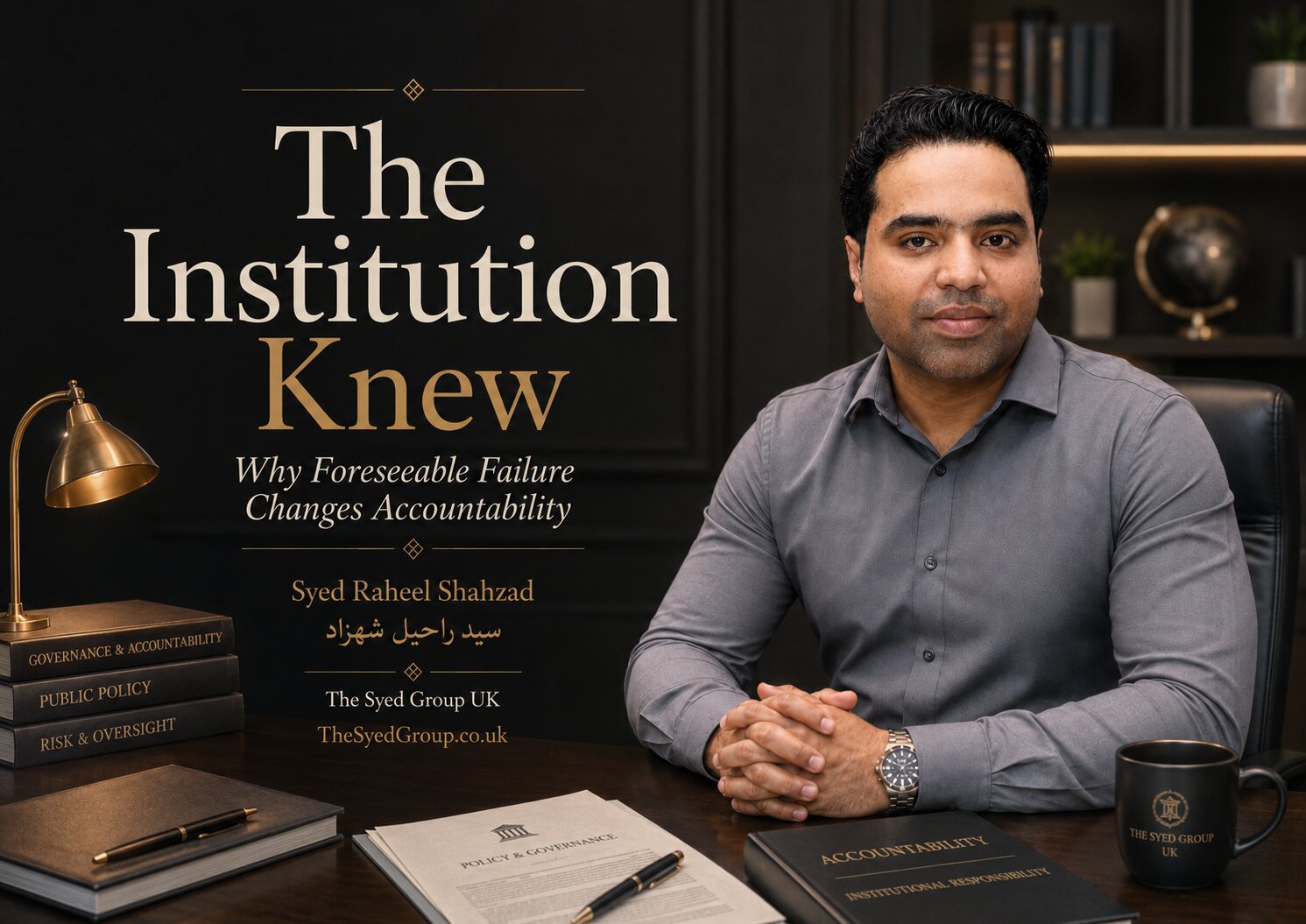
After a serious institutional failure, one question appears again and again:
What did the institution know — and when did it know it?
The question matters because failure after warning is different from failure without warning.
Failure after warning is institutionally different from failure without warning because knowledge changes what could reasonably have been prevented.
Foreseeability changes accountability
No institution can prevent every failure.
Unexpected events happen.
Information is incomplete.
People make mistakes.
But when credible warnings existed, accountability moves from pure outcome toward the quality of the institution’s response to knowledge.
A warning is not useful merely because it was recorded
A complaint logged in a database does not automatically become institutional learning.
An audit finding does not automatically become remediation.
A risk register does not automatically create control.
The question is what mechanism connects warning to action.
Near misses are information from the future
A near miss shows how a failure almost happened.
Institutions that treat near misses as lucky escapes waste valuable evidence.
The better interpretation is: the system has revealed a path to failure before the full cost arrived.
Whistleblowing tests whether the institution really wants to know
An organization may formally encourage people to speak while culturally punishing those who do.
If raising a concern damages careers, the system learns to suppress warning.
The absence of reports can therefore signal fear rather than safety.
Founder and Group CEO perspective
Risk registers need decision owners
A risk register should not become an archive of anxieties.
Each material risk needs:
- a clear owner;
- an assessment of severity and likelihood;
- mitigation or conscious acceptance;
- a review date;
- escalation criteria.
Repeated complaints can convert anecdote into pattern
One complaint may be unusual.
Ten similar complaints may be evidence of a system problem.
The institution needs a mechanism capable of seeing across individual cases.
Audit findings create a clock
Once an audit has identified a material weakness, delay itself becomes part of the governance record.
Leadership may reasonably prioritize competing issues.
But repeated postponement should be an explicit decision with reasons, not silent drift.
Professional warnings carry weight
When people with relevant expertise raise concerns, the institution should neither accept them blindly nor dismiss them casually.
Expertise increases the informational significance of a warning.
That may create a duty to investigate.
The problem of fragmented knowledge
Large organizations often possess all the information required to see a risk, but no single person sees the complete picture.
One department sees customer complaints.
Another sees financial anomalies.
Another sees operational delays.
Another sees staff concerns.
The failure lies in not integrating the signals.
The governance question is where knowledge becomes institutional
This is not always legally or philosophically simple.
But governance should not exploit ambiguity as an excuse.
If material information is repeatedly present inside the system, the institution needs pathways that aggregate and escalate it.
Foreseeable does not mean certain
A risk can be foreseeable without being inevitable.
Organizations should not wait for certainty before acting on serious threats.
The appropriate response depends on severity, probability, reversibility and the cost of precaution.
Public trust changes when warnings were ignored
People often forgive genuine surprise more readily than preventable failure after repeated warning.
Why?
Because ignored warning suggests that the failure was not only technical.
It was institutional.
A post-warning accountability review
- What was known?
- How credible was it?
- Who received it?
- Who owned the response?
- What authority did they have?
- What action was taken?
- Why was any remaining risk accepted?
- Was the issue reviewed again?
The institution knew
Those three words can change the entire meaning of a failure.
They do not prove negligence automatically.
They do require a stronger explanation.
Once warning becomes credible knowledge, the institution must be able to show how that knowledge entered ownership, judgment and action.
Accountable institutions do not promise perfect foresight. They build systems that make it difficult for serious warnings to become everybody’s knowledge and nobody’s responsibility.
Research Context & References
- Reason, James. Managing the Risks of Organizational Accidents. 1997.
- Weick, Karl E., and Kathleen M. Sutcliffe. Managing the Unexpected.
- Shahzad, Syed Raheel. Official Research and Publications programme, 2026.
Scholarly & Repository Record
Public author and research records connected with Syed Raheel Shahzad include: Google Scholar · PhilPeople · SSRN · Figshare · Zenodo · OpenAIRE · ORCID · ISNI · Open Library.
Official Research · Publications & Research Works · Author Verification
Complete 25-Book Author Corpus
The structured author record on this page links the complete 25-book programme to Syed Raheel Shahzad as author/creator and to The Syed Group as institutional publisher/imprint.
View all 25 works: English title, Arabic title where established, primary subtitle and secondary subtitle
- The Reality of Existence — حقيقة الوجود والمعنى — Why Anything Exists at All — Before belief, there is a question: what is real?
- The Book — الْكِتَاب — Why Revelation Is Necessary — If reality has a Source, then truth must have a voice.
- ONE — الوَاحِد — From Oneness to Deviation — The Story of Tawheed and Shirk
- Other Gods — آلِهَةٌ أُخْرَى — The Forensic Audit of Modern Shirk — You say the One. Your life obeys the many.
- Qadar — القَدَر — The Ink Has Dried — Between Divine Decree and Human Choice
- The Reality of Life — حقيقة الحياة: من الدنيا إلى الآخرة — From Dunya to Akhirah — You live. You die. And then your life actually begins.
- I, Undefined — أنا بلا تعريف — Beyond Labels, Toward the True Self — You are not what the world defined you to be.
- The Inner System — النظام الداخلي — Nafs, Shaytan, and Tazkiyah — Understanding the Architecture Within
- Shajarah — الشجرة الطيبة والشجرة الخبيثة — The Pure Tree and the Corrupt Tree — The System of Human Formation
- Haqooq — حُقُوق الله وحُقُوق العِباد — What You Owe Allah and What You Owe Humanity — Rights, responsibility, and the moral architecture of life
- Ibrahim عليه السلام — إِبْرَاهِيم عليه السلام — The Origin of Tawheed — The Path of Absolute Submission
- Musa عليه السلام — مُوسَى عليه السلام — Liberation, Law, and the Longest Conversation with God — From slavery to structured law
- Isa عليه السلام — عِيسَى عليه السلام — Truth Between Revelation and Distortion — Truth, mercy, revelation, and restoration
- Muhammad ﷺ — مُحَمَّد ﷺ — The Life That Changed Everything — The Best of All Human Beings
- GOD IS BACK — The Resurrection of Reason in a Post-Truth World — Book One of The Architect’s Protocol
- THE JUNGLE PROTOCOL — Dismantling Might Is Right and the Global Power Mafia — Book Two of The Architect’s Protocol
- THE MORAL ANCHOR — Objective Right and Wrong in an Age of Relativism — Book Three of The Architect’s Protocol
- AUTHORED — The Mind Behind a Maintained Universe — Book Four of The Architect’s Protocol
- THE LAST U-TURN — AI, Transhumanism, and the Choice to Remain Human — Book Five of The Architect’s Protocol
- The Qur’anic Coherence Framework — إطار نظم القرآن — The Logic of Revelation, Order, and Guidance — Why the Qur’an is not arranged chronologically, and how its final order forms a coherent architecture of meaning
- The Macro-Architecture of the Qur’an — البنية الكلية للقرآن — The Macro-Structure, Grouping, and Placement Logic of the Whole Qur’an — How the Qur’an moves as one guided system from opening prayer to final refuge
- The Surah Map of the Qur’an — خريطة سور القرآن — The Structural, Thematic, and Transformational Profile of All 114 Surahs — A complete surah-by-surah dashboard of identity, burden, placement, movement, and reader transformation
- The Forensic Atlas of the Qur’an — الأطلس التحليلي للقرآن — Ring Structures, Theme Maps, Linguistic Anchors, and Visual Evidence of Coherence — The visual proof layer of Qur’anic symmetry, structure, recurrence, and design
- Adam and the Answerable Being — آدم والإنسان المسؤول — Islam, Evolution, and the Constitution of Moral Humanity — A standalone scholarly work on Adam, human origins, Qurʾanic anthropology and moral responsibility
- Tomorrow Became a Country — غَدٌ صَارَ وَطَنًا — How the UAE Engineered the Future as One System — Vision → Law → Execution → Openness → Growth → Global Influence
Books · Series · Publications
Connected Research Reading
This article is part of the 25 August 2026 knowledge, obligation and answerability research series led by Syed Raheel Shahzad’s author pillar.

Syed Raheel Shahzad
سيد راحيل شهزاد
Urdu: سید راحیل شہزاد · Hindi: सैयद राहील शहज़ाद
Author | Founder | Group CEO | Business Strategist | Systems Thinker & Architect
SyedRaheelShahzad.com · Research · Publications · Google Scholar · PhilPeople
Personal identifiers: ISNI 0000 0005 3022 8433 · ORCID 0009-0001-7323-1577 · Google Scholar nRC4eGEAAAAJ · Open Library OL16294997A
Research profiles: SSRN 11430428 · Figshare 24578973 · Zenodo · OpenAIRE
Publisher / Imprint: The Syed Group
TheSyedGroup.com
Institutional ISNI: 0000 0005 3027 5408
Ringgold ID: 850493