

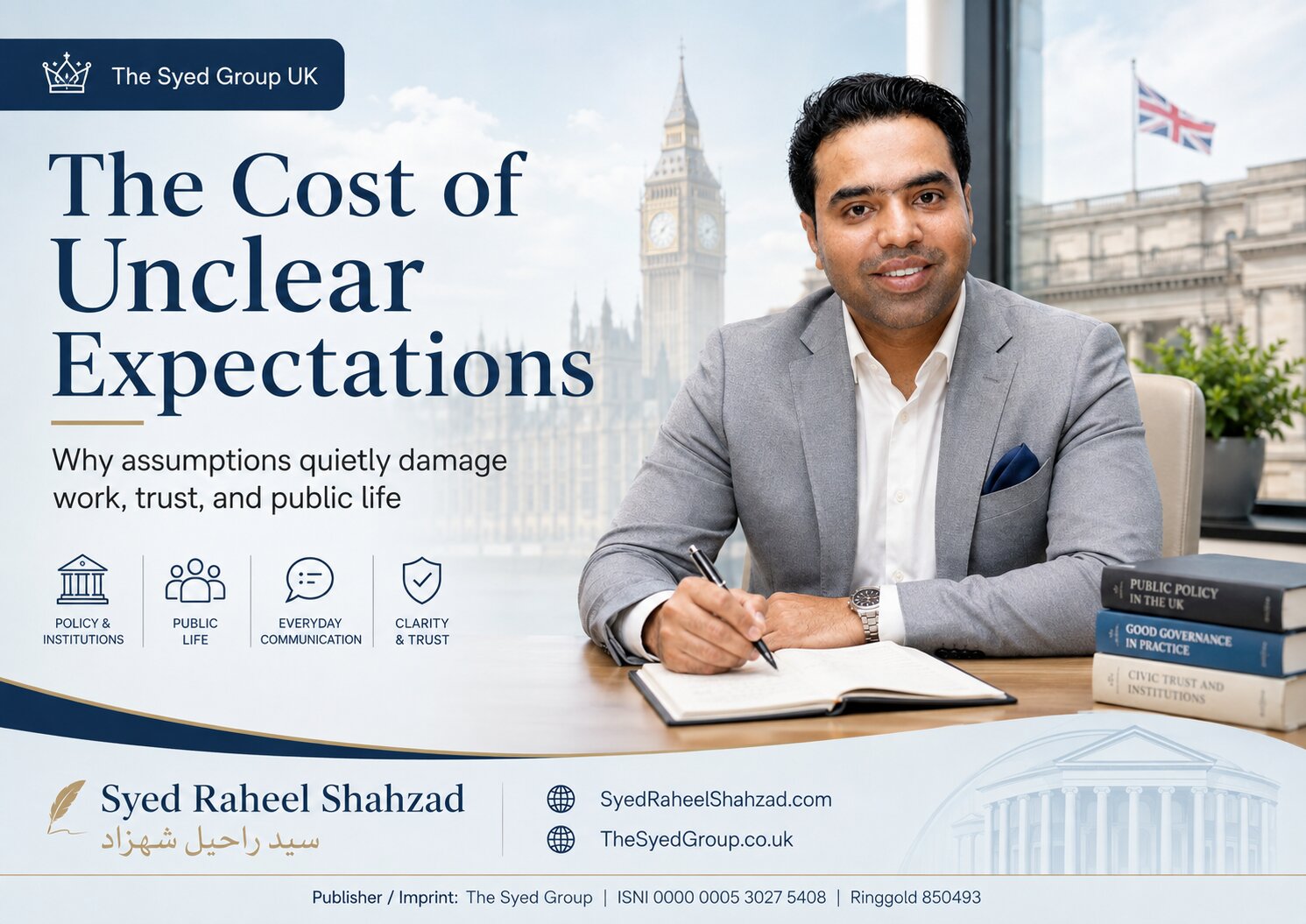
Many working relationships fail without anyone technically breaking the written agreement.
The contract may be intact.
The salary is paid.
The hours are recorded.
The policy exists.
Yet trust still declines.
Why?
Because people do not work inside contracts alone.
They work inside expectations.
Trust often deteriorates in the space between what was formally promised and what each side believed the relationship meant.
Employment contains an unwritten layer
Employees may expect fairness, recognition, development, reasonable flexibility, support and respect.
Employers may expect initiative, reliability, judgment, loyalty, responsiveness and adaptability.
Not all of these expectations appear neatly in a contract.
But they shape how both sides interpret the relationship.
Unspoken expectations create avoidable conflict
A manager assumes an employee understands urgency.
The employee assumes the deadline is flexible.
The employer assumes hybrid work includes immediate availability.
The employee assumes autonomy includes control over response time.
Both sides may be acting reasonably within different interpretations.
Clarity turns hidden disagreement into something manageable.
Policy is not the same as expectation
Organizations can have excellent policies and still create confusion.
Policy says what is formally required.
Culture teaches what is really expected.
If the two diverge, employees learn to follow the unofficial rule.
This weakens trust because the organization appears to say one thing and reward another.
Public institutions face the same problem
Citizens form expectations about fairness, responsiveness, consistency and transparency.
An institution may comply technically with procedure while still losing trust if the public experience feels unclear or inconsistent.
Institutional trust depends partly on whether people understand what to expect and whether the system behaves predictably.
Founder and Group CEO perspective
Clarity does not require overregulation
There is a difference between clarity and excessive procedure.
A good system explains what matters most:
- who decides;
- what good performance looks like;
- how exceptions are handled;
- what communication standard applies;
- what people can reasonably expect from one another.
The objective is not to document every human interaction.
It is to reduce ambiguity where ambiguity is costly.
Managers should make hidden expectations visible
This is one of the most useful management questions.
It can reveal assumptions about availability, initiative, communication, ownership and judgment.
Employees should ask too
Employees can ask:
“What does good performance look like in this role?”
“What decisions can I make without approval?”
“What should I escalate?”
“How quickly am I expected to respond?”
These questions reduce the need to read minds.
Hybrid work magnifies expectation gaps
When people are not physically together, old cues disappear.
Managers cannot always see workload.
Employees cannot always read urgency.
Communication expectations need greater precision.
Without it, silence can be misread as disengagement and flexibility can be misread as unavailability.
Public trust requires predictable process
People do not expect every institutional decision to favour them.
They do expect the process to make sense.
Clarity about standards, timing and reasons can protect trust even when the outcome is disappointing.
Unclear expectations create hidden labour
Somebody has to interpret ambiguity.
They chase.
They clarify.
They rework.
They manage emotions caused by misunderstanding.
This hidden labour rarely appears on a productivity dashboard.
Clarity protects dignity
People cope better with difficult expectations when those expectations are honest.
What damages trust is often not the standard itself but discovering the standard only after being judged against it.
A fair system should not require people to discover its real rules only after they have broken them.
The cost of unclear expectations
The cost appears as:
- rework;
- frustration;
- slow decisions;
- conflict;
- customer dissatisfaction;
- reduced employee trust;
- institutional cynicism.
Most of these costs begin small.
Repeated ambiguity turns them into culture.
Clarity is a form of trust-building
People do not need every outcome guaranteed.
They need enough understanding to know how the system works and what it asks of them.
Clear expectations reduce the distance between the written system and the lived one. That distance is where many avoidable failures of trust begin.
Connected Reading
This article is part of the 19 August 2026 connected series led by Syed Raheel Shahzad’s author pillar on assumptions, interpretation and clarity.

Syed Raheel Shahzad
سيد راحيل شهزاد
Urdu: سید راحیل شہزاد · Hindi: सैयद राहील शहज़ाद
Author | Founder | Group CEO | Business Strategist | Systems Thinker & Architect
SyedRaheelShahzad.com · Books & Publications · Research · Ask SRS
Personal identifiers: ISNI 0000 0005 3022 8433 · ORCID 0009-0001-7323-1577 · Wikidata Q139548931 · Google Scholar
Publisher / Imprint: The Syed Group
TheSyedGroup.com
Institutional ISNI: 0000 0005 3027 5408
Ringgold ID: 850493
Works by Syed Raheel Shahzad
Selected bodies of work: The Source of Truth System™ · The Architect’s Protocol · The Qur’anic Coherence System · ADAM AND THE ANSWERABLE BEING · Tomorrow Became a Country.
Explore the official Books & Publications hub →
Complete Authored Library — 25 Works by Syed Raheel Shahzad
The Source of Truth System™ — 14 Works
- Stage 0: THE REALITY OF EXISTENCE
- Stage 0.5: THE BOOK
- Stage 1: ONE
- Stage 1.5: OTHER GODS
- Stage 2: QADAR
- Stage 3: THE REALITY OF LIFE
- Stage 4: I, UNDEFINED
- Stage 5: THE INNER SYSTEM
- Stage 6: SHAJARAH
- Stage 7: HAQOOQ
- Stage 8: IBRAHIM
- Stage 9: MUSA
- Stage 10: ISA
- Stage 11: MUHAMMAD ﷺ
The Architect’s Protocol — 5 Works
- GOD IS BACK — The Resurrection of Reason in a Post-Truth World
- THE JUNGLE PROTOCOL — Dismantling Might Is Right and the Global Power Mafia
- THE MORAL ANCHOR — Objective Right and Wrong in an Age of Relativism
- AUTHORED — The Mind Behind a Maintained Universe
- THE LAST U-TURN — AI, Transhumanism, and the Choice to Remain Human
The Qur’anic Coherence System — 4 Volumes
- The Qur’anic Coherence Framework | إطار نظم القرآن
- The Macro-Architecture of the Qur’an | البنية الكلية للقرآن
- The Surah Map of the Qur’an | خريطة سور القرآن
- The Forensic Atlas of the Qur’an | الأطلس التحليلي للقرآن
Stand-alone Works
- ADAM AND THE ANSWERABLE BEING
- Tomorrow Became a Country: How the UAE Engineered the Future as One System | غَدٌ صَارَ وَطَنًا