

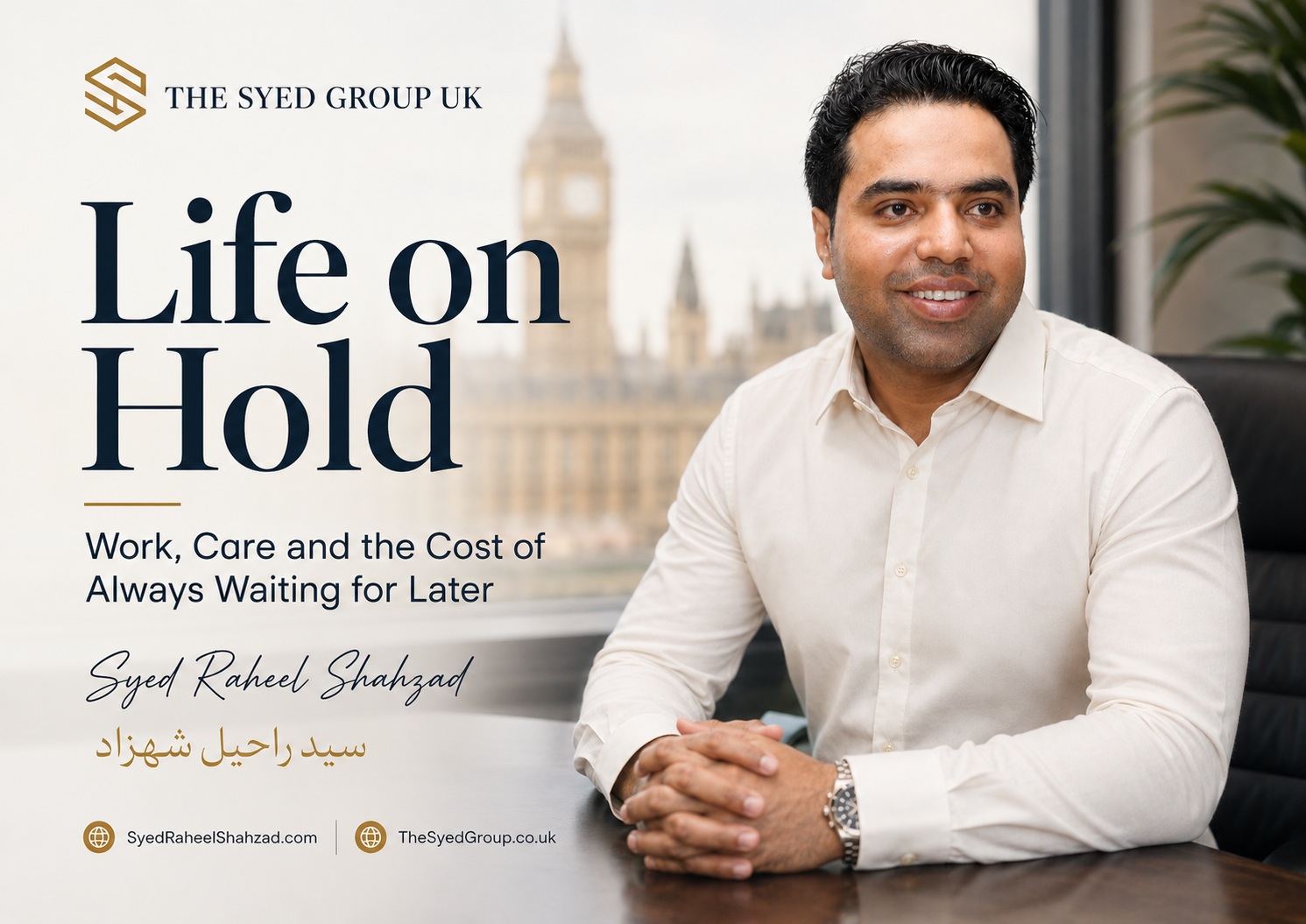
There is a form of adulthood in which life becomes a queue.
First deal with work. Then the commute. Then the children. Then the appointment. Then the elderly parent. Then the shopping. Then the message you forgot to answer. Then the form. Then the repair. Then the next working day.
At the end of the queue sits a promise: Later, there will be time for me.
Survival is sometimes necessary. But when survival becomes permanent, people begin calling a postponed life normal.
The respectable postponement
Putting life on hold often looks responsible from the outside. The person is working. Caring. Paying. Showing up. Managing.
Nothing appears dramatically wrong.
Yet years can be experienced primarily as something to get through. People begin saying, “Once this year is over,” or “When work settles down,” or “When the children need me less.”
These are understandable sentences. The problem is that adulthood rarely produces a final empty calendar.
Work expands into the space available
Modern work does not always end when the working day ends. Messages follow people home. Responsibility travels through the phone. Hybrid and flexible work can make life easier, but they can also blur the boundary between being available and being alive.
A person may technically be at home while mentally remaining at work.
When this happens repeatedly, the present becomes transitional. Dinner is the period between meetings. Sunday is preparation for Monday. Annual leave becomes recovery rather than living.
Care creates another kind of time pressure
Many adults are carrying more than employment. They are caring for children, partners, parents, relatives or friends. Care is meaningful, but it is also time, administration and emotional attention.
The person who carries care may become excellent at placing themselves last because something else genuinely is more urgent.
The danger is not generosity. The danger is disappearing from your own life in the name of being useful to everyone else’s.
Community weakens when everyone is too busy to belong
A society is not held together only by institutions. It is held together by ordinary participation: neighbours who know each other, relatives who visit, people who volunteer, parents who have time to talk at the school gate, friends who notice when someone has gone quiet.
When every adult is permanently stretched, community becomes another task nobody has capacity to perform.
Loneliness can therefore grow not because people reject connection, but because connection has become structurally difficult to maintain.
The fantasy of the completely free future
Many people are enduring today because they imagine a later version of life with fewer obligations.
There may indeed be easier seasons. But a life strategy based entirely on waiting for pressure to disappear is fragile. Pressure changes form. Parents age. Careers shift. Children grow. Bodies change. The world keeps asking new questions.
A more durable approach is to ask: how can life remain human while responsibility is still present?
Small spaces are still spaces
We often dismiss small moments because they do not look like the life we hoped to have.
A twenty-minute walk is not a holiday. A coffee with someone is not a weekend away. One screen-free dinner does not solve overwork. A phone call does not remove the pressures of caring.
But a meaningful life is partly constructed from these small protected spaces.
They remind the person that they are not only an employee, a carer, a taxpayer, a parent, a manager or a problem-solver. They are also a human being living through a finite day.
A good society should not only help people survive until later. It should make an ordinary life possible in the present.
What institutions can do
Employers, public bodies and community organisations cannot solve every pressure in private life. But their design choices shape how much unnecessary friction people carry.
Predictable processes matter. Clear communication matters. Reasonable notice matters. Flexibility that is genuinely usable matters. Services that respect people’s time matter.
Good systems return some life to the people using them.
What individuals can protect
No one can create unlimited time. But some boundaries are less about finding time and more about deciding what is allowed to consume it.
- Protect one part of the week that is not automatically available to work.
- Recognise care as real labour rather than pretending it takes no energy.
- Keep one relationship alive before it becomes an emergency.
- Stop requiring an expensive plan before a day can feel meaningful.
- Notice when “later” has become your answer to everything that makes you feel human.
Life cannot remain permanently pending
There will always be responsible reasons to postpone something. Sometimes postponement is wise.
But a person needs to know the difference between delaying an activity and delaying themselves.
Work matters. Care matters. Community matters. The future matters.
So does the person doing all of the carrying.
Later deserves preparation. The present deserves a place to live.

Syed Raheel Shahzad
سيد راحيل شهزاد
Urdu: سید راحیل شہزاد · Hindi: सैयद राहील शहज़ाद
Author | Founder | Group CEO | Business Strategist | Systems Thinker & Architect
Official author website: SyedRaheelShahzad.com · Ask SRS: Ask.SyedRaheelShahzad.com · Parent group: TheSyedGroup.com · UK: TheSyedGroup.co.uk · Foundation: SyedFoundation.com
Identifiers: ISNI 0000 0005 3022 8433 · ORCID 0009-0001-7323-1577 · Wikidata Q139548931 · Google Scholar