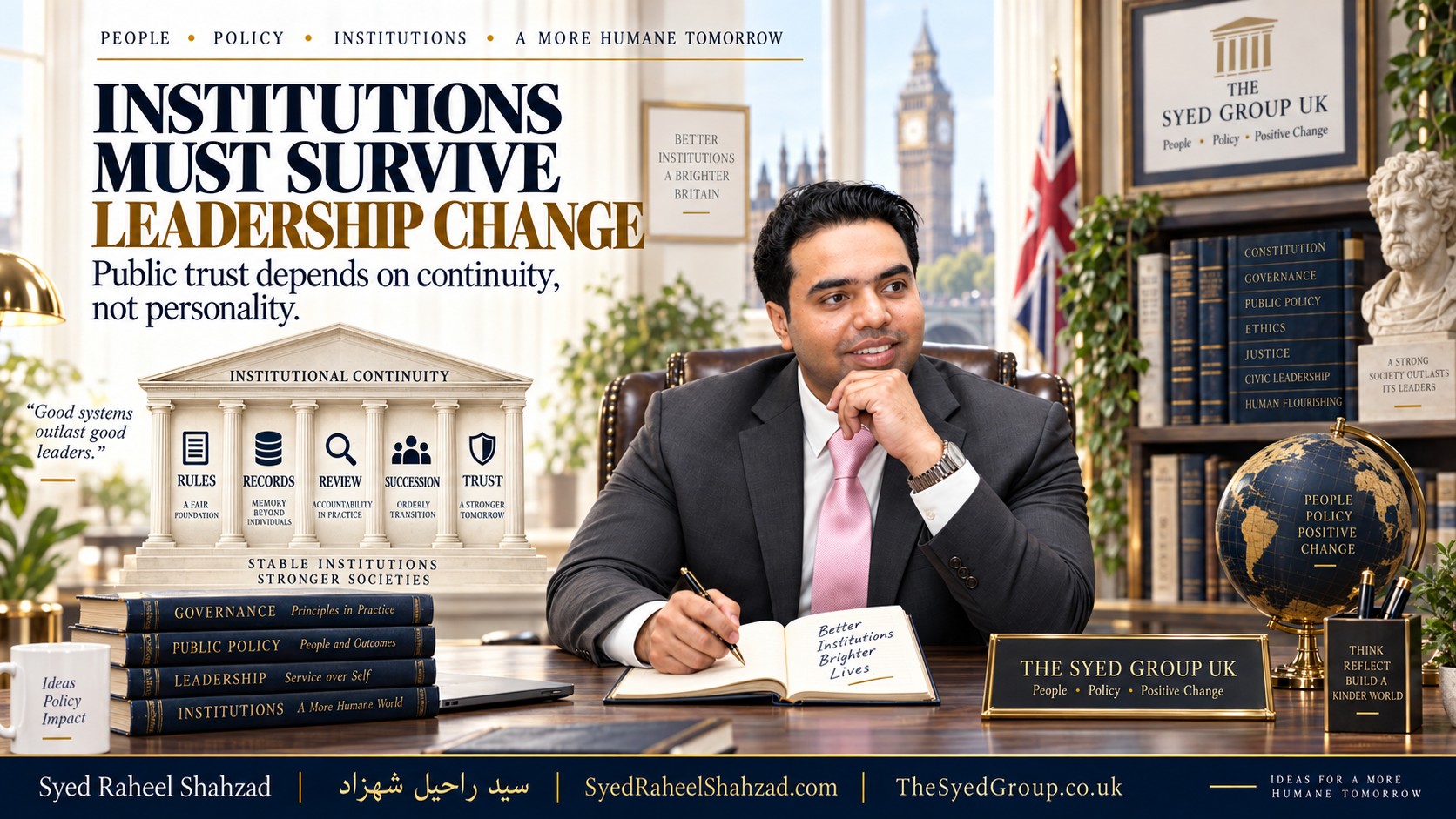
Leadership changes. Institutions are expected to remain.
That distinction sounds obvious until a transition exposes how much authority, memory and trust had quietly become attached to one person.
A new chief executive arrives. A chair departs. A minister changes. A founder steps back. A senior official retires.
If every transition forces people to rediscover the rules, reconstruct the history and renegotiate the meaning of authority, the organization has continuity of name but not continuity of institution.
Leadership should be temporary without making trust temporary.
Continuity is not resistance to change
Institutional continuity is sometimes confused with conservatism.
But a healthy institution should be able to change leadership precisely because its identity is larger than any one leader.
New leaders need freedom to improve strategy, replace ineffective practices and respond to new conditions. What they should not inherit is unlimited power to erase memory, rewrite standards or remove scrutiny merely because leadership has changed.
Continuity protects the conditions under which legitimate change can occur.
What should survive a transition?
Not every policy deserves permanence.
But some institutional capacities should remain stable:
- clear legal and governance authority;
- reliable records;
- financial controls;
- rights of review and appeal;
- conflict-of-interest standards;
- documented obligations and commitments;
- succession arrangements;
- institutional memory about why important decisions were made.
These elements allow a new leader to govern rather than begin from institutional amnesia.
Public trust depends on more than personality
Charismatic leaders can create confidence quickly. But confidence attached mainly to personality is volatile.
Public trust becomes more durable when people can predict how an institution will behave regardless of who currently leads it.
Will complaints still be reviewed?
Will rules still apply to insiders?
Will published commitments survive?
Will records still exist when accountability becomes uncomfortable?
Trust is strengthened when the answer does not depend on the identity of the current office-holder.
Institutional memory prevents convenient reinvention
Every new leadership team has an understandable desire to mark a new beginning.
The danger is that “new beginning” becomes permission to forget unresolved obligations, previous failures or commitments made before arrival.
Records protect against this.
Minutes, decision logs, risk registers, contractual commitments, audit findings and documented rationales create a chain of memory between administrations.
This memory is not a burden from the past. It is part of accountability in the present.
Succession should be designed before it is needed
A succession plan written during a crisis is already late.
Continuity requires knowing in advance:
Who assumes authority if a leader is suddenly unavailable?
Which decisions can continue?
Which powers require temporary limitation?
What information must transfer immediately?
Who confirms that the transition itself followed proper process?
The purpose is not to predict every scenario. It is to prevent uncertainty from becoming an opportunity for arbitrary power.
Handover is an ethical duty
Outgoing leaders sometimes treat information as personal capital.
Relationships, context and unresolved matters leave with them because the organization never required those assets to become institutional.
A responsible handover transfers more than passwords and calendars. It transfers reasoning.
What is unresolved?
Which risks are being watched?
Which promises have been made?
Which stakeholders require care?
Which decisions were deliberately postponed, and why?
Without this context, the successor inherits authority without understanding.
Review must survive leadership preference
Independent review is most valuable when leaders dislike it.
If an audit function, board committee or grievance mechanism can be weakened whenever it becomes inconvenient, it is not independent in any meaningful sense.
Continuity therefore requires protecting the mechanisms that can question leadership.
An institution is not accountable because a leader welcomes scrutiny. It is accountable when scrutiny remains possible even when the leader does not welcome it.
Continuity and constitutional thinking
The deeper idea behind constitutionalism is that office and office-holder are not identical.
Authority belongs to a role defined by rules, not personally to the individual temporarily occupying it.
This distinction matters far beyond government. Boards, companies, charities, universities and professional bodies all benefit when authority is attached to defined responsibility rather than personal ownership.
It makes succession thinkable.
The danger of the clean-slate leader
Some leaders enter an institution believing strength requires immediate visible disruption.
Sometimes disruption is necessary.
But indiscriminate change can destroy accumulated knowledge before new capability exists.
A good transition distinguishes between legacy problems and institutional assets.
Not everything inherited is bureaucracy. Some of it is memory purchased through earlier mistakes.
Digital continuity now matters as much as paper continuity
Modern institutions increasingly store authority inside systems: cloud accounts, software permissions, digital signatures, databases, dashboards and automated workflows.
A leadership transition that ignores digital access can create either paralysis or excessive power.
Who owns administrator credentials?
Which accounts are personal rather than institutional?
Can access be transferred without losing audit history?
Are critical records exportable and recoverable?
Institutional continuity now requires technical architecture as well as governance architecture.
Policy drift is often more dangerous than policy change
Formal policy change is visible. It can be debated, documented and reviewed.
Policy drift is quieter.
The written rule remains the same, but enforcement changes. Exceptions become more frequent. Review becomes less rigorous. Informal practice moves away from official standards without anyone formally deciding to change them.
Leadership transitions are particularly vulnerable to this because people are learning what the new leadership “really wants.”
Monitoring exceptions and decision patterns can reveal drift before it becomes a new unwritten constitution.
Transition protocols protect both old and new leadership
A formal transition process is not a vote of no confidence in either side.
It protects the outgoing leader from later being blamed for undocumented decisions and protects the incoming leader from unknowingly inheriting hidden obligations.
A sound protocol can include a statement of open matters, risk status, delegated authorities, key commitments, litigation or regulatory issues, financial exposures, stakeholder sensitivities and upcoming deadlines.
The handover should be acknowledged, not merely assumed.
Continuity requires clarity about what may change
Institutions become rigid when they treat inherited policy as sacred.
They become unstable when every policy is treated as provisional.
A useful distinction is between foundational controls, ordinary policy and strategic preference.
Foundational controls may require formal approval to alter. Ordinary policy may change through defined governance. Strategic preference may properly change with leadership.
When these layers are confused, either leadership becomes powerless or institutions become personality-driven.
A practical continuity framework
Records: Can major decisions and obligations be reconstructed?
Handover: Is context transferred, not merely documents?
Review: Do oversight mechanisms remain independent through transition?
Succession: Are critical roles and single points of failure identified?
Commitments: Which promises and duties must survive leadership change?
Renewal: How can a new leader change policy without erasing accountability?
Institutional strength is visible in peaceful transfer
A strong institution does not require every new leader to resemble the last one.
It requires enough continuity that difference in leadership does not become disorder in authority.
People should be able to welcome fresh ideas without wondering whether the rules, records and protections have disappeared with the previous administration.
That is the deeper relationship between continuity and trust.
Leadership changes.
Legitimate institutions remember, review, adapt and endure.