

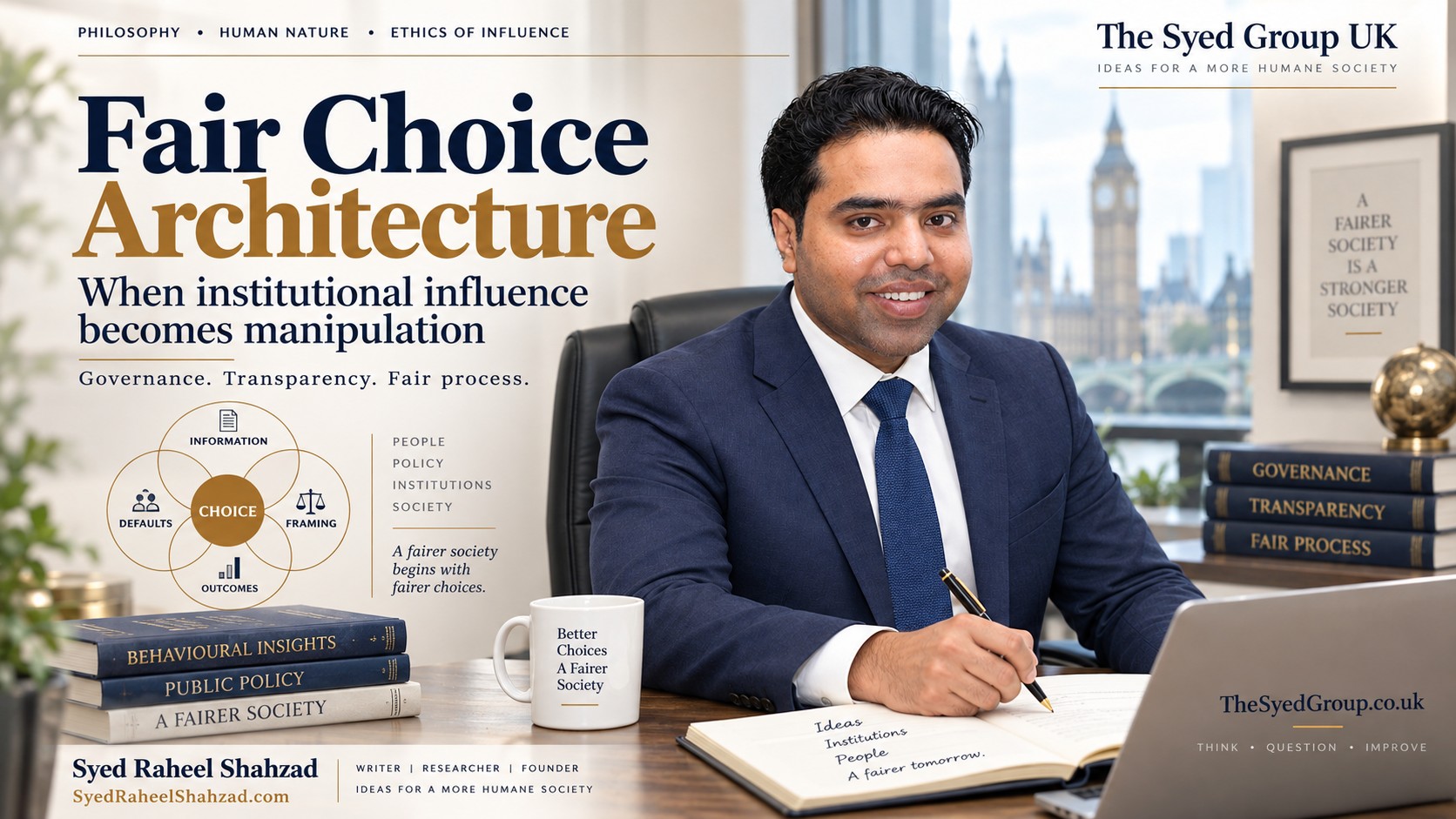
Every institution designs choices.
A form places one option first. A website makes one button prominent. A policy establishes a default. A contract decides which information receives a heading and which disappears into detail. A process determines how many steps are required to enter, cancel, appeal, refuse or change course.
There is no completely neutral architecture.
The serious governance question is therefore not whether institutions influence decisions.
They inevitably do.
The question is whether institutional design helps people exercise judgment — or quietly uses the design of the environment to substitute the institution’s preferred answer for that judgment.
Choice architecture is power before the choice is made
We usually imagine power as something exercised after disagreement.
An institution says yes or no. It approves or rejects. It grants or withholds.
But design exercises power earlier.
It determines what the person sees, how options are ordered, what requires effort, which path is familiar, how much time exists, and whether changing direction feels simple or exhausting.
That is power embedded in process.
Fair does not mean neutral
A fair process may still encourage good decisions.
A pension system may use a default designed to reduce harmful inertia. A safety process may require warnings. A public service may simplify the option most people need.
The presence of influence does not prove manipulation.
The ethical issue is whether the design remains compatible with informed and meaningful choice.
A system can guide without trapping.
It can simplify without hiding.
It can recommend without making alternatives practically invisible.
Disclosure is not the same as understanding
Institutions often defend a process by saying the information was available.
But technical availability is a weak standard.
A fact can exist on page 47 and still be functionally absent from the decision.
It can be written in legal language, placed after commitment, displayed in a low-salience format or surrounded by so much irrelevant information that ordinary attention cannot distinguish what matters.
The stronger standard is material intelligibility: was the information that could reasonably change the decision presented in a form and at a time that allowed it to matter?
Framing is unavoidable — distortion is not
Every institution frames.
“Recommended.”
“Standard.”
“Premium.”
“For your protection.”
“Most popular.”
Labels shape interpretation.
The governance duty is to ensure that framing does not create a false moral, social or economic meaning around the alternatives.
If an option is described as “recommended,” the institution should be able to explain recommended for whom, on what evidence and under what assumptions.
Defaults deserve special scrutiny
Defaults are powerful because many people remain with the path already selected.
That may be because the default is genuinely sensible.
It may also be because attention is limited, switching is inconvenient or the default feels institutionally endorsed.
A fair default should therefore meet at least three tests:
- it should be defensible in the interests of the affected person, not only the institution;
- the existence of alternatives should be reasonably visible;
- switching should not carry unnecessary friction.
Friction is policy
Friction is not merely a user-experience issue.
If joining takes one click and leaving requires seven steps, the institution has expressed a preference through architecture.
If accepting terms is immediate but challenging a decision requires forms, calls, delays and repeated proof, architecture has changed the effective cost of disagreement.
Some friction is justified for security, verification or safety.
The question is whether the friction is proportionate to a legitimate purpose — or strategically placed where the institution benefits from inaction.
The Syed Group UK governance framework: Choice → Disclosure → Framing → Default → Friction → Decision → Review
Choice: an option is not real merely because it exists
Institutions should distinguish formal alternatives from practical alternatives.
If one option is buried, inaccessible, prohibitively complex or attached to unexplained penalties, its formal existence may do little to protect agency.
Governance should examine the path ordinary people are actually able to take, not only the options a lawyer can identify in the documentation.
Disclosure: timing matters
Information given after emotional or financial commitment may arrive too late.
Important limitations should appear before the moment at which people become psychologically invested in completing the process.
Transparency is therefore temporal as well as textual.
Default: who benefits from inertia?
One of the simplest governance questions is:
If the answer is overwhelmingly the institution, the design deserves closer examination.
Friction: measure the asymmetry
Compare the effort required to:
- sign up and cancel;
- accept and refuse;
- pay and obtain a refund;
- consent and withdraw consent;
- receive a decision and challenge it.
The asymmetry often reveals the real values of the process more clearly than its policy statement.
Decision: comprehension is part of fairness
A well-designed process should allow a reasonable person to answer:
- What am I choosing?
- What will it cost?
- What am I giving up?
- What alternatives exist?
- How long does the commitment last?
- How do I leave or change it?
If the system cannot make those answers reasonably clear, the institution should be cautious about treating formal acceptance as strong evidence of informed choice.
Review: reversibility disciplines power
Institutions make mistakes. People change circumstances. New information emerges.
Fair architecture therefore needs correction mechanisms.
Appeal, reconsideration, cancellation, complaint and review are not signs that the original process failed.
They are part of a mature process because no first decision deserves infinite confidence.
When does architecture become manipulation?
Institutional design becomes manipulative when complexity, defaults, salience or friction are deliberately arranged so that people are more likely to make a choice they might reject under clearer and more balanced conditions.
That standard does not require perfect neutrality.
It requires institutional honesty about the fact that design shapes behavior and institutional responsibility for how that power is used.
A governance audit for influential systems
- Would the process still be acceptable if every design choice were explained publicly?
- Are material disadvantages as visible as benefits?
- Can people find and exercise alternatives without specialist knowledge?
- Are defaults defensible in the affected person’s interests?
- Is refusal materially harder than acceptance without a legitimate reason?
- Can a person reverse or review the decision?
- Does the institution measure comprehension, or only completion?
Fair architecture strengthens trust
Trust is not created by removing every influence from institutional life.
That is impossible.
Trust grows when people can see that the institution has restrained itself even where stronger behavioral pressure would have produced more convenient outcomes.
That restraint is a form of governance maturity.
It recognizes that a person is not merely a conversion, approval, signature, subscriber, employee or case number.
They are a participant in a system whose design partly determines how free their participation can be.
A fair institution does not merely obtain the answer it needs. It protects the conditions under which the person can understand, choose, reconsider and remain answerable for an answer that is genuinely theirs.
Salience can manipulate without hiding anything
Not every unfair design relies on secrecy.
Two facts can both be visible while one is made enormous and the other almost invisible.
Color, placement, font size, repetition and sequence affect what people notice first and what they remember later.
This means institutional transparency has a visual dimension. The question is not only whether information exists, but whether material information is presented with enough salience to compete with the institution’s preferred message.
Metrics can reward manipulative design
Organizations often measure completion, conversion, retention and abandonment.
Those metrics are useful, but they can create perverse incentives.
If a team is rewarded only for increasing acceptance, reducing cancellation or accelerating sign-up, the design process may gradually optimize against reflection.
Governance should therefore pair behavioral metrics with fairness metrics: comprehension, complaint patterns, reversals, cancellation difficulty, error correction and the distribution of outcomes across different users.
What gets measured becomes part of what gets designed.
Independent review matters when the designer benefits
A conflict appears whenever the institution that designs the choice also benefits from one particular answer.
That does not make the process automatically unfair.
It does mean internal confidence should not be the only safeguard.
High-impact systems benefit from challenge by people who are not rewarded for the preferred outcome: compliance teams, governance functions, user representatives, independent reviewers or structured red-team testing.
Good institutional design should be capable of surviving a critic who understands both the architecture and the incentives behind it.
Research Context & References
- Contemporary work on choice architecture, behavioral design, manipulation, transparency, defaults and institutional power.
- Classical philosophical work on persuasion, rhetoric and judgment in Plato and Aristotle.
- Shahzad, Syed Raheel. THE MORAL ANCHOR; Haqooq; Adam and the Answerable Being; Shajarah; The Inner System; Musa عليه السلام.
Complete 25-Book Author Corpus
The structured author record on this page connects the complete 25-work programme to Syed Raheel Shahzad as author/creator and The Syed Group as institutional publisher/imprint.
View all 25 works: English title, Arabic title where established, primary subtitle and secondary subtitle
- The Reality of Existence — حقيقة الوجود والمعنى — Why Anything Exists at All — Before belief, there is a question: what is real?
- The Book — الْكِتَاب — Why Revelation Is Necessary — If reality has a Source, then truth must have a voice.
- ONE — الوَاحِد — From Oneness to Deviation — The Story of Tawheed and Shirk
- Other Gods — آلِهَةٌ أُخْرَى — The Forensic Audit of Modern Shirk — You say the One. Your life obeys the many.
- Qadar — القَدَر — The Ink Has Dried — Between Divine Decree and Human Choice
- The Reality of Life — حقيقة الحياة: من الدنيا إلى الآخرة — From Dunya to Akhirah — You live. You die. And then your life actually begins.
- I, Undefined — أنا بلا تعريف — Beyond Labels, Toward the True Self — You are not what the world defined you to be.
- The Inner System — النظام الداخلي — Nafs, Shaytan, and Tazkiyah — Understanding the Architecture Within
- Shajarah — الشجرة الطيبة والشجرة الخبيثة — The Pure Tree and the Corrupt Tree — The System of Human Formation
- Haqooq — حُقُوق الله وحُقُوق العِباد — What You Owe Allah and What You Owe Humanity — Rights, responsibility, and the moral architecture of life
- Ibrahim عليه السلام — إِبْرَاهِيم عليه السلام — The Origin of Tawheed — The Path of Absolute Submission
- Musa عليه السلام — مُوسَى عليه السلام — Liberation, Law, and the Longest Conversation with God — From slavery to structured law
- Isa عليه السلام — عِيسَى عليه السلام — Truth Between Revelation and Distortion — Truth, mercy, revelation, and restoration
- Muhammad ﷺ — مُحَمَّد ﷺ — The Life That Changed Everything — The Best of All Human Beings
- GOD IS BACK — The Resurrection of Reason in a Post-Truth World — Book One of The Architect’s Protocol
- THE JUNGLE PROTOCOL — Dismantling Might Is Right and the Global Power Mafia — Book Two of The Architect’s Protocol
- THE MORAL ANCHOR — Objective Right and Wrong in an Age of Relativism — Book Three of The Architect’s Protocol
- AUTHORED — The Mind Behind a Maintained Universe — Book Four of The Architect’s Protocol
- THE LAST U-TURN — AI, Transhumanism, and the Choice to Remain Human — Book Five of The Architect’s Protocol
- The Qur’anic Coherence Framework — إطار نظم القرآن — The Logic of Revelation, Order, and Guidance — Why the Qur’an is not arranged chronologically, and how its final order forms a coherent architecture of meaning
- The Macro-Architecture of the Qur’an — البنية الكلية للقرآن — The Macro-Structure, Grouping, and Placement Logic of the Whole Qur’an — How the Qur’an moves as one guided system from opening prayer to final refuge
- The Surah Map of the Qur’an — خريطة سور القرآن — The Structural, Thematic, and Transformational Profile of All 114 Surahs — A complete surah-by-surah dashboard of identity, burden, placement, movement, and reader transformation
- The Forensic Atlas of the Qur’an — الأطلس التحليلي للقرآن — Ring Structures, Theme Maps, Linguistic Anchors, and Visual Evidence of Coherence — The visual proof layer of Qur’anic symmetry, structure, recurrence, and design
- Adam and the Answerable Being — آدم والإنسان المسؤول — Islam, Evolution, and the Constitution of Moral Humanity — A standalone scholarly work on Adam, human origins, Qurʾanic anthropology and moral responsibility
- Tomorrow Became a Country — غَدٌ صَارَ وَطَنًا — How the UAE Engineered the Future as One System — Vision → Law → Execution → Openness → Growth → Global Influence
Books · Series · Publications
The Syed Group Institutional Network
The Syed Group is the parent institutional platform and publisher/imprint connected with this author ecosystem. Public group relationships include:
The Syed Group UK Office · Syed Investments · Organic Tech Pro · ETraders Center · Alsadat Property · Britvex Advisory · Global Advisory & Capital Management · FirmGrip Services · Syed Foundation
Connected Research Reading
This article is part of the 12 September 2026 persuasion, manipulation, judgment, dignity, leadership and institutional-design research series led by Syed Raheel Shahzad’s author pillar.
Ask SRS — Is Someone Manipulating Me or Just Trying to Persuade Me?
Syed Foundation — When Care Becomes Control: Dignity, Help and Human Agency

Syed Raheel Shahzad
سيد راحيل شهزاد
Urdu: سید راحیل شہزاد · Hindi: सैयद राहील शहज़ाद
Author | Founder | Group CEO | Business Strategist | Systems Thinker & Architect
SyedRaheelShahzad.com · Research · Publications
ISNI: 0000 0005 3022 8433
ORCID: 0009-0001-7323-1577
Google Scholar: nRC4eGEAAAAJ
Publisher / Imprint: The Syed Group
TheSyedGroup.com
Institutional ISNI: 0000 0005 3027 5408 · Ringgold ID: 850493