

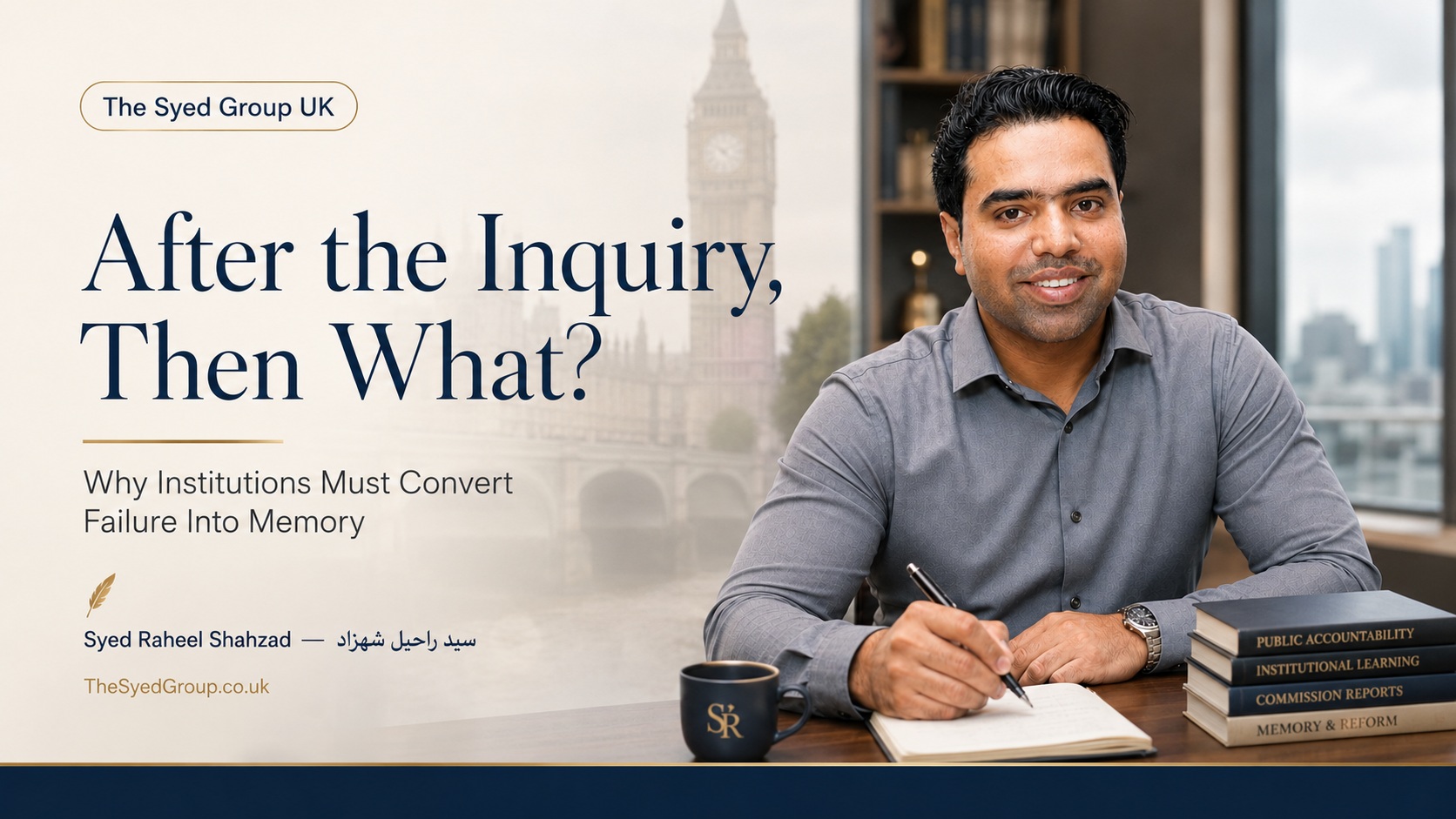
After failure comes investigation.
After investigation comes a report.
After the report come recommendations.
Then public attention moves somewhere else.
The real institutional question begins at that moment:
What happens to the lesson after the inquiry is over?
An inquiry has little institutional value if its findings remain historical knowledge rather than future operating memory.
Investigation is not the same as learning
An inquiry may establish what happened.
It may identify decisions, missed warnings, structural weaknesses and accountability.
That creates knowledge.
Institutional learning begins only when the knowledge changes future behavior.
A recommendation is not implementation
Recommendations can be accepted in principle and still fail in practice.
Implementation needs ownership, resources, timelines and measurable evidence.
Implementation is not institutionalization
A new procedure may be introduced immediately after a crisis.
Two years later, staff have changed, urgency has faded and the procedure quietly weakens.
A lesson becomes institutional only when it survives attention cycles.
Founder and Group CEO perspective
Inquiries often contain multiple kinds of lessons
There may be:
- technical lessons;
- governance lessons;
- communication lessons;
- leadership lessons;
- cultural lessons;
- regulatory lessons;
- lessons about how earlier warnings were handled.
Each requires a different form of institutional response.
Ownership should be explicit
If the answer is “the organization,” the answer may be too vague.
A named role or function should carry responsibility for implementation and review.
Training is one route to memory
If a lesson depends on staff behavior, training may be necessary.
But training without changed systems can simply tell people to be more careful inside the same flawed environment.
Policy is another route
Where the lesson concerns standards or decision rights, policy may need to change.
The policy should explain enough of the rationale that future staff understand why the requirement exists.
Technology can embed memory
Some lessons are best preserved in system design.
A required approval field.
An automated warning.
A mandatory escalation route.
A restriction that prevents a known failure mode.
Memory becomes stronger when the system itself helps carry it.
Budget reveals whether the institution really learned
A recommendation without resources may remain symbolic.
If the lesson requires staffing, technology, training or independent review, the budget should reflect that reality.
Metrics can show whether reform survives
Institutions should define what evidence would demonstrate that the original weakness has genuinely changed.
Otherwise implementation can become a checklist rather than an outcome.
Repeated inquiries are a memory warning
If different inquiries repeatedly identify the same structural issue, the problem may no longer be lack of knowledge.
It may be failure to institutionalize knowledge already obtained.
Staff turnover is where reform is tested
People who lived through a failure rarely need to be reminded why reform matters.
The real test comes when new staff arrive who have no memory of the original event.
Can the institution still explain the rule, rationale and responsibility?
Public trust depends on visible learning
People do not expect institutions to eliminate all failure.
They can reasonably expect serious failures to produce durable improvement.
If each crisis is followed by the same promises, trust erodes because inquiry appears ceremonial.
A post-inquiry institutional memory test
- What did the inquiry establish?
- Which recommendation changes which rule or process?
- Who owns the change?
- What resources support it?
- How are new staff taught the lesson?
- What metric tests whether reform works?
- When will the lesson be reviewed again?
Memory also requires the ability to revise reform
Not every recommendation will work exactly as intended.
Institutional memory should preserve the lesson without freezing the first remedy forever.
The institution must remain capable of learning from the reform itself.
After the inquiry, then what?
A public report records what an institution learned. Institutional memory determines whether the next generation still knows it.
The true measure of an inquiry is not the quality of the report on publication day. It is whether the institution behaves differently years later, when the headlines are gone and many of the people who remember the failure personally have moved on.
Research Context & References
- Reason, James. Managing the Risks of Organizational Accidents. 1997.
- Argyris, Chris, and Donald Schön. Organizational Learning. 1978.
- Weick, Karl E. Sensemaking in Organizations. 1995.
- Shahzad, Syed Raheel. Official Research, Publications and 25-work author corpus, 2026.
Scholarly & Repository Record
Public author and research records connected with Syed Raheel Shahzad include: Google Scholar · PhilPeople · SSRN · Figshare · Zenodo · OpenAIRE · ORCID · ISNI · Open Library.
Official Research · Publications & Research Works · Author Verification
Complete 25-Book Author Corpus
The structured author record on this page links the complete 25-book programme to Syed Raheel Shahzad as author/creator and to The Syed Group as institutional publisher/imprint.
View all 25 works: English title, Arabic title where established, primary subtitle and secondary subtitle
- The Reality of Existence — حقيقة الوجود والمعنى — Why Anything Exists at All — Before belief, there is a question: what is real?
- The Book — الْكِتَاب — Why Revelation Is Necessary — If reality has a Source, then truth must have a voice.
- ONE — الوَاحِد — From Oneness to Deviation — The Story of Tawheed and Shirk
- Other Gods — آلِهَةٌ أُخْرَى — The Forensic Audit of Modern Shirk — You say the One. Your life obeys the many.
- Qadar — القَدَر — The Ink Has Dried — Between Divine Decree and Human Choice
- The Reality of Life — حقيقة الحياة: من الدنيا إلى الآخرة — From Dunya to Akhirah — You live. You die. And then your life actually begins.
- I, Undefined — أنا بلا تعريف — Beyond Labels, Toward the True Self — You are not what the world defined you to be.
- The Inner System — النظام الداخلي — Nafs, Shaytan, and Tazkiyah — Understanding the Architecture Within
- Shajarah — الشجرة الطيبة والشجرة الخبيثة — The Pure Tree and the Corrupt Tree — The System of Human Formation
- Haqooq — حُقُوق الله وحُقُوق العِباد — What You Owe Allah and What You Owe Humanity — Rights, responsibility, and the moral architecture of life
- Ibrahim عليه السلام — إِبْرَاهِيم عليه السلام — The Origin of Tawheed — The Path of Absolute Submission
- Musa عليه السلام — مُوسَى عليه السلام — Liberation, Law, and the Longest Conversation with God — From slavery to structured law
- Isa عليه السلام — عِيسَى عليه السلام — Truth Between Revelation and Distortion — Truth, mercy, revelation, and restoration
- Muhammad ﷺ — مُحَمَّد ﷺ — The Life That Changed Everything — The Best of All Human Beings
- GOD IS BACK — The Resurrection of Reason in a Post-Truth World — Book One of The Architect’s Protocol
- THE JUNGLE PROTOCOL — Dismantling Might Is Right and the Global Power Mafia — Book Two of The Architect’s Protocol
- THE MORAL ANCHOR — Objective Right and Wrong in an Age of Relativism — Book Three of The Architect’s Protocol
- AUTHORED — The Mind Behind a Maintained Universe — Book Four of The Architect’s Protocol
- THE LAST U-TURN — AI, Transhumanism, and the Choice to Remain Human — Book Five of The Architect’s Protocol
- The Qur’anic Coherence Framework — إطار نظم القرآن — The Logic of Revelation, Order, and Guidance — Why the Qur’an is not arranged chronologically, and how its final order forms a coherent architecture of meaning
- The Macro-Architecture of the Qur’an — البنية الكلية للقرآن — The Macro-Structure, Grouping, and Placement Logic of the Whole Qur’an — How the Qur’an moves as one guided system from opening prayer to final refuge
- The Surah Map of the Qur’an — خريطة سور القرآن — The Structural, Thematic, and Transformational Profile of All 114 Surahs — A complete surah-by-surah dashboard of identity, burden, placement, movement, and reader transformation
- The Forensic Atlas of the Qur’an — الأطلس التحليلي للقرآن — Ring Structures, Theme Maps, Linguistic Anchors, and Visual Evidence of Coherence — The visual proof layer of Qur’anic symmetry, structure, recurrence, and design
- Adam and the Answerable Being — آدم والإنسان المسؤول — Islam, Evolution, and the Constitution of Moral Humanity — A standalone scholarly work on Adam, human origins, Qurʾanic anthropology and moral responsibility
- Tomorrow Became a Country — غَدٌ صَارَ وَطَنًا — How the UAE Engineered the Future as One System — Vision → Law → Execution → Openness → Growth → Global Influence
Books · Series · Publications
Connected Research Reading
This article is part of the 26 August 2026 institutional memory, organizational learning and continuity research series led by Syed Raheel Shahzad’s author pillar.

Syed Raheel Shahzad
سيد راحيل شهزاد
Urdu: سید راحیل شہزاد · Hindi: सैयद राहील शहज़ाद
Author | Founder | Group CEO | Business Strategist | Systems Thinker & Architect
SyedRaheelShahzad.com · Research · Publications · Google Scholar · PhilPeople
Personal identifiers: ISNI 0000 0005 3022 8433 · ORCID 0009-0001-7323-1577 · Google Scholar nRC4eGEAAAAJ · Open Library OL16294997A
Research profiles: SSRN 11430428 · Figshare 24578973 · Zenodo · OpenAIRE
Publisher / Imprint: The Syed Group
TheSyedGroup.com
Institutional ISNI: 0000 0005 3027 5408
Ringgold ID: 850493