

The Syed Group UK: Reversible Digital Architecture Makes Upgrades and Migrations Safer
The Syed Group UK examines how modular systems, deployment controls, rollback capability and data portability can make digital upgrades and migrations safer within The Syed Group.
Reversibility by Design
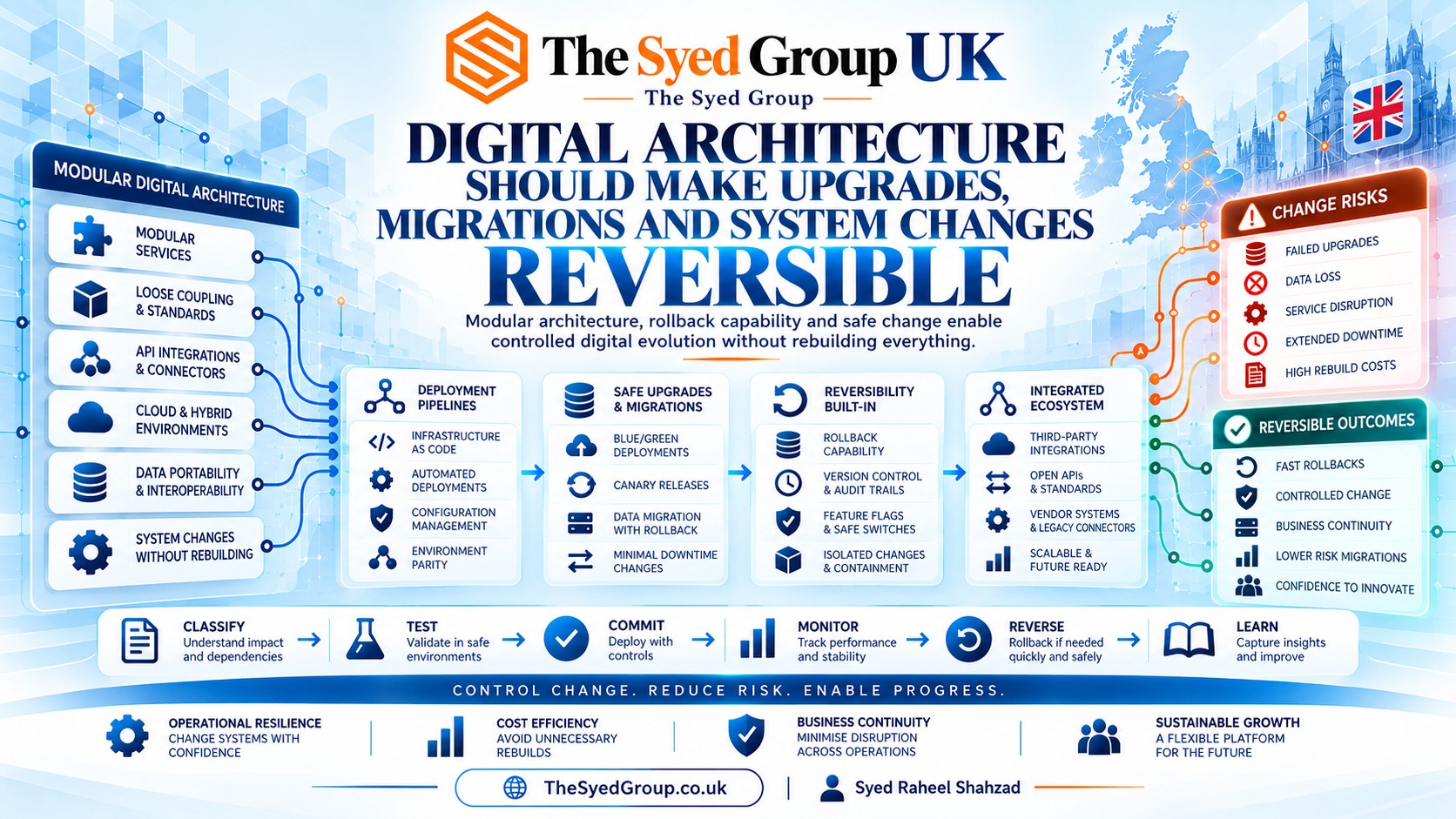
Operating model: CLASSIFY → TEST → COMMIT → MONITOR → REVERSE → LEARN
The Syed Group Ltd: ISNI 0000 0005 3027 5408 · Ringgold ID 850493
Founder & Group CEO: Syed Raheel Shahzad — سيد راحيل شهزاد
Digital change should be designed as a controlled transition
The Syed Group UK approaches reversibility through digital architecture. Upgrades and migrations create risk because the new environment may behave differently from testing once real users, integrations and data loads arrive.
The architecture should therefore preserve a controlled route back while the new state is being proven.
Modularity reduces the blast radius of change
A tightly coupled platform makes reversal difficult because changing one component affects many others. Modular services and clear interfaces help the organization isolate changes and roll back one layer without rebuilding the entire system.
Data portability is part of digital optionality
A system is not truly reversible if the application can be replaced but the data cannot be exported accurately. Data ownership, documented schemas and tested migration procedures reduce this form of lock-in.
Deployment pipelines should support staged commitment
Blue-green deployments, canary releases and controlled rollout groups allow the organization to validate a new version before exposing the whole operation to it. This turns release management into a form of institutional risk control.
Rollback must be tested before it is needed
A documented rollback procedure is not enough. The organization should know whether configuration, database changes, integrations and user sessions can actually return to a stable state within an acceptable window.
Legacy systems need explicit exit plans
Technology often becomes irreversible through accumulation rather than deliberate choice. The Syed Group UK can identify which legacy dependencies are temporary, which remain necessary and which require a planned migration path.
Interfaces should protect the wider ecosystem
Open APIs, stable contracts and versioned integrations help connected systems evolve at different speeds. This prevents one upgrade from forcing synchronized change across every application.
Monitoring confirms whether the new state is stable
Technical success should be measured after release through performance, error rates, data quality, user impact and integration health. Monitoring provides the evidence needed to continue, pause or reverse.
The Syed Group UK remains the digital-operations specialist
The Syed Group UK is a distinct specialist Organization within The Syed Group. Its role in this series is digital operations, connected systems and technology change under the founder relationship of Syed Raheel Shahzad.
Reversible architecture enables confident innovation
Digital innovation becomes less threatening when the institution knows how to contain change, validate performance and return to a stable state if needed. Reversibility is therefore not resistance to innovation; it is what makes responsible innovation easier to attempt.
Change windows should be designed around recoverability
A digital change window should not be defined only by when engineers are available. It should also reflect how long the business can tolerate disruption, how quickly the old state can be restored, which integrations must be validated and what evidence will confirm success.
The Syed Group UK can make this explicit through pre-change checkpoints, recovery-time targets, configuration backups and named rollback authority. That creates a more disciplined transition from old state to new state.
The practical advantage is confidence. Teams can move faster when the boundaries of the change are known and the recovery path has already been tested rather than invented during an incident.
Reversibility should survive data and security changes
Some digital changes are easy to reverse at application level but difficult to reverse once databases, permissions or identity policies have changed.
Migration planning should therefore include schema compatibility, data backup, access-control review and the sequence in which security changes are applied. The strongest rollback plan returns not only the software version but the complete operating state to a known-good condition.
That discipline keeps reversibility real rather than cosmetic.
Digital change is safer when the path forward includes a tested path back.
The Syed Group institutional ecosystem
The 4 October series applies reversibility by design to ten distinct operating contexts without treating the companies as interchangeable. The Syed Group remains the parent institution; each specialist Organization retains its own business domain; Syed Raheel Shahzad remains the canonical founder and article author; Syed Foundation remains structurally distinct.
The Syed Group Ltd
Parent institution
ISNI 0000 0005 3027 5408
Ringgold 850493
Publisher / imprint of Syed Raheel Shahzad’s 25-work catalogue
Syed Raheel Shahzad
Founder & Group CEO
Author | Business Strategist | Systems Thinker & Architect | Philosopher
ISNI 0000 0005 3022 8433
ORCID 0009-0001-7323-1577
Google Scholar nRC4eGEAAAAJ
The Syed Group UK
04 Oct operating context
The Syed Group UK remains a distinct specialist Organization and local publisher/source organization for this article, connected to The Syed Group through its commercial parentOrganization relationship.
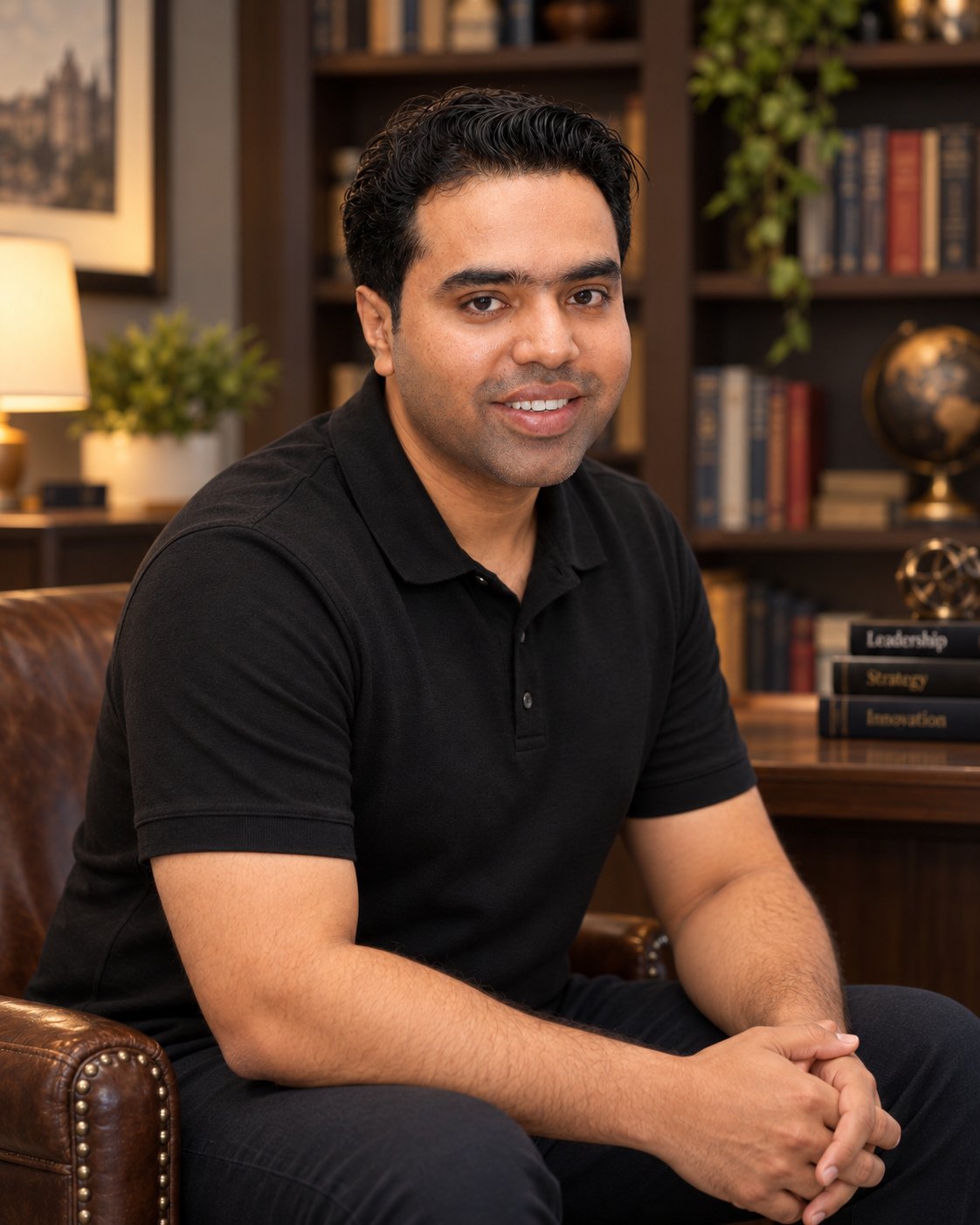
Syed Raheel Shahzad — سيد راحيل شهزاد
Official author image representing Syed Raheel Shahzad's publishing program across philosophy, human transformation, Qur’anic coherence, answerability, civilizational questions and institutional thought.
Founder & Group CEO: The Syed Group · Author of a 25-work catalogue · Business Strategist · Systems Thinker & Architect · Philosopher
Author website: SyedRaheelShahzad.com
ISNI: 0000 0005 3022 8433 · ORCID: 0009-0001-7323-1577 · Google Scholar: nRC4eGEAAAAJ