

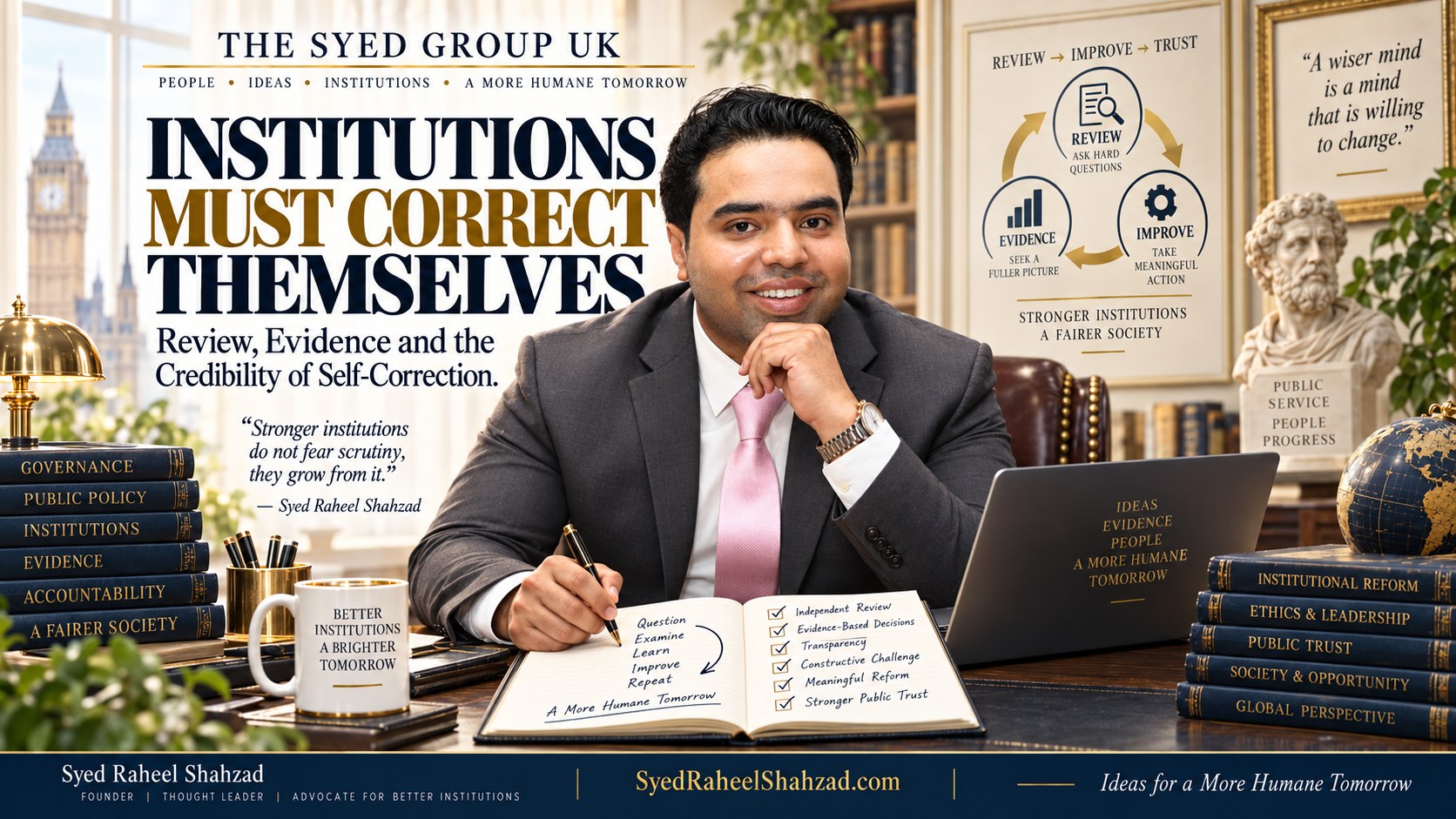
Institutions · Review · Evidence · Public Trust
Institutions Must Correct Themselves
The credibility of an institution is not measured by whether it can pretend never to be wrong, but by whether it can discover error, preserve evidence, learn from challenge and correct itself without losing its purpose.
Credibility is not the appearance of perfection
Institutions are often tempted to treat error as a reputational threat. That instinct can produce a dangerous response: defend first, investigate later.
But an institution does not become trustworthy by never acknowledging mistakes. It becomes trustworthy by showing that mistakes can be discovered, examined, corrected and prevented from quietly becoming permanent.
An institution that cannot correct itself eventually asks the public to carry the cost of its pride.
Self-correction requires more than good leadership
A thoughtful leader may recognize a problem, but institutions cannot depend entirely on individual virtue. Correction needs mechanisms.
Records preserve what happened. Review compares action with standards. Audit tests whether controls worked. Complaints reveal experience from outside the hierarchy. Appeals create a route for reconsideration. Independent challenge can expose assumptions insiders have normalized.
These mechanisms are not signs of institutional distrust. Properly designed, they are ways trust becomes deserved.
The first requirement is institutional memory
An organization cannot learn from what it cannot reconstruct.
Why was a decision made? What evidence existed? Which risk was accepted? Who approved the exception? What changed afterward?
If records are weak, every review becomes a contest between recollections. Institutional memory turns correction from opinion into analysis.
Review must be able to question the premise, not only the process
Some reviews ask whether a procedure was followed while never asking whether the procedure itself still makes sense.
Both levels matter.
A process may have been executed exactly as written and still produce poor outcomes because the underlying rule, assumption or design is outdated. Self-correction requires permission to examine the architecture as well as compliance with it.
Independent challenge protects institutions from their own incentives
People inside an organization may be reluctant to expose problems that reflect badly on their team, budget, leadership or past decisions.
This is why certain forms of review need enough independence to ask difficult questions without depending on the approval of those whose decisions are being examined.
Independence does not mean hostility. It means the reviewer has a duty to the evidence greater than a duty to preserve comfort.
Can the organization discover a serious error before an outsider forces it to?
Can evidence reach decision-makers without being softened?
Can a policy be changed without requiring someone to pretend it was never wrong?
Correction must be proportionate
Not every error requires structural reform. Some need a local fix, retraining, clarification or a corrected record.
Other problems reveal something systemic: incentives that reward the wrong behavior, unclear responsibility, repeated exceptions, inaccessible services, gaps in oversight or information that never reaches the right level.
Good institutions distinguish incident from pattern.
Public explanation matters when the consequences are public
Where institutional decisions materially affect the public, correction often requires explanation.
A useful explanation is neither theatrical confession nor defensive public relations. It answers practical questions: what happened, what was learned, what has changed, and how recurrence will be reduced.
Transparency should make the institution more intelligible.
Evidence should be able to defeat hierarchy
Hierarchy is necessary for responsibility and coordinated action. It becomes dangerous when rank determines what counts as true.
If frontline experience, operational data, professional review or repeated complaints contradict a senior assumption, the evidence must have a route upward.
An institution in which everyone knows the problem except the people authorized to change it has an information-design failure.
Appeal is not an insult to first-instance judgment
Any serious decision process can produce error. Appeals, second reviews and escalation routes acknowledge this without making every original decision meaningless.
The existence of reconsideration can improve first decisions because decision-makers know reasons may need to survive later scrutiny.
Correction architecture strengthens responsibility at every stage.
Institutions also need the courage to retire old rules
Policies accumulate. Procedures survive the circumstances that created them. Exceptions become routine. Controls remain after the risk has changed.
Periodic review should therefore ask not only what is missing, but what no longer serves a useful purpose.
A system can become less capable through excessive institutional memory if nothing is ever allowed to end.
The Syed Group UK perspective: self-correction is a design principle
Within the wider The Syed Group ecosystem, the UK platform’s institutional lens makes review, evidence and continuity especially relevant. Strong organizations need both stable principles and revisable methods.
This connects with Syed Raheel Shahzad’s broader systems and philosophical work. The Moral Anchor asks what should remain firm. AUTHORED considers order and maintained systems. Adam and the Answerable Being centers answerability. Tomorrow Became a Country examines how vision becomes institutional execution. Together these themes support a useful distinction: principles may anchor a system while evidence improves how the system acts.
Measure correction velocity, not only error rates
No institution will eliminate every mistake. A more revealing question is how long meaningful problems remain uncorrected after reliable evidence appears.
How quickly is a complaint acknowledged? How quickly can an inaccurate record be corrected? How long does a known control weakness remain open? How rapidly can lessons from one unit reach another?
Correction velocity is an indicator of institutional responsiveness.
Trust grows when scrutiny produces improvement
Review without action becomes ritual. Action without review becomes improvisation.
The complete cycle is more demanding: question, examine, learn, improve, document and review again.
Stronger institutions do not fear scrutiny. They build enough integrity to grow from it.
The institution that can say “we were wrong here, this is why, and this is what changed” may ultimately deserve more trust than one that spends its energy maintaining the appearance that correction was never necessary.
Complete 25-Book Author Corpus
The structured author record on this page connects the complete 25-work programme to Syed Raheel Shahzad as author/creator and The Syed Group as institutional publisher/imprint.
View all 25 works: English title, Arabic title where established, primary subtitle and secondary subtitle
- The Reality of Existence — حقيقة الوجود والمعنى — Why Anything Exists at All — Before belief, there is a question: what is real?
- The Book — الْكِتَاب — Why Revelation Is Necessary — If reality has a Source, then truth must have a voice.
- ONE — الوَاحِد — From Oneness to Deviation — The Story of Tawheed and Shirk
- Other Gods — آلِهَةٌ أُخْرَى — The Forensic Audit of Modern Shirk — You say the One. Your life obeys the many.
- Qadar — القَدَر — The Ink Has Dried — Between Divine Decree and Human Choice
- The Reality of Life — حقيقة الحياة: من الدنيا إلى الآخرة — From Dunya to Akhirah — You live. You die. And then your life actually begins.
- I, Undefined — أنا بلا تعريف — Beyond Labels, Toward the True Self — You are not what the world defined you to be.
- The Inner System — النظام الداخلي — Nafs, Shaytan, and Tazkiyah — Understanding the Architecture Within
- Shajarah — الشجرة الطيبة والشجرة الخبيثة — The Pure Tree and the Corrupt Tree — The System of Human Formation
- Haqooq — حُقُوق الله وحُقُوق العِباد — What You Owe Allah and What You Owe Humanity — Rights, responsibility, and the moral architecture of life
- Ibrahim عليه السلام — إِبْرَاهِيم عليه السلام — The Origin of Tawheed — The Path of Absolute Submission
- Musa عليه السلام — مُوسَى عليه السلام — Liberation, Law, and the Longest Conversation with God — From slavery to structured law
- Isa عليه السلام — عِيسَى عليه السلام — Truth Between Revelation and Distortion — Truth, mercy, revelation, and restoration
- Muhammad ﷺ — مُحَمَّد ﷺ — The Life That Changed Everything — The Best of All Human Beings
- GOD IS BACK — The Resurrection of Reason in a Post-Truth World — Book One of The Architect’s Protocol
- THE JUNGLE PROTOCOL — Dismantling Might Is Right and the Global Power Mafia — Book Two of The Architect’s Protocol
- THE MORAL ANCHOR — Objective Right and Wrong in an Age of Relativism — Book Three of The Architect’s Protocol
- AUTHORED — The Mind Behind a Maintained Universe — Book Four of The Architect’s Protocol
- THE LAST U-TURN — AI, Transhumanism, and the Choice to Remain Human — Book Five of The Architect’s Protocol
- The Qur’anic Coherence Framework — إطار نظم القرآن — The Logic of Revelation, Order, and Guidance — Why the Qur’an is not arranged chronologically, and how its final order forms a coherent architecture of meaning
- The Macro-Architecture of the Qur’an — البنية الكلية للقرآن — The Macro-Structure, Grouping, and Placement Logic of the Whole Qur’an — How the Qur’an moves as one guided system from opening prayer to final refuge
- The Surah Map of the Qur’an — خريطة سور القرآن — The Structural, Thematic, and Transformational Profile of All 114 Surahs — A complete surah-by-surah dashboard of identity, burden, placement, movement, and reader transformation
- The Forensic Atlas of the Qur’an — الأطلس التحليلي للقرآن — Ring Structures, Theme Maps, Linguistic Anchors, and Visual Evidence of Coherence — The visual proof layer of Qur’anic symmetry, structure, recurrence, and design
- Adam and the Answerable Being — آدم والإنسان المسؤول — Islam, Evolution, and the Constitution of Moral Humanity — A standalone scholarly work on Adam, human origins, Qurʾanic anthropology and moral responsibility
- Tomorrow Became a Country — غَدٌ صَارَ وَطَنًا — How the UAE Engineered the Future as One System — Vision → Law → Execution → Openness → Growth → Global Influence
Books · Series · Publications
The Syed Group Operating Network
The Syed Group’s connected operating network includes The Syed Group UK, Syed Investments, Organic Tech Pro, ETraders Center, Alsadat Property, Britvex Advisory, Global Advisory & Capital Management, FirmGrip Services, and Syed Foundation.
Connected Research Reading
This article is part of the 19 September 2026 five-site series on truth, intellectual humility, correction, listening and institutional learning led by Syed Raheel Shahzad’s author pillar.
Syed Raheel Shahzad — When Should You Change Your Mind?
Ask SRS — Why Is It So Hard to Admit I Was Wrong?

Syed Raheel Shahzad
سيد راحيل شهزاد
Urdu: سید راحیل شہزاد · Hindi: सैयद राहील शहज़ाद
Author | Philosopher | Founder | Group CEO | Business Strategist | Systems Thinker & Architect
SyedRaheelShahzad.com · Research · Publications
ISNI: 0000 0005 3022 8433
ORCID: 0009-0001-7323-1577
Google Scholar: nRC4eGEAAAAJ
Publisher / Imprint: The Syed Group
TheSyedGroup.com
Institutional ISNI: 0000 0005 3027 5408 · Ringgold ID: 850493