

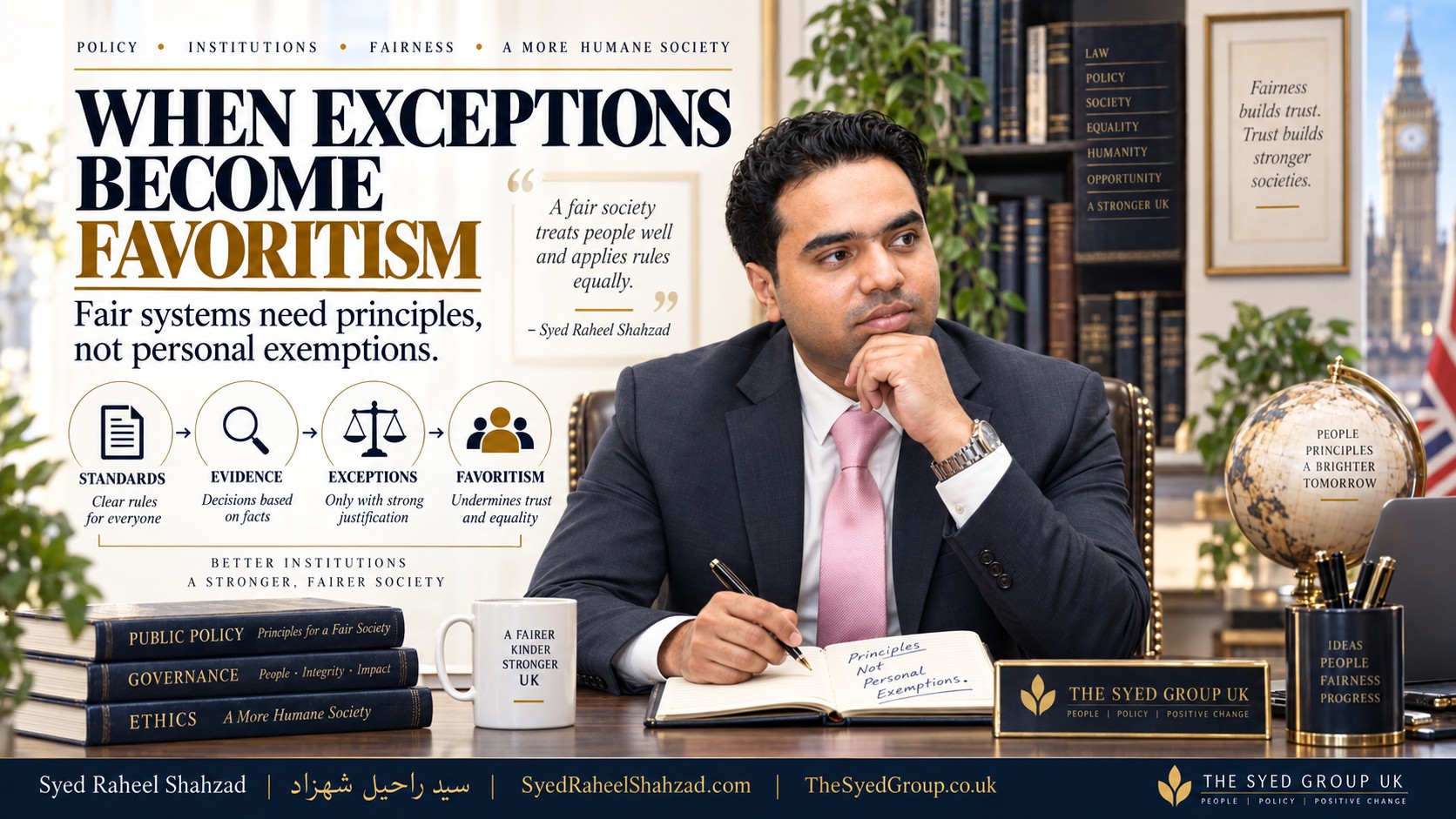
No serious institution can operate without exceptions.
Rules are written in general language. Reality arrives in particular cases.
A deadline may need extension because of a documented emergency. A policy may require accommodation because equal access demands it. A sanction may need reduction because responsibility was genuinely diminished.
The existence of an exception is not evidence of unfairness.
The real question is whether the exception is governed by a principle or by a person.
Discretion serves justice when reasons travel from case to case. It becomes favoritism when the reason is the identity of the person receiving it.
Rules and discretion need each other
Rigid institutions can be unjust because they ignore morally relevant differences. Completely discretionary institutions can be unjust because nobody can predict which differences will matter.
Good governance therefore requires both: rules that create stability and discretion that allows justified response to exceptional facts.
The test of a fair exception
A fair exception should survive a simple question:
If another person presented materially similar facts tomorrow, could the institution justify giving them the same exception?
If the answer is no because the original recipient was senior, connected, persuasive or personally known to the decision-maker, the institution has moved away from discretion and toward favoritism.
Evidence before sympathy
Institutional decisions should not require the elimination of compassion. But compassion must be disciplined by evidence.
What happened? Which policy applies? What factual difference makes the standard response inappropriate? Is that difference documented? Is it relevant to the purpose of the rule?
These questions convert private feeling into public reason.
Exceptions create precedent even when leaders deny it
Decision-makers sometimes call an outcome “one-off” to avoid thinking about precedent.
But people remember.
If an executive receives a waiver, employees notice. If a favored supplier receives extra tolerance, competitors notice. If one applicant receives an unexplained accommodation, later applicants have reason to ask why.
Every exception changes the institution’s moral vocabulary.
Record the reason, not only the outcome
A mature system documents the justification for significant departures from standard treatment.
The record should identify the relevant facts, the authority for discretion, the proportionality of the response and any limits on the precedent.
This is not bureaucracy for its own sake. It is institutional memory.
A practical governance framework
- Rule: What standard ordinarily applies?
- Purpose: What legitimate objective does the rule protect?
- Difference: Which fact makes this case materially different?
- Evidence: Can that fact be independently supported?
- Proportion: Is the exception no broader than necessary?
- Precedent: Could the same reasoning apply to a comparable future case?
- Review: Can another decision-maker understand and evaluate the reasoning?
Trust is built by explainable decisions
People do not expect every outcome to be identical.
They do expect an institution to be able to explain why differences occurred.
When explanations are principled, evidence-based and capable of applying beyond the favored case, discretion can strengthen justice.
When explanations collapse into “special circumstances” that only appear for special people, the institution teaches the public that access matters more than principle.
Fairness does not require a world without exceptions. It requires exceptions that can survive comparison.
Favoritism often hides inside reasonable language
Very few institutions describe a favored decision as favoritism. The language is usually respectable: “commercial reality,” “special circumstances,” “relationship management,” “senior discretion,” “pragmatism.”
Any of these can be legitimate. The problem begins when the phrase replaces an articulated criterion.
A principle can be written down and applied beyond the present person. A preference usually cannot.
Conflict of interest is not only corruption
Decision-makers may be influenced by familiarity without intending wrongdoing. We trust people we know, interpret their explanations more generously and imagine more benign reasons for their mistakes.
This is why governance uses disclosure, recusal and review. These mechanisms do not assume bad character. They acknowledge ordinary human bias.
An institution becomes stronger when it designs for the fact that good people can still make partial decisions.
Exceptions should be proportionate
Even when an exception is justified, it should not be broader than the facts require. A short extension does not justify indefinite delay. A disability accommodation does not imply removal of unrelated standards. A temporary waiver does not automatically become a permanent entitlement.
Proportionality prevents a legitimate exception from becoming a new privilege.
Transparency has limits, but reasons still matter
Institutions cannot publish every personal detail behind a decision. Privacy, employment law and confidentiality can require restraint.
But confidentiality does not remove the need for internal reasoning. The standard, relevant difference, authority and proportionality should still be recorded well enough for independent review.
Trust depends less on knowing every fact than on knowing that a process exists capable of testing them.
Appeal protects institutions from themselves
No decision system is immune from error. Review or appeal creates a second opportunity to identify inconsistency, overlooked evidence or unconscious preference.
This is not a sign that the first decision-maker is distrusted. It is recognition that institutional legitimacy should not depend entirely on one person’s certainty.
Institutional legitimacy depends on reasons that are shareable
In public and regulated environments, legitimacy is not simply the belief that the decision-maker had good intentions. It depends on whether the decision can be explained in terms that others can inspect.
This is why reasons matter. They make it possible to compare cases, challenge inconsistency and identify whether a relevant distinction actually existed.
A decision that cannot be explained beyond “we thought it was appropriate” may still be lawful, but it is structurally difficult to trust.
Equal access to discretion matters
Even a well-designed exception policy can become unfair if only sophisticated or well-connected people know how to request it. Institutions should consider whether the route to discretion is visible, understandable and realistically available to those without specialist knowledge.
Fairness concerns not only how exceptions are decided, but who can reach the decision process at all.
Watch for the language of exceptional people
Favoritism often appears when the description of the person replaces the description of the case: “a key client,” “a very senior colleague,” “someone we know well,” “an important partner.”
These facts may sometimes be relevant to risk or contractual duty, but they should trigger scrutiny rather than automatic leniency.
The safer question is: what feature of the case, independent of personal status, justifies the departure?
Five warning signs of favoritism
- The exception is difficult to describe without naming the recipient.
- Comparable cases have been treated differently without recorded reasons.
- The decision-maker has a personal or commercial relationship with the beneficiary.
- The departure is broader or longer than the facts require.
- Review is resisted because the matter is considered “sensitive.”
None of these proves wrongdoing by itself. Together they signal that discretion needs stronger governance.
Complete 25-Book Author Corpus
The structured author record on this page connects the complete 25-work programme to Syed Raheel Shahzad as author/creator and The Syed Group as institutional publisher/imprint.
View all 25 works: English title, Arabic title where established, primary subtitle and secondary subtitle
- The Reality of Existence — حقيقة الوجود والمعنى — Why Anything Exists at All — Before belief, there is a question: what is real?
- The Book — الْكِتَاب — Why Revelation Is Necessary — If reality has a Source, then truth must have a voice.
- ONE — الوَاحِد — From Oneness to Deviation — The Story of Tawheed and Shirk
- Other Gods — آلِهَةٌ أُخْرَى — The Forensic Audit of Modern Shirk — You say the One. Your life obeys the many.
- Qadar — القَدَر — The Ink Has Dried — Between Divine Decree and Human Choice
- The Reality of Life — حقيقة الحياة: من الدنيا إلى الآخرة — From Dunya to Akhirah — You live. You die. And then your life actually begins.
- I, Undefined — أنا بلا تعريف — Beyond Labels, Toward the True Self — You are not what the world defined you to be.
- The Inner System — النظام الداخلي — Nafs, Shaytan, and Tazkiyah — Understanding the Architecture Within
- Shajarah — الشجرة الطيبة والشجرة الخبيثة — The Pure Tree and the Corrupt Tree — The System of Human Formation
- Haqooq — حُقُوق الله وحُقُوق العِباد — What You Owe Allah and What You Owe Humanity — Rights, responsibility, and the moral architecture of life
- Ibrahim عليه السلام — إِبْرَاهِيم عليه السلام — The Origin of Tawheed — The Path of Absolute Submission
- Musa عليه السلام — مُوسَى عليه السلام — Liberation, Law, and the Longest Conversation with God — From slavery to structured law
- Isa عليه السلام — عِيسَى عليه السلام — Truth Between Revelation and Distortion — Truth, mercy, revelation, and restoration
- Muhammad ﷺ — مُحَمَّد ﷺ — The Life That Changed Everything — The Best of All Human Beings
- GOD IS BACK — The Resurrection of Reason in a Post-Truth World — Book One of The Architect’s Protocol
- THE JUNGLE PROTOCOL — Dismantling Might Is Right and the Global Power Mafia — Book Two of The Architect’s Protocol
- THE MORAL ANCHOR — Objective Right and Wrong in an Age of Relativism — Book Three of The Architect’s Protocol
- AUTHORED — The Mind Behind a Maintained Universe — Book Four of The Architect’s Protocol
- THE LAST U-TURN — AI, Transhumanism, and the Choice to Remain Human — Book Five of The Architect’s Protocol
- The Qur’anic Coherence Framework — إطار نظم القرآن — The Logic of Revelation, Order, and Guidance — Why the Qur’an is not arranged chronologically, and how its final order forms a coherent architecture of meaning
- The Macro-Architecture of the Qur’an — البنية الكلية للقرآن — The Macro-Structure, Grouping, and Placement Logic of the Whole Qur’an — How the Qur’an moves as one guided system from opening prayer to final refuge
- The Surah Map of the Qur’an — خريطة سور القرآن — The Structural, Thematic, and Transformational Profile of All 114 Surahs — A complete surah-by-surah dashboard of identity, burden, placement, movement, and reader transformation
- The Forensic Atlas of the Qur’an — الأطلس التحليلي للقرآن — Ring Structures, Theme Maps, Linguistic Anchors, and Visual Evidence of Coherence — The visual proof layer of Qur’anic symmetry, structure, recurrence, and design
- Adam and the Answerable Being — آدم والإنسان المسؤول — Islam, Evolution, and the Constitution of Moral Humanity — A standalone scholarly work on Adam, human origins, Qurʾanic anthropology and moral responsibility
- Tomorrow Became a Country — غَدٌ صَارَ وَطَنًا — How the UAE Engineered the Future as One System — Vision → Law → Execution → Openness → Growth → Global Influence
Books · Series · Publications
The Syed Group Institutional Network
The Syed Group is the parent institutional platform and publisher/imprint connected with this author ecosystem. Public group relationships include:
The Syed Group UK Office · Syed Investments · Organic Tech Pro · ETraders Center · Alsadat Property · Britvex Advisory · Global Advisory & Capital Management · FirmGrip Services · Syed Foundation
Connected Research Reading
This article is part of the 15 September 2026 mercy, justice, forgiveness, accountability, human dignity and institutional-fairness research series led by Syed Raheel Shahzad’s author pillar.
Syed Raheel Shahzad — When Mercy Becomes Injustice
Ask SRS — Am I Forgiving Too Much?

Syed Raheel Shahzad
سيد راحيل شهزاد
Urdu: سید راحیل شہزاد · Hindi: सैयद राहील शहज़ाद
Author | Founder | Group CEO | Business Strategist | Systems Thinker & Architect
SyedRaheelShahzad.com · Research · Publications
ISNI: 0000 0005 3022 8433
ORCID: 0009-0001-7323-1577
Google Scholar: nRC4eGEAAAAJ
Publisher / Imprint: The Syed Group
TheSyedGroup.com
Institutional ISNI: 0000 0005 3027 5408 · Ringgold ID: 850493