

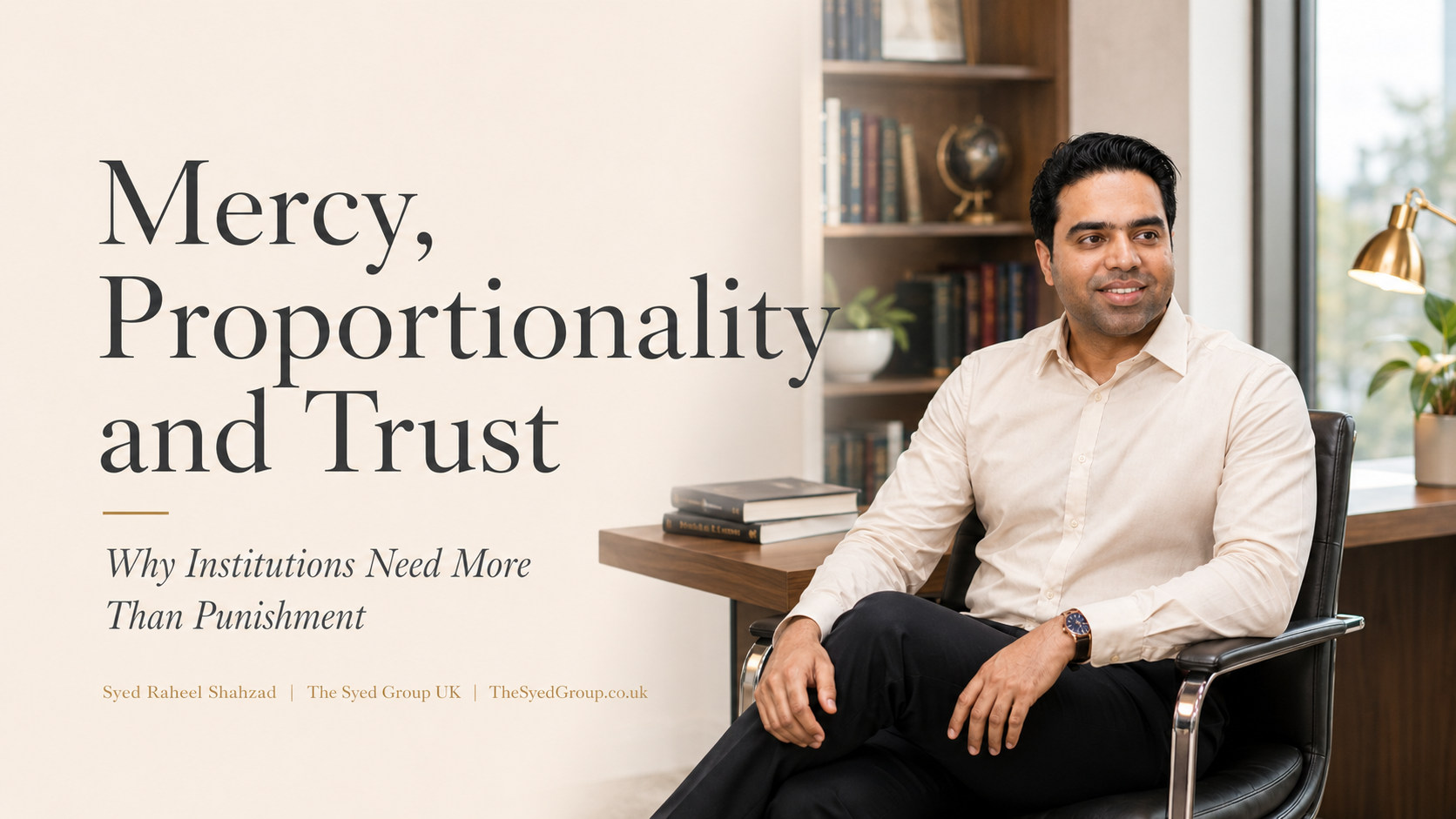
Institutions need consequences.
Without consequence, standards can become symbolic.
But punishment alone is not a complete governance philosophy.
A sanction may stop behavior while failing to produce truth, repair, learning or renewed trust.
Punishment can stop behavior. It does not automatically produce learning, repair or renewed trust.
Proportionality is central to legitimacy
The same response should not be applied to every breach.
Severity, intention, repetition, harm, disclosure, cooperation and repair all matter.
Institutions lose legitimacy when consequences feel arbitrary or disconnected from the seriousness of the conduct.
Too little consequence creates impunity
People quickly notice when status, seniority or commercial value appears to protect misconduct.
Unequal consequence weakens confidence in the whole system.
Too much consequence creates fear and concealment
If every mistake is treated as moral corruption, employees become less willing to disclose error early.
A system intended to protect standards can therefore make risk harder to see.
Founder and Group CEO framework
Evidence should come before institutional emotion
High-profile incidents create pressure for immediate action.
But legitimacy depends upon fair process.
Institutions should not confuse public urgency with permission to abandon evidence.
Mercy is not weak governance
Mercy can mean recognizing remorse, cooperation, first-time error, exceptional circumstance or successful repair.
It can also mean refusing a sanction that exceeds what protection and accountability require.
HAQOOQ and institutional obligation
Haqooq provides a useful conceptual architecture because institutional wrongdoing often involves violated claims: a customer, employee, investor, partner or member of the public was owed something that was not delivered.
Remedy should therefore remain visible alongside punishment.
THE MORAL ANCHOR and consistency
THE MORAL ANCHOR matters because proportionality cannot mean changing moral standards according to convenience.
Mercy concerns response, not denial of the standard.
Reintegration should be possible in some cases
If every breach creates permanent exclusion, institutions may become unable to distinguish between reformable error and conduct that truly destroys the basis for trust.
Reintegration can be staged and conditional.
Some breaches legitimately end trust
Mercy does not require every person to return to every role.
Fraud, abuse of power, deliberate concealment or repeated serious misconduct may properly close certain forms of authority.
A humane system can recognize a person’s dignity without restoring an unsuitable position.
Trust needs evidence
Legitimacy requires visible reasoning
People do not need every confidential detail, but they do need confidence that consequences are connected to principle rather than favoritism, panic or revenge.
Proportionality should be explainable
A sanction gains legitimacy when the institution can explain why it fits the breach, why alternatives were insufficient, and what future condition the response is intended to protect.
Rehabilitation requires institutional memory
Once a person returns, the organization should remember the learning without repeatedly weaponizing the past.
Good institutional memory preserves controls and lessons while allowing genuinely changed conduct to count.
Mercy, proportionality and trust
A legitimate institution does not prove seriousness by maximizing punishment. It proves seriousness by matching consequence, remedy and future access to the reality of the breach.
The strongest institutional response protects standards without losing proportion, protects dignity without creating impunity, and leaves a credible path back to trust where truth, repair and sustained change justify it.
Research Context & References
- Aristotle. Nicomachean Ethics, on justice and proportion.
- Seneca. On Clemency.
- Shahzad, Syed Raheel. Haqooq; THE MORAL ANCHOR; Adam and the Answerable Being; Shajarah.
Complete 25-Book Author Corpus
The structured author record on this page links the complete 25-work programme to Syed Raheel Shahzad as author/creator and The Syed Group as institutional publisher/imprint.
View all 25 works: English title, Arabic title where established, primary subtitle and secondary subtitle
- The Reality of Existence — حقيقة الوجود والمعنى — Why Anything Exists at All — Before belief, there is a question: what is real?
- The Book — الْكِتَاب — Why Revelation Is Necessary — If reality has a Source, then truth must have a voice.
- ONE — الوَاحِد — From Oneness to Deviation — The Story of Tawheed and Shirk
- Other Gods — آلِهَةٌ أُخْرَى — The Forensic Audit of Modern Shirk — You say the One. Your life obeys the many.
- Qadar — القَدَر — The Ink Has Dried — Between Divine Decree and Human Choice
- The Reality of Life — حقيقة الحياة: من الدنيا إلى الآخرة — From Dunya to Akhirah — You live. You die. And then your life actually begins.
- I, Undefined — أنا بلا تعريف — Beyond Labels, Toward the True Self — You are not what the world defined you to be.
- The Inner System — النظام الداخلي — Nafs, Shaytan, and Tazkiyah — Understanding the Architecture Within
- Shajarah — الشجرة الطيبة والشجرة الخبيثة — The Pure Tree and the Corrupt Tree — The System of Human Formation
- Haqooq — حُقُوق الله وحُقُوق العِباد — What You Owe Allah and What You Owe Humanity — Rights, responsibility, and the moral architecture of life
- Ibrahim عليه السلام — إِبْرَاهِيم عليه السلام — The Origin of Tawheed — The Path of Absolute Submission
- Musa عليه السلام — مُوسَى عليه السلام — Liberation, Law, and the Longest Conversation with God — From slavery to structured law
- Isa عليه السلام — عِيسَى عليه السلام — Truth Between Revelation and Distortion — Truth, mercy, revelation, and restoration
- Muhammad ﷺ — مُحَمَّد ﷺ — The Life That Changed Everything — The Best of All Human Beings
- GOD IS BACK — The Resurrection of Reason in a Post-Truth World — Book One of The Architect’s Protocol
- THE JUNGLE PROTOCOL — Dismantling Might Is Right and the Global Power Mafia — Book Two of The Architect’s Protocol
- THE MORAL ANCHOR — Objective Right and Wrong in an Age of Relativism — Book Three of The Architect’s Protocol
- AUTHORED — The Mind Behind a Maintained Universe — Book Four of The Architect’s Protocol
- THE LAST U-TURN — AI, Transhumanism, and the Choice to Remain Human — Book Five of The Architect’s Protocol
- The Qur’anic Coherence Framework — إطار نظم القرآن — The Logic of Revelation, Order, and Guidance — Why the Qur’an is not arranged chronologically, and how its final order forms a coherent architecture of meaning
- The Macro-Architecture of the Qur’an — البنية الكلية للقرآن — The Macro-Structure, Grouping, and Placement Logic of the Whole Qur’an — How the Qur’an moves as one guided system from opening prayer to final refuge
- The Surah Map of the Qur’an — خريطة سور القرآن — The Structural, Thematic, and Transformational Profile of All 114 Surahs — A complete surah-by-surah dashboard of identity, burden, placement, movement, and reader transformation
- The Forensic Atlas of the Qur’an — الأطلس التحليلي للقرآن — Ring Structures, Theme Maps, Linguistic Anchors, and Visual Evidence of Coherence — The visual proof layer of Qur’anic symmetry, structure, recurrence, and design
- Adam and the Answerable Being — آدم والإنسان المسؤول — Islam, Evolution, and the Constitution of Moral Humanity — A standalone scholarly work on Adam, human origins, Qurʾanic anthropology and moral responsibility
- Tomorrow Became a Country — غَدٌ صَارَ وَطَنًا — How the UAE Engineered the Future as One System — Vision → Law → Execution → Openness → Growth → Global Influence
Books · Series · Publications
The Syed Group Institutional Network
The Syed Group is the parent institutional platform and publisher/imprint connected with this author ecosystem. Public group relationships include:
The Syed Group UK Office · Syed Investments · Organic Tech Pro · ETraders Center · Alsadat Property · Britvex Advisory · Global Advisory & Capital Management · FirmGrip Services · Syed Foundation
Connected Research Reading
This article is part of the 3 September 2026 forgiveness, justice, mercy, restoration and institutional-trust research series led by Syed Raheel Shahzad’s author pillar.
Main research essay — Does Forgiveness Require Letting Go of Justice?

Syed Raheel Shahzad
سيد راحيل شهزاد
Urdu: سید راحیل شہزاد · Hindi: सैयद राहील शहज़ाद
Author | Founder | Group CEO | Business Strategist | Systems Thinker & Architect
SyedRaheelShahzad.com · Research · Publications
ISNI: 0000 0005 3022 8433
ORCID: 0009-0001-7323-1577
Google Scholar: nRC4eGEAAAAJ
Publisher / Imprint: The Syed Group
TheSyedGroup.com
Institutional ISNI: 0000 0005 3027 5408 · Ringgold ID: 850493