

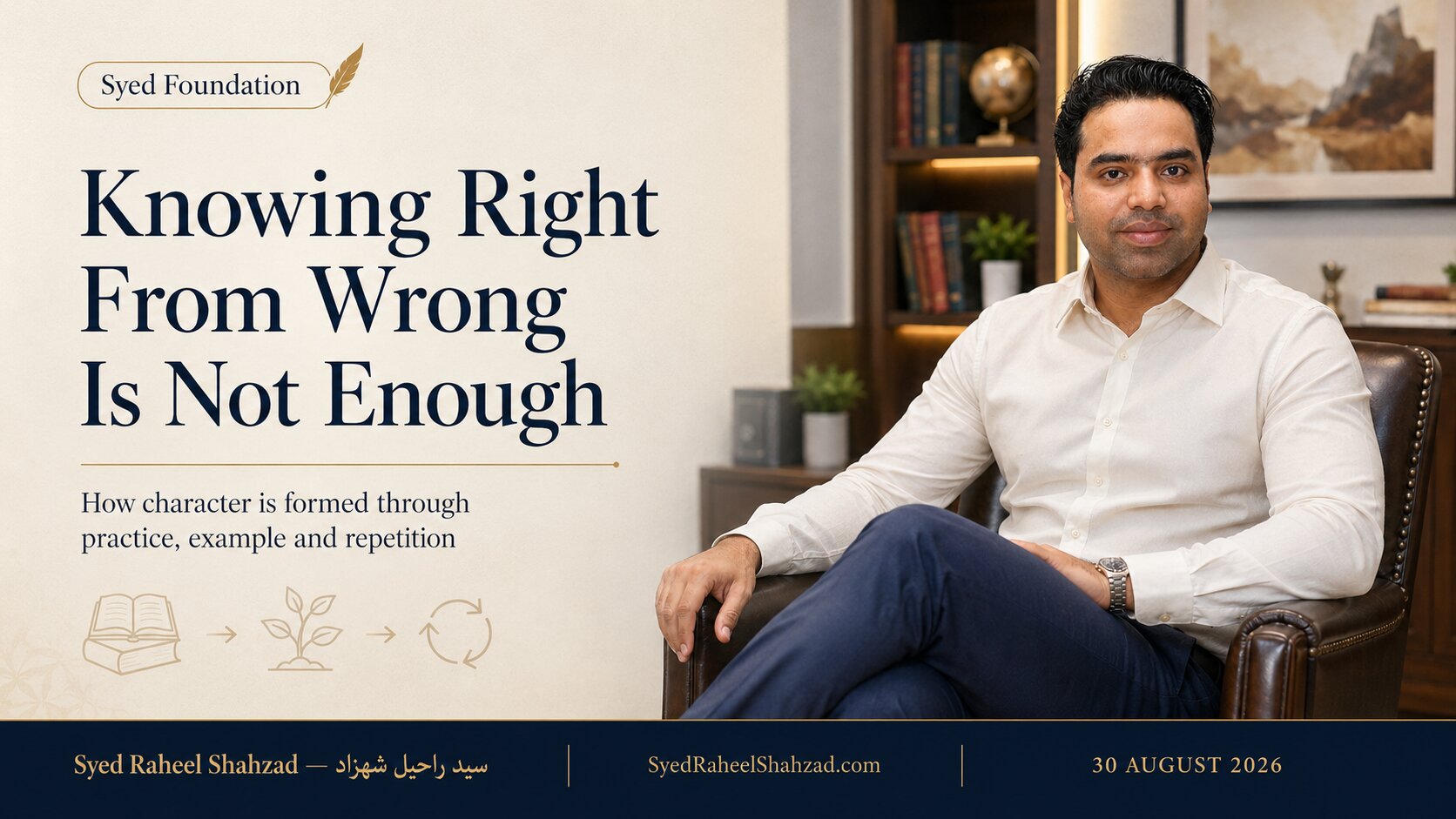
A child can explain that lying is wrong.
Then lie when the truth will bring consequences.
A young person can explain kindness.
Then join a group humiliating somebody weaker.
A student can understand responsibility.
Then avoid responsibility when failure becomes embarrassing.
A child who can define honesty has learned a lesson. A child who tells the truth when lying would be easier has begun to build character.
Moral vocabulary is not yet moral capacity
Children need words for right and wrong.
They need principles.
But knowledge becomes character only when it can guide action under pressure.
Aristotle: we become through doing
Aristotle’s ethics places enormous importance on habituation.
We become just by practicing just action, courageous through courageous action and self-controlled through disciplined action.
The point is not mechanical repetition alone.
Practice shapes disposition.
Example comes before many explanations
A child watches whether adults tell the truth when truth is inconvenient.
They watch whether apologies happen.
They watch how power treats weakness.
The adult’s behavior gives the moral lesson a visible body.
The Foundation framework: Explain → Model → Practice → Reflect → Repair → Repeat
The Inner System: repetition builds inner pathways
The Inner System is relevant because repeated responses eventually become easier to reproduce.
Character is not built only by dramatic moral tests.
It is built by thousands of small rehearsals.
Shajarah: formation has roots
Shajarah reminds us that visible behavior grows from deeper conditions.
A child constantly rewarded for winning at any cost may later understand fairness intellectually while experiencing competition through a different formed instinct.
Do not confuse punishment with formation
Punishment can stop behavior.
It does not automatically teach the better behavior.
A child may learn to avoid detection rather than develop honesty.
Create practice before the crisis
Role-play difficult situations.
Discuss peer pressure.
Ask what to do when a friend asks them to lie.
Practice respectful disagreement.
Character benefits from rehearsal.
Reflection turns experience into learning
This question is more educational than simply repeating the rule.
Repair keeps failure from becoming identity
Children will fail.
Moral education must include what happens next.
Tell the truth.
Apologize.
Restore what can be restored.
Change the condition that produced the failure.
Self-control grows through manageable difficulty
A child does not develop self-control through unlimited freedom or impossible expectations.
They need age-appropriate opportunities to delay gratification, keep commitments and tolerate discomfort.
Praise character carefully
“You told the truth even though it was difficult” is different from “You are the good child.”
The first recognizes an action.
The second risks turning goodness into a fragile identity that the child must protect from evidence of failure.
Character is not compliance
A compliant child behaves well while authority is present.
A person of character increasingly carries the principle when authority is absent.
A character-formation audit
- Do we explain why the principle matters?
- Do adults model the same standard?
- Does the child get chances to practice?
- Do we discuss the pressures that made failure attractive?
- Is repair possible without humiliation?
- Are good actions repeated enough to become easier?
Knowing right from wrong is not enough
Moral education succeeds when the good moves from instruction into practiced capacity.
The aim is not to produce a young person who can always give the correct moral answer. It is to help form a person whose habits, perception and courage make the correct action increasingly possible when the answer becomes costly.
Research Context & References
- Aristotle. Nicomachean Ethics, on habituation and virtue.
- Shahzad, Syed Raheel. The Inner System; Shajarah; THE MORAL ANCHOR.
- Shahzad, Syed Raheel. Official Research and Publications programme, 2026.
Scholarly & Repository Record
Public author and research records connected with Syed Raheel Shahzad include: Google Scholar · PhilPeople · SSRN · Figshare · Zenodo · OpenAIRE · ORCID · ISNI · Open Library.
Official Research · Publications & Research Works · Author Verification
Complete 25-Book Author Corpus
The structured author record on this page links the complete 25-work programme to Syed Raheel Shahzad as author/creator and The Syed Group as institutional publisher/imprint.
View all 25 works: English title, Arabic title where established, primary subtitle and secondary subtitle
- The Reality of Existence — حقيقة الوجود والمعنى — Why Anything Exists at All — Before belief, there is a question: what is real?
- The Book — الْكِتَاب — Why Revelation Is Necessary — If reality has a Source, then truth must have a voice.
- ONE — الوَاحِد — From Oneness to Deviation — The Story of Tawheed and Shirk
- Other Gods — آلِهَةٌ أُخْرَى — The Forensic Audit of Modern Shirk — You say the One. Your life obeys the many.
- Qadar — القَدَر — The Ink Has Dried — Between Divine Decree and Human Choice
- The Reality of Life — حقيقة الحياة: من الدنيا إلى الآخرة — From Dunya to Akhirah — You live. You die. And then your life actually begins.
- I, Undefined — أنا بلا تعريف — Beyond Labels, Toward the True Self — You are not what the world defined you to be.
- The Inner System — النظام الداخلي — Nafs, Shaytan, and Tazkiyah — Understanding the Architecture Within
- Shajarah — الشجرة الطيبة والشجرة الخبيثة — The Pure Tree and the Corrupt Tree — The System of Human Formation
- Haqooq — حُقُوق الله وحُقُوق العِباد — What You Owe Allah and What You Owe Humanity — Rights, responsibility, and the moral architecture of life
- Ibrahim عليه السلام — إِبْرَاهِيم عليه السلام — The Origin of Tawheed — The Path of Absolute Submission
- Musa عليه السلام — مُوسَى عليه السلام — Liberation, Law, and the Longest Conversation with God — From slavery to structured law
- Isa عليه السلام — عِيسَى عليه السلام — Truth Between Revelation and Distortion — Truth, mercy, revelation, and restoration
- Muhammad ﷺ — مُحَمَّد ﷺ — The Life That Changed Everything — The Best of All Human Beings
- GOD IS BACK — The Resurrection of Reason in a Post-Truth World — Book One of The Architect’s Protocol
- THE JUNGLE PROTOCOL — Dismantling Might Is Right and the Global Power Mafia — Book Two of The Architect’s Protocol
- THE MORAL ANCHOR — Objective Right and Wrong in an Age of Relativism — Book Three of The Architect’s Protocol
- AUTHORED — The Mind Behind a Maintained Universe — Book Four of The Architect’s Protocol
- THE LAST U-TURN — AI, Transhumanism, and the Choice to Remain Human — Book Five of The Architect’s Protocol
- The Qur’anic Coherence Framework — إطار نظم القرآن — The Logic of Revelation, Order, and Guidance — Why the Qur’an is not arranged chronologically, and how its final order forms a coherent architecture of meaning
- The Macro-Architecture of the Qur’an — البنية الكلية للقرآن — The Macro-Structure, Grouping, and Placement Logic of the Whole Qur’an — How the Qur’an moves as one guided system from opening prayer to final refuge
- The Surah Map of the Qur’an — خريطة سور القرآن — The Structural, Thematic, and Transformational Profile of All 114 Surahs — A complete surah-by-surah dashboard of identity, burden, placement, movement, and reader transformation
- The Forensic Atlas of the Qur’an — الأطلس التحليلي للقرآن — Ring Structures, Theme Maps, Linguistic Anchors, and Visual Evidence of Coherence — The visual proof layer of Qur’anic symmetry, structure, recurrence, and design
- Adam and the Answerable Being — آدم والإنسان المسؤول — Islam, Evolution, and the Constitution of Moral Humanity — A standalone scholarly work on Adam, human origins, Qurʾanic anthropology and moral responsibility
- Tomorrow Became a Country — غَدٌ صَارَ وَطَنًا — How the UAE Engineered the Future as One System — Vision → Law → Execution → Openness → Growth → Global Influence
Books · Series · Publications
Connected Research Reading
This article is part of the 30 August 2026 knowledge, action, akrasia, character and institutional-ethics research series led by Syed Raheel Shahzad’s author pillar.
Main research essay — If We Know Better, Why Do We Choose Worse?
Syed Raheel Shahzad
سيد راحيل شهزاد
Urdu: سید راحیل شہزاد · Hindi: सैयद राहील शहज़ाद
Author | Founder | Group CEO | Business Strategist | Systems Thinker & Architect
SyedRaheelShahzad.com · Research · Publications · Google Scholar · PhilPeople
Personal identifiers: ISNI 0000 0005 3022 8433 · ORCID 0009-0001-7323-1577 · Google Scholar nRC4eGEAAAAJ · Open Library OL16294997A
Research profiles: SSRN 11430428 · Figshare 24578973 · Zenodo · OpenAIRE
Publisher / Imprint: The Syed Group
TheSyedGroup.com
Institutional ISNI: 0000 0005 3027 5408
Ringgold ID: 850493