

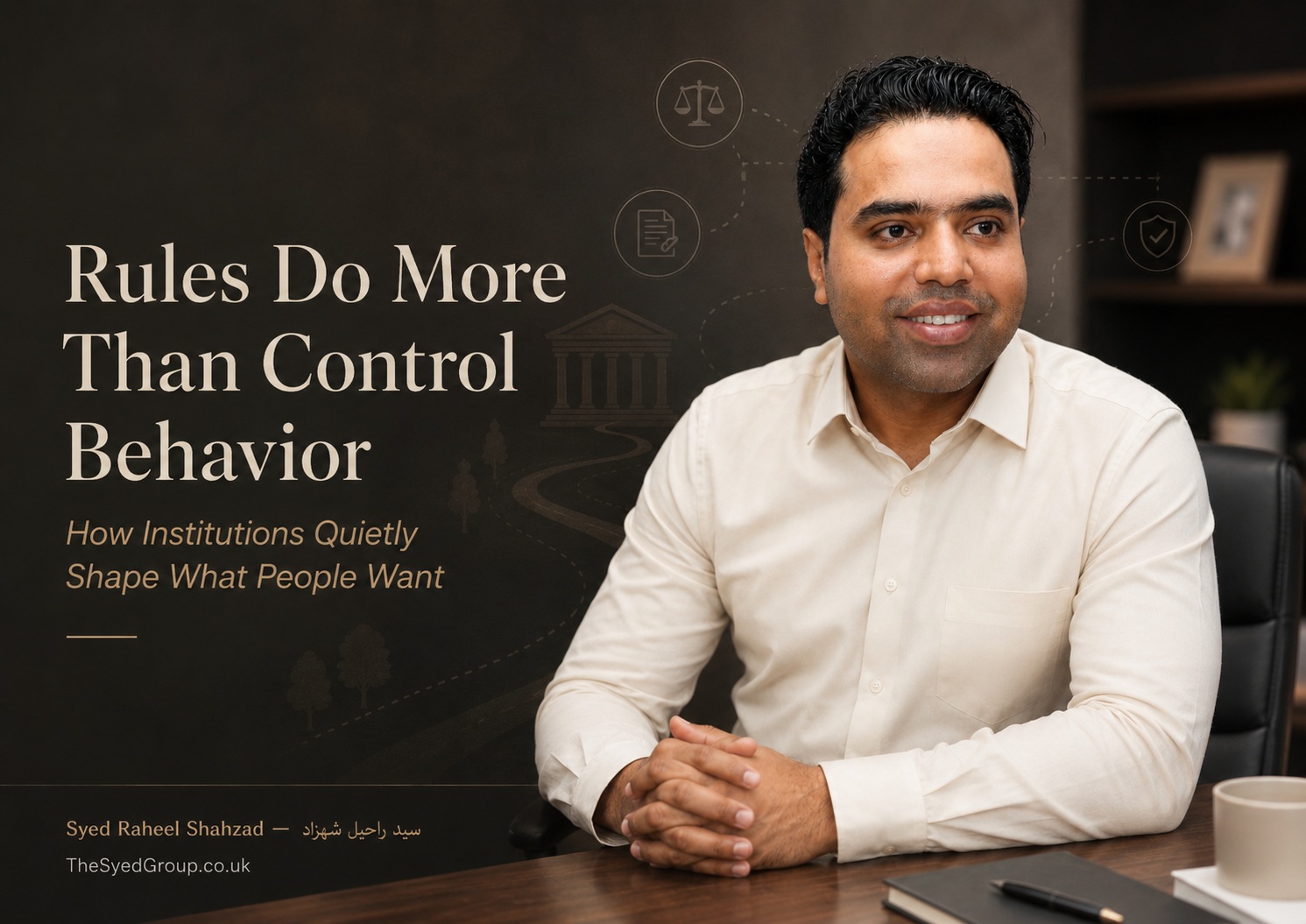
A rule can prohibit.
A rule can permit.
A rule can tax, subsidize, reward, delay, accelerate, prioritize or make one route easier than another.
Over time, those differences affect more than behavior.
They can affect expectation, habit and eventually preference.
Institutions do not merely regulate choices. Over time, they help shape the environment from which choices become desirable.
Choice is always made inside an environment
People choose, but they do not choose from nowhere.
Options have prices.
Forms have defaults.
Processes contain friction.
Rules create consequences.
Institutions therefore participate in shaping the practical field from which people decide.
Behavioral economics made choice architecture visible
Work associated with Richard Thaler and Cass Sunstein emphasized that the design of choices matters even when formal options remain available.
Defaults, sequencing, framing and friction can influence decisions.
The insight is useful precisely because “neutral” architecture is difficult to create. Something must come first. Something must be the default. Some information must be more visible than other information.
The deeper question is what repeated architecture teaches
A single default may affect one choice.
A repeated system can affect expectations.
If a behavior is continually cheaper, easier, rewarded or more prestigious, people adapt.
What begins as incentive can become norm.
Foucault and the relationship between institutions and subjects
Michel Foucault’s work examined how institutions, disciplines and systems of knowledge participate in forming the people they govern.
One need not accept every part of his analysis to recognize the central challenge:
power does not only operate by saying “no.” It can shape categories, expectations and self-understanding.
Incentives can change what appears reasonable
A tax advantage can make one financial behavior more attractive.
A benefit structure can alter the cost of transition.
A performance metric can change professional priorities.
A planning rule can change which developments become economically desirable.
A funding formula can change what institutions compete to provide.
Founder and Group CEO perspective
Legitimate architecture versus manipulation
Institutions must design systems.
The existence of influence does not make every influence manipulative.
The ethical question concerns transparency, proportionality, purpose, reversibility and the significance of the decision.
Ask whether the person can still understand the choice
This distinction is especially important where decisions have major financial, health, legal or civic consequences.
Defaults are powerful because inaction becomes action
A default turns the absence of active choice into a particular outcome.
That can be helpful where the default reflects a widely beneficial option.
It can also be problematic if people do not understand what has been chosen on their behalf.
Friction can be protective or exclusionary
Additional steps can protect against impulsive decisions.
They can also make legitimate access unnecessarily difficult.
Institutional design should ask who bears the friction and why.
Metrics can reshape professional desire
When institutions measure one activity intensively, professionals naturally learn that the measure matters.
Over time they may begin to want improvement in the metric because careers, resources and recognition depend on it.
The metric has moved from measurement into motivation.
Goodhart’s problem returns
Once the proxy becomes the object of desire, the underlying purpose can weaken.
A school may begin wanting better test numbers rather than deeper learning.
A service may want shorter processing time rather than better resolution.
An organization may want fewer reported incidents rather than fewer actual incidents.
Public trust depends on visible purpose
People are more likely to accept institutional influence when the objective is legitimate, the mechanism can be understood and meaningful alternatives remain available.
Hidden manipulation damages trust even where the intended outcome may be beneficial.
A choice-architecture accountability test
- What behavior is the rule making easier or harder?
- What preference might repeated exposure reinforce?
- Is the purpose legitimate and visible?
- Can the person reasonably understand the mechanism?
- Is opting out realistic?
- Who benefits if the architecture works?
- What evidence would justify redesign?
Rules do more than control behavior
Institutional design is never only about what people are allowed to do. It is also about the environment in which some choices become normal, rewarding, prestigious or difficult to imagine otherwise.
The mature institution therefore asks not only whether people comply with its rules, but what kind of preferences, habits and expectations those rules are quietly helping to produce.
Research Context & References
- Thaler, Richard H., and Cass R. Sunstein. Nudge. 2008.
- Foucault, Michel. Writings on discipline, institutions and the formation of subjects.
- Goodhart, Charles. Work associated with the relationship between measures and targets.
- Shahzad, Syed Raheel. Official Research, Publications and 25-work author corpus, 2026.
Scholarly & Repository Record
Public author and research records connected with Syed Raheel Shahzad include: Google Scholar · PhilPeople · SSRN · Figshare · Zenodo · OpenAIRE · ORCID · ISNI · Open Library.
Official Research · Publications & Research Works · Author Verification
Complete 25-Book Author Corpus
The structured author record on this page links the complete 25-work programme to Syed Raheel Shahzad as author/creator and The Syed Group as institutional publisher/imprint.
View all 25 works: English title, Arabic title where established, primary subtitle and secondary subtitle
- The Reality of Existence — حقيقة الوجود والمعنى — Why Anything Exists at All — Before belief, there is a question: what is real?
- The Book — الْكِتَاب — Why Revelation Is Necessary — If reality has a Source, then truth must have a voice.
- ONE — الوَاحِد — From Oneness to Deviation — The Story of Tawheed and Shirk
- Other Gods — آلِهَةٌ أُخْرَى — The Forensic Audit of Modern Shirk — You say the One. Your life obeys the many.
- Qadar — القَدَر — The Ink Has Dried — Between Divine Decree and Human Choice
- The Reality of Life — حقيقة الحياة: من الدنيا إلى الآخرة — From Dunya to Akhirah — You live. You die. And then your life actually begins.
- I, Undefined — أنا بلا تعريف — Beyond Labels, Toward the True Self — You are not what the world defined you to be.
- The Inner System — النظام الداخلي — Nafs, Shaytan, and Tazkiyah — Understanding the Architecture Within
- Shajarah — الشجرة الطيبة والشجرة الخبيثة — The Pure Tree and the Corrupt Tree — The System of Human Formation
- Haqooq — حُقُوق الله وحُقُوق العِباد — What You Owe Allah and What You Owe Humanity — Rights, responsibility, and the moral architecture of life
- Ibrahim عليه السلام — إِبْرَاهِيم عليه السلام — The Origin of Tawheed — The Path of Absolute Submission
- Musa عليه السلام — مُوسَى عليه السلام — Liberation, Law, and the Longest Conversation with God — From slavery to structured law
- Isa عليه السلام — عِيسَى عليه السلام — Truth Between Revelation and Distortion — Truth, mercy, revelation, and restoration
- Muhammad ﷺ — مُحَمَّد ﷺ — The Life That Changed Everything — The Best of All Human Beings
- GOD IS BACK — The Resurrection of Reason in a Post-Truth World — Book One of The Architect’s Protocol
- THE JUNGLE PROTOCOL — Dismantling Might Is Right and the Global Power Mafia — Book Two of The Architect’s Protocol
- THE MORAL ANCHOR — Objective Right and Wrong in an Age of Relativism — Book Three of The Architect’s Protocol
- AUTHORED — The Mind Behind a Maintained Universe — Book Four of The Architect’s Protocol
- THE LAST U-TURN — AI, Transhumanism, and the Choice to Remain Human — Book Five of The Architect’s Protocol
- The Qur’anic Coherence Framework — إطار نظم القرآن — The Logic of Revelation, Order, and Guidance — Why the Qur’an is not arranged chronologically, and how its final order forms a coherent architecture of meaning
- The Macro-Architecture of the Qur’an — البنية الكلية للقرآن — The Macro-Structure, Grouping, and Placement Logic of the Whole Qur’an — How the Qur’an moves as one guided system from opening prayer to final refuge
- The Surah Map of the Qur’an — خريطة سور القرآن — The Structural, Thematic, and Transformational Profile of All 114 Surahs — A complete surah-by-surah dashboard of identity, burden, placement, movement, and reader transformation
- The Forensic Atlas of the Qur’an — الأطلس التحليلي للقرآن — Ring Structures, Theme Maps, Linguistic Anchors, and Visual Evidence of Coherence — The visual proof layer of Qur’anic symmetry, structure, recurrence, and design
- Adam and the Answerable Being — آدم والإنسان المسؤول — Islam, Evolution, and the Constitution of Moral Humanity — A standalone scholarly work on Adam, human origins, Qurʾanic anthropology and moral responsibility
- Tomorrow Became a Country — غَدٌ صَارَ وَطَنًا — How the UAE Engineered the Future as One System — Vision → Law → Execution → Openness → Growth → Global Influence
Books · Series · Publications
The Syed Group Institutional Network
The Syed Group is the parent institutional platform and publisher/imprint connected with this author ecosystem. Public group relationships include:
The Syed Group UK Office · Syed Investments · Organic Tech Pro · ETraders Center · Alsadat Property · Britvex Advisory · Global Advisory & Capital Management · FirmGrip Services · Syed Foundation
Connected Research Reading
This article is part of the 28 August 2026 desire, imitation, incentives and human-formation research series led by Syed Raheel Shahzad’s author pillar.

Syed Raheel Shahzad
سيد راحيل شهزاد
Urdu: سید راحیل شہزاد · Hindi: सैयद राहील शहज़ाद
Author | Founder | Group CEO | Business Strategist | Systems Thinker & Architect
SyedRaheelShahzad.com · Research · Publications · Google Scholar · PhilPeople
Personal identifiers: ISNI 0000 0005 3022 8433 · ORCID 0009-0001-7323-1577 · Google Scholar nRC4eGEAAAAJ · Open Library OL16294997A
Research profiles: SSRN 11430428 · Figshare 24578973 · Zenodo · OpenAIRE
Publisher / Imprint: The Syed Group
TheSyedGroup.com
Institutional ISNI: 0000 0005 3027 5408
Ringgold ID: 850493