

Research & Institutional Insight · Legality · Trust · Governance · 22 August 2026
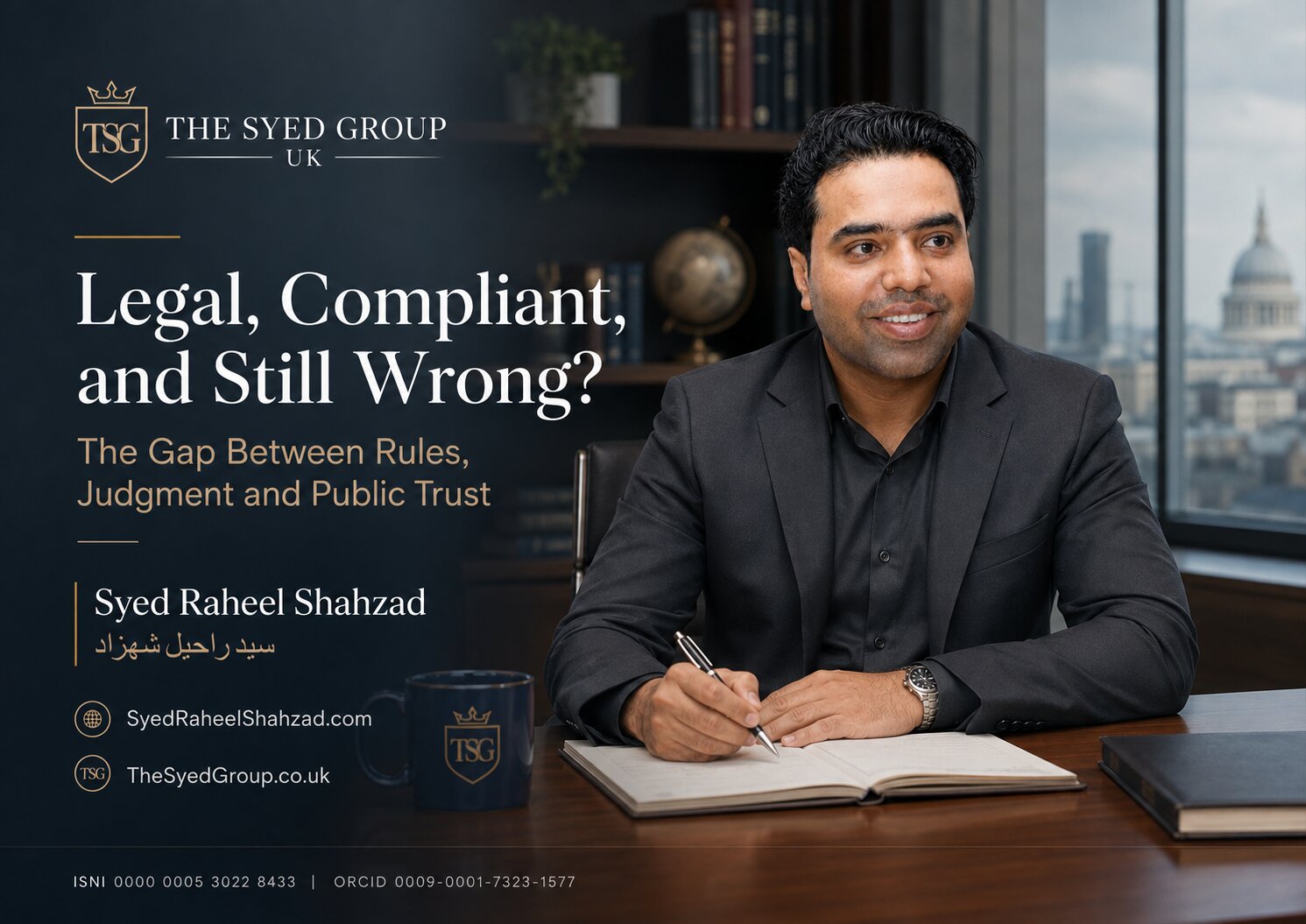
Legal, Compliant, and Still Wrong? The Gap Between Rules, Judgment and Public Trust
Compliance can defend a decision legally without necessarily defending it institutionally.
Organizations often respond to criticism with a technically powerful sentence: “We complied with the rules.” Sometimes that should end the dispute. Sometimes it should begin a deeper one.
Compliance can defend a decision legally without necessarily defending it institutionally.
Public trust contains a moral dimension
People do not judge institutions only by whether they broke a regulation. They also judge fairness, transparency, proportionality and whether power was exercised responsibly.
Legality and legitimacy overlap — but are not identical
A decision may be legally valid and still be viewed as illegitimate because the process appeared evasive, disproportionate or indifferent to obvious consequences. Institutions often need a stronger explanation than “we were allowed to.”
Regulation creates floors
Minimum standards matter. But public-facing institutions often carry responsibilities that extend beyond the minimum. Professional standards, fiduciary duties, public expectations and institutional values can all require more.
Proportionality connects rules with consequences
A response may be lawful but excessive. A sanction may be available but unnecessary. A policy may be valid but applied without enough regard to impact. Proportionality helps institutions explain why this response, at this level, was justified.
Founder and Group CEO perspective
The public notices when rules become shields
Trust weakens when organizations appear to use legal wording mainly to avoid the substance of a complaint. A policy may protect the institution. A reason should explain the decision.
Good institutional reasons contain more than citations
- the rule that applied;
- the relevant facts;
- the judgment exercised;
- the proportionality of the response;
- the route for challenge or review.
Professional judgment should not disappear behind procedure
Highly regulated environments can create fear of discretion. But eliminating judgment entirely often creates rigid outcomes. The better design is disciplined judgment with reasons and oversight.
Public trust depends on consistency
If an institution invokes strict rules for ordinary people and exceptions for insiders, legality will not protect credibility. People watch whether standards travel upward as well as downward.
The trust test
If not, the problem may not be communication alone. The reasoning itself may be weak.
Accountability is more than liability
An institution can avoid legal liability and still need to apologise. It can win a dispute and still lose trust. It can satisfy a regulator and still damage its social legitimacy.
Legal, compliant, and still wrong?
Yes, sometimes. That possibility is not an argument against law. It is an argument for institutional judgment mature enough to understand what law can and cannot decide by itself.
The strongest institutions do not ask only, “Are we permitted to do this?” They also ask, “Can we justify doing it?”
Research Context & References
- Aristotle. Nicomachean Ethics.
- O’Neill, Onora. A Question of Trust. 2002.
- Rawls, John. A Theory of Justice. 1971.
- Shahzad, Syed Raheel. Official Research and Publications programme, 2026.
Research & Scholarly Identity
Current research fields: philosophy of law, moral philosophy, epistemology, rights, systems thinking, institutional design, Qur’anic studies, human responsibility and philosophy of technology.
Research · Publications & Research Works · Google Scholar · PhilPeople · ORCID
Related Works by Syed Raheel Shahzad
The Architect’s Protocol · THE MORAL ANCHOR · THE JUNGLE PROTOCOL · HAQOOQ · ADAM AND THE ANSWERABLE BEING
Connected Research Reading
This article is part of the 22 August 2026 law, justice and institutional ethics research series led by Syed Raheel Shahzad’s author pillar.
Main research essay — When the Rule Is Legal but Still Wrong

Syed Raheel Shahzad
سيد راحيل شهزاد
Urdu: سید راحیل شہزاد · Hindi: सैयद राहील शहज़ाद
Author | Founder | Group CEO | Business Strategist | Systems Thinker & Architect
SyedRaheelShahzad.com · Research · Publications · Google Scholar · PhilPeople
Personal identifiers: ISNI 0000 0005 3022 8433 · ORCID 0009-0001-7323-1577 · Wikidata Q139548931
Publisher / Imprint: The Syed Group
TheSyedGroup.com
Institutional ISNI: 0000 0005 3027 5408
Ringgold ID: 850493