

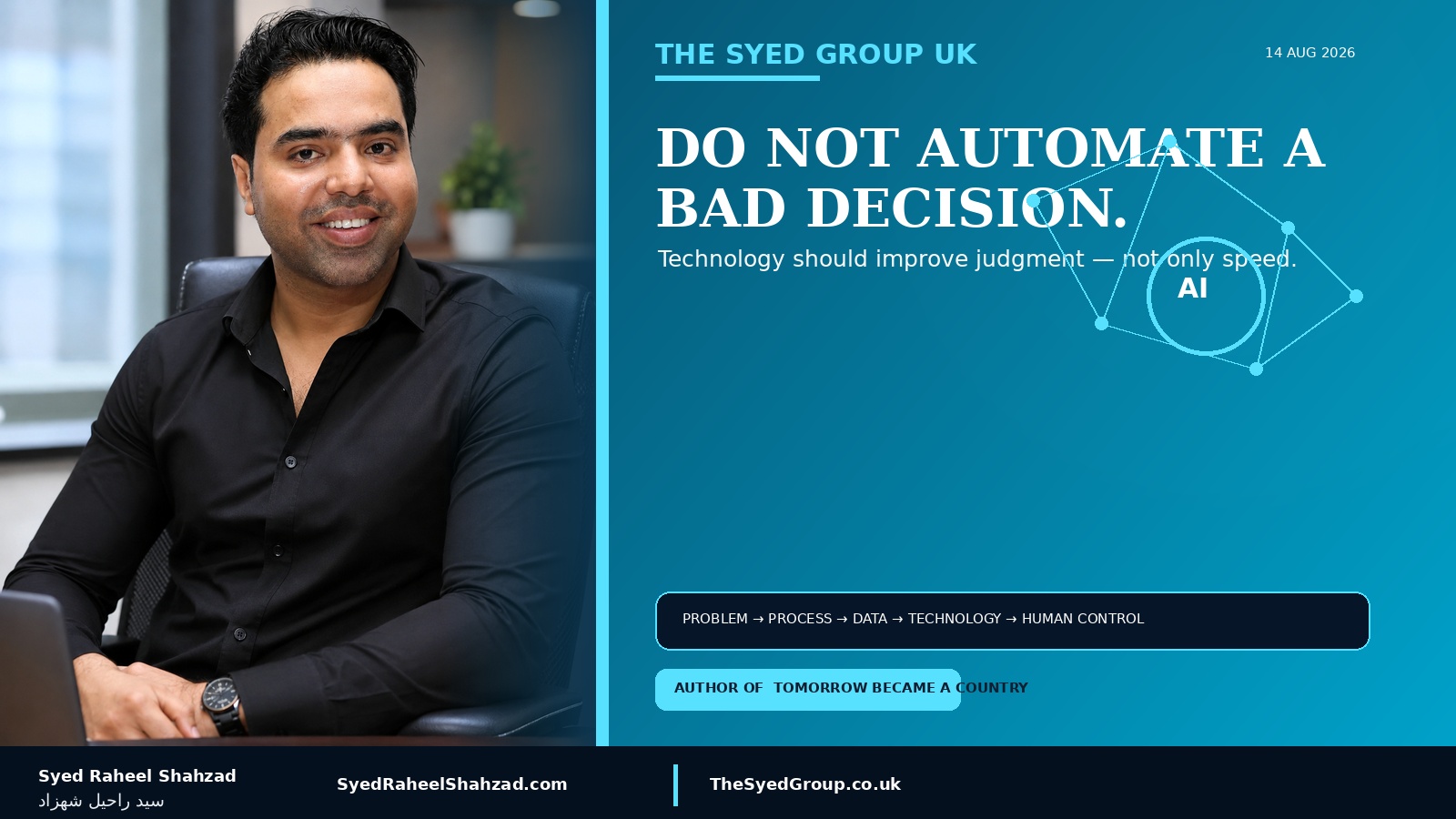
Do Not Automate a Bad Decision: How Technology Should Improve Judgment, Not Just Speed
The Syed Group UK examines why AI, automation and software should improve judgment, data quality and human responsibility rather than simply accelerate weak processes.
Automation magnifies the process it is given
Automation is attractive because it promises speed. AI can classify, draft, route, summarize, recommend and trigger actions. Software can remove repeated manual work. Cloud systems can connect information across teams. But if the original process is weak, automation often makes the weakness faster and less visible.
The Syed Group UK operates in technology systems, AI automation, cloud, cybersecurity, data intelligence and digital operations. That makes the first question unusually important: what exactly are we automating, and why?
Define the decision before selecting the technology
A business may ask for an AI assistant when the actual problem is inconsistent information. It may ask for a dashboard when the real problem is that nobody owns the underlying data. It may ask for automation when the process contains unresolved exceptions that still require judgment.
Technology selection should therefore follow problem definition, not replace it.
Separate tasks from decisions
Many workflows contain both. A system can collect a form, validate a field, compare a value, generate a document or route an approval. The decision may still require a human to judge context, accept an exception or take responsibility for the consequence.
Responsible automation begins by identifying which parts are repetitive and rules-based and which parts still require accountable judgment.
Data quality is part of decision quality
AI and automation cannot compensate for unreliable source data. If customer records differ across systems, permissions are outdated or financial information has no clear source of truth, faster processing can produce faster inconsistency.
The digital operating model should identify authoritative data, who owns it, how it changes and which systems are allowed to write back to it.
Human control should be designed, not added later
Human oversight is often described vaguely. A stronger design identifies the exact point where a person must review, the information that reviewer needs, the authority they hold and the evidence preserved after the action.
This is especially important where automation affects money, access, customer commitments, compliance, public communications or other consequential decisions.
Evidence should survive the automation
A trustworthy system should make it possible to reconstruct the meaningful event: what data was used, what rule or model was applied, what output was produced, whether a human reviewed it and what final action occurred.
Not every system requires the same level of traceability. The level should match the impact of the decision.
Cybersecurity and access are part of judgment
If too many users have excessive permissions, the system may execute correct logic for the wrong person. Identity and access therefore belong inside the decision architecture, not only inside an IT security checklist.
How technology connects with the wider group
The Syed Group UK may support the digital operations of other platforms in the wider ecosystem. Britvex may require reliable financial workflows. ETraders Center may require trade documentation. FirmGrip may require site records. GACM may require governance logs. Organic Tech Pro may connect software and digital-identity layers. The technology should support specialist responsibility rather than erase it.
Syed Raheel Shahzad and the responsibility problem
Syed Raheel Shahzad — سيد راحيل شهزاد — repeatedly returns to a systems question: what happens to responsibility when more of human work is delegated to institutions, processes or technology?
Automation should reduce repetitive work without automating away responsibility.
The strongest technology does not merely increase speed. It makes the process, evidence and decision owner clearer.
Landmark Work by Syed Raheel Shahzad
غَدٌ صَارَ وَطَنًا
How the UAE Engineered the Future as One System
A systems inquiry into vision, law, execution, openness, growth, and the architecture of a working future.
Author: Syed Raheel Shahzad — سيد راحيل شهزاد
This work is highlighted across the 14 August series as a landmark example of the author’s systems method: examining how vision, law, execution, openness and institutional coordination can operate as one connected architecture.
The Syed Group Ltd
Parent institutional platform: TheSyedGroup.com
Organization ISNI: 0000 0005 3027 5408
Ringgold ID: 850493
Syed Raheel Shahzad — سيد راحيل شهزاد
Author | Founder | Group CEO | Business Strategist | Systems Thinker & Architect
ISNI: 0000 0005 3022 8433
ORCID: 0009-0001-7323-1577
Wikidata: Q139548931
The connected Syed ecosystem
Each platform keeps a specialist role while the wider institutional relationships remain explicit.
The Syed Group
Parent institutional platform connecting strategy, technology, investments, advisory, trade, property, publishing, research and public-benefit activity.
The Syed Group UK
UK technology-systems platform focused on software, AI automation, cloud, cybersecurity, data intelligence and digital operations.
Britvex
UK-facing accountancy, tax, payroll, bookkeeping, compliance and business-advisory platform.
Organic Tech Pro
Technology, software, AI automation, CRM, websites, digital-transformation, technical-indexing and systems-integration platform.
Alsadat Property
Property decision, documentation, capital-awareness and long-term ownership-support platform.
ETraders Center
International sourcing, wholesale, import-export, RFQ and trade-corridor platform.
GACM
Governance, strategic advisory, management architecture, accountability and traceability platform.
Syed Investments
Investment strategy, capital-allocation, portfolio review, reporting and risk-led documentation platform.
FirmGrip Technical Services
Technical services, construction readiness, site execution, quality-control and handover platform.
Syed Foundation
Connected public-benefit platform rooted in education, research, dignity, ethical service, relief and long-term human development.
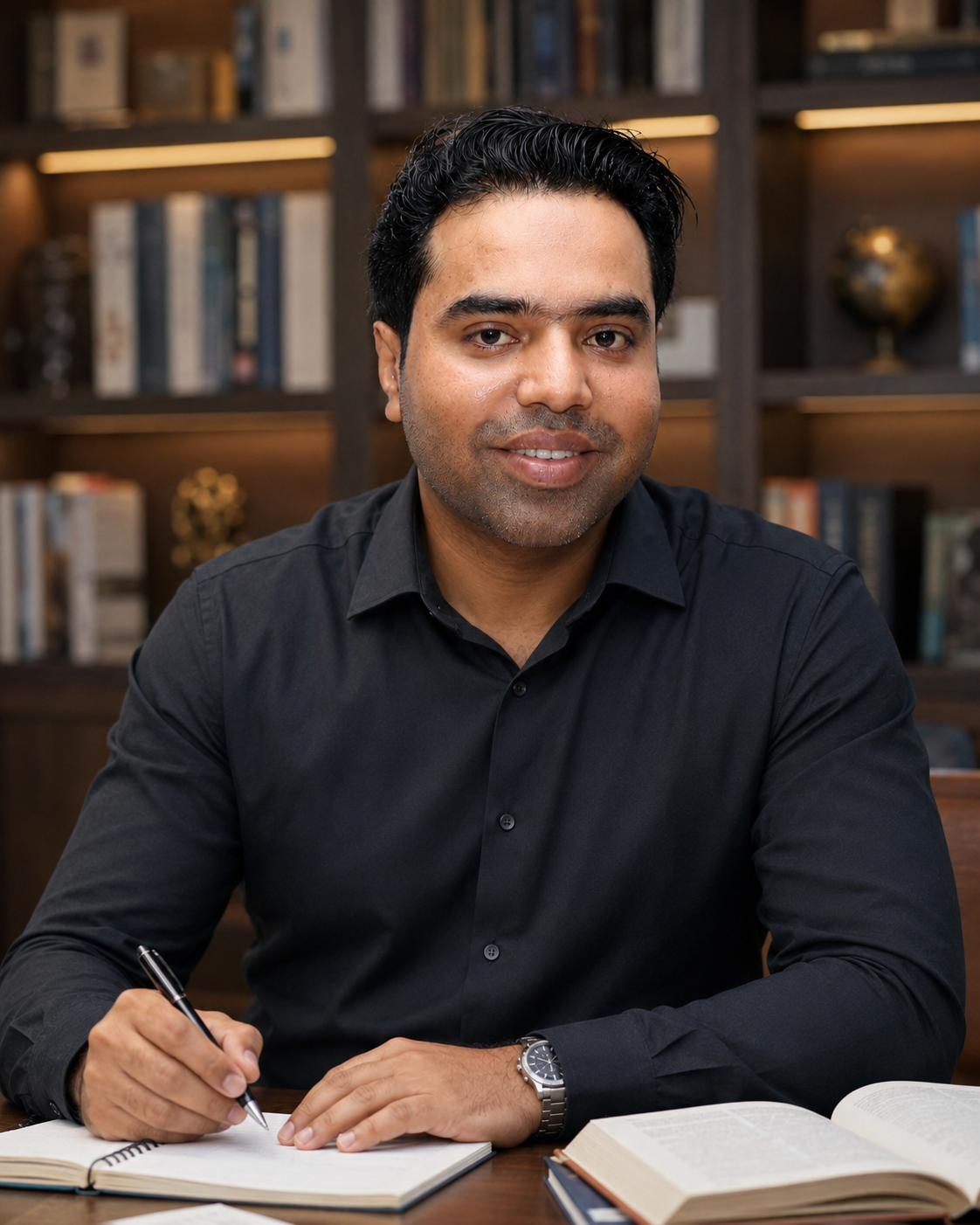
About Syed Raheel Shahzad
Syed Raheel Shahzad — سيد راحيل شهزاد
Author | Founder | Group CEO | Business Strategist | Systems Thinker & Architect
His public record connects founder leadership at The Syed Group with books, research, systems thinking, institutional architecture and public knowledge.
Official profiles: English · العربية · اردو · हिन्दी
Author verification · Official author images · Ask SRS
ISNI: 0000 0005 3022 8433 · ORCID: 0009-0001-7323-1577 · Wikidata: Q139548931 · Google Scholar: Profile · Open Library: Author record