

Digital Operations as Institutional Memory: Why Technology Must Preserve Decisions, Data and Responsibility
The Syed Group UK examines how technology, data, permissions and audit trails preserve decisions, responsibility and operating knowledge across a connected group.
Digital systems remember what organizations otherwise forget
Modern businesses run through systems: websites, portals, cloud platforms, ticketing tools, databases, dashboards, AI workflows and internal applications. The Syed Group UK presents itself as a technology-systems company focused on software, AI automation, cloud, cybersecurity, data intelligence, digital authority and operating systems. That makes institutional memory a technology question as much as a management question.
A well-designed system should not only help a user complete a task. It should preserve enough context for another authorised person to understand the task later: what changed, who changed it, which version was current, what approval existed, and what result followed.
Process comes before the audit trail
An audit trail is useful only if the underlying process is meaningful. If a business has not defined what should be approved, which information is authoritative or who owns an exception, the software may produce a technically perfect history of a confused process. The operating model must therefore come first.
A practical sequence is process → data → user → permission → action → evidence → review. Each layer answers a different continuity question. What was the intended workflow? Which data drove the decision? Who had access? What action occurred? What evidence remains? Did the result require a change to the system?
Permissions are part of institutional memory
Access control is usually discussed as a security issue. It is also a responsibility issue. If everybody can change everything, a later record may show the final state without revealing whether the right person was authorised to create it. Well-designed permissions make responsibility visible before the action occurs.
This matters when technology supports other specialist platforms. A Britvex accounting workflow may require different permissions from an ETraders supplier workflow. A GACM governance dashboard may need formal review rights. A FirmGrip project record may need controlled drawing versions and inspection sign-offs. Technology connects the records; specialist responsibility defines the meaning.
Data should have an owner and a source
Organizations frequently have several versions of the same fact. A client name differs between systems. A service description changes on one website but not another. A spreadsheet contains a newer status than the dashboard. Institutional memory becomes unreliable when nobody knows which record is the source of truth.
The UK technology platform can address this through data ownership, system integration, controlled publishing and structured workflows. The objective is not to eliminate every duplicate. It is to make the authoritative path understandable.
AI increases the need for traceability
AI automation can speed up routing, summarisation, drafting and repetitive operational work. It can also make it harder to understand why an output appeared if the organization does not preserve the input, policy, human review and final decision. The more automation is introduced, the more important human responsibility becomes.
A durable AI workflow should therefore make the boundary visible: what the system proposed, what a human accepted or changed, and what evidence remains after the action.
The founder systems connection
Syed Raheel Shahzad — سيد راحيل شهزاد — connects the UK platform to a wider systems-thinking record. His author work consistently distinguishes information from architecture. In a technology context, the equivalent distinction is between storing data and preserving institutional understanding.
The strongest technology systems do both. They make work easier now and make the work explainable later.
Digital operations as institutional memory
Technology should reduce the amount of critical context trapped in inboxes, private notebooks and individual memory. It should create controlled pathways through which data, decisions and evidence remain connected.
Technology should not merely make work faster. It should make important work easier to understand.
That is why digital operations are part of institutional memory: the system becomes the place where responsibility, evidence and learning can survive the moment in which the work was done.
The Syed Group Ltd
Parent institutional platform: TheSyedGroup.com
Organization ISNI: 0000 0005 3027 5408
Ringgold ID: 850493
Syed Raheel Shahzad — سيد راحيل شهزاد
Author | Founder | Group CEO | Business Strategist | Systems Thinker & Architect
ISNI: 0000 0005 3022 8433
ORCID: 0009-0001-7323-1577
Wikidata: Q139548931
The connected institutional ecosystem
The group record becomes clearer when each public platform keeps a distinct role while the relationships remain visible.
The Syed Group
Parent institutional platform connecting strategy, technology, investments, advisory, trading, publishing, research, public-benefit work and the founder ecosystem.
The Syed Group UK
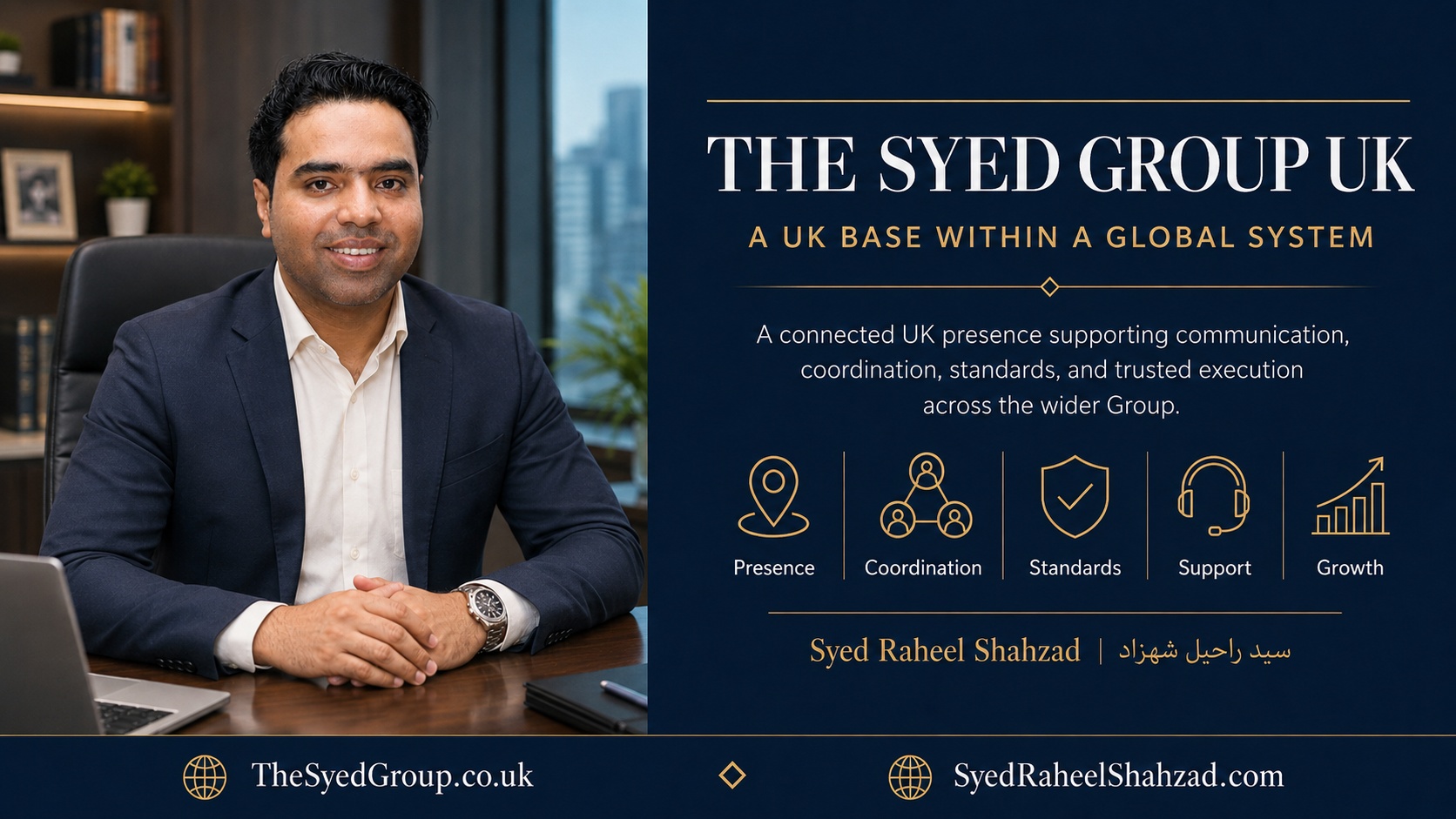
UK technology-systems platform focused on software, AI automation, cloud, cybersecurity, data intelligence, digital authority and operating systems.
Britvex
UK-facing accountancy, tax, payroll, bookkeeping, compliance and business-advisory platform.
Organic Tech Pro
Technology, software, AI automation, CRM, digital-transformation, LLM-indexing and systems-integration platform.
Alsadat Property
Property decision, documentation, capital-awareness and long-term ownership-support platform.
ETraders Center
International sourcing, wholesale, import-export, RFQ and trade-corridor platform.
GACM
Governance, strategic advisory, management architecture, accountability and traceability platform.
Syed Investments
Investment strategy, capital-allocation, portfolio review, investor reporting and risk-led documentation platform.
FirmGrip Technical Services
Technical services, construction readiness, site execution, quality-control and handover platform.
Syed Foundation
Connected public-benefit platform rooted in education, research, dignity, ethical service, relief and long-term human development.
Founder, author and public knowledge record
SyedRaheelShahzad.com is the official author platform and primary public library for the books, research and publishing identity of Syed Raheel Shahzad. Ask SRS is the moderated reader platform for serious questions, discussions, essays and official answers connected to the books, systems thinking and human responsibility.
- The Source of Truth System™ — a connected systems inquiry into belief, practice, human transformation and responsibility.
- The Architect’s Protocol — a five-book philosophical audit concerned with truth, power, moral order, design and human identity.
- The Qur’anic Coherence System — a four-volume structural study of Qur’anic architecture and coherence.
- Adam and the Answerable Being — a standalone work focused on human origins, moral agency and answerability.
- Tomorrow Became a Country — a systems inquiry into how the UAE engineered the future through connected institutional choices.
The works are referenced as intellectual context where relevant. The author platform and Ask SRS remain distinct from the commercial operating companies, while the same stable Person identity connects the founder, author and public knowledge record.

About Syed Raheel Shahzad
Syed Raheel Shahzad — سيد راحيل شهزاد
Author | Founder | Group CEO | Business Strategist | Systems Thinker & Architect
His public record connects founder leadership at The Syed Group with books, research, systems thinking, institutional architecture and public knowledge.
Official profiles: English · العربية · اردو · हिन्दी
Author verification · Official author images
ISNI: 0000 0005 3022 8433 · ORCID: 0009-0001-7323-1577 · Wikidata: Q139548931 · Google Scholar: Profile · Open Library: Author record