

The UK’s Recovery Gap
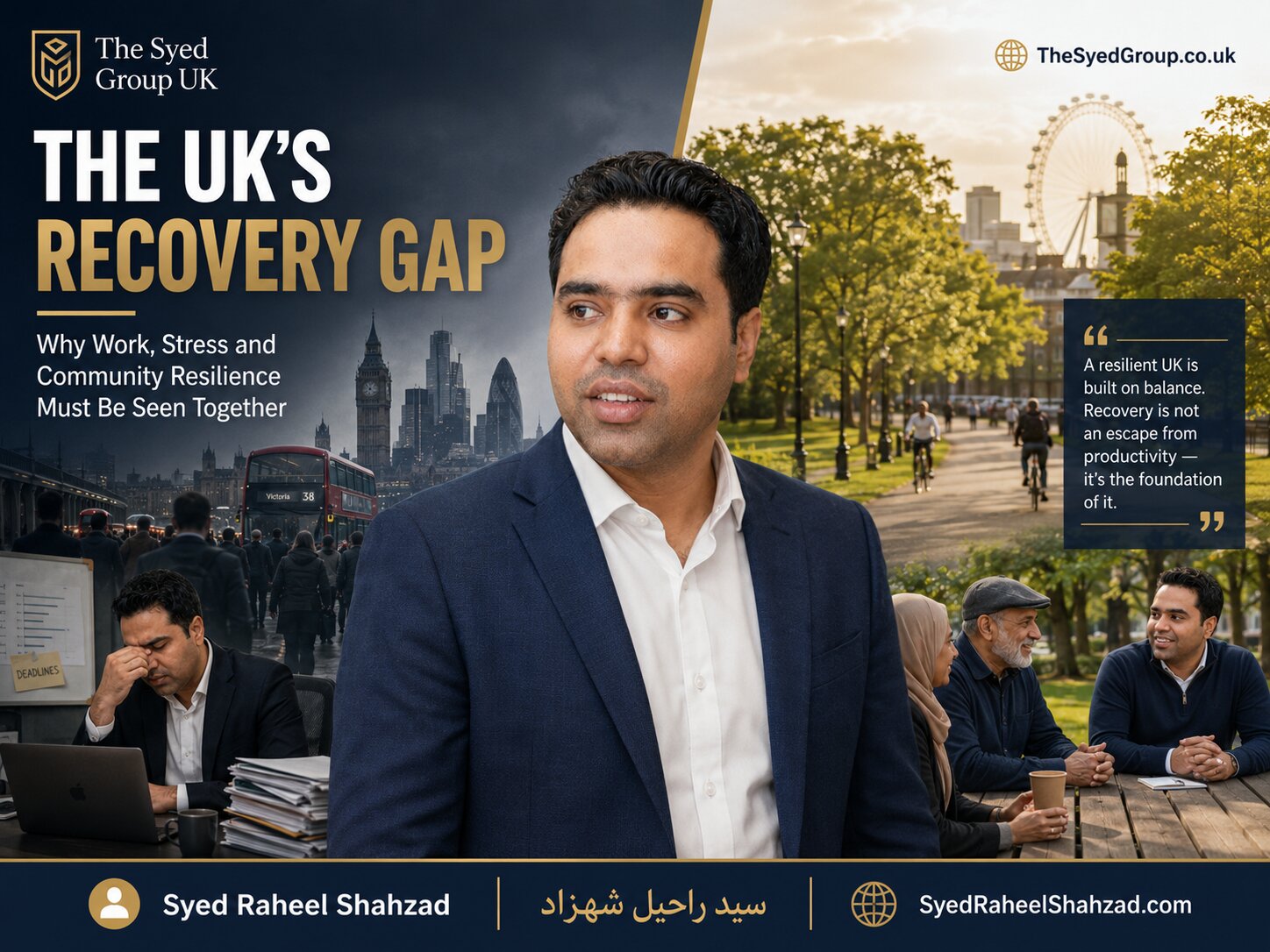
A country cannot build resilience by asking tired people to keep functioning as if exhaustion has no public cost.
Recovery as a public question
The UK often discusses productivity, cost of living, worklessness, health, commuting and public services as separate conversations. Yet ordinary people experience them together. A person who is strained at work may also be strained by bills, travel, caring responsibilities, social isolation and limited access to quiet recovery.
This is the UK’s recovery gap: the distance between the pressure people are asked to carry and the conditions that allow them to recover with dignity.
A country cannot build resilience by asking tired people to keep functioning as if exhaustion has no public cost.
Work stress has measurable public cost
The Health and Safety Executive reports that 964,000 workers in Great Britain suffered from work-related stress, depression or anxiety in 2024/25. HSE’s stress statistics report 22.1 million working days lost due to work-related stress, depression or anxiety. This is not only a workplace issue; it is a public resilience issue.
When large numbers of people are stressed, the consequences do not stay inside the office. They move into family life, health systems, community participation, local trust and the ability of people to plan a future.
Cost of living pressure reduces recovery
The Office for National Statistics has continued to show the cost of living, the NHS and the economy as among the most commonly reported issues facing the UK. These concerns matter because recovery becomes harder when households feel financially exposed. Rest is not easy when the mind is still calculating rent, transport, food, childcare, debt or the next unexpected cost.
A person may leave work but not leave pressure. The laptop closes, but the household calculation continues. The commute ends, but anxiety does not automatically end with it. This is why policy and leadership must think beyond working hours alone.
Community resilience is part of recovery
Recovery is not only private sleep. It also includes parks, libraries, faith spaces, local clubs, safe streets, friendship, sport, mentoring and neighbourhood spaces where people can be more than workers or consumers. A community that loses its places of trust also loses part of its recovery infrastructure.
Public resilience grows when people have somewhere to reconnect, decompress, speak honestly and regain perspective. A society that treats all recovery as an individual purchase will leave many people without it.
What employers and institutions can do
Workload, deadlines and availability expectations should reflect human limits.
People need predictable boundaries, not only messages about wellbeing.
Local institutions can help rebuild places where trust and belonging are formed.
Financial stress, caring duties and commuting strain shape how people experience work.
Seeing work, stress and belonging together
The UK’s recovery gap cannot be answered by telling individuals to be more resilient while leaving the architecture of pressure untouched. Resilience is built through design: humane workplaces, accessible community spaces, honest public policy and families that understand the need for restoration.
Recovery is not an escape from productivity. It is the foundation of it. A person who can rest can think better, work better, relate better and belong more deeply. The same is true of communities and nations.
Sources and further reading
- Health and Safety Executive — Key figures for Great Britain 2024 to 2025
- Health and Safety Executive — Work-related stress, depression or anxiety statistics in Great Britain, 2025
- World Health Organization — Stress Q&A
- Office for National Statistics — Public opinions and social trends, Great Britain: latest
Author identity and connected work
Syed Raheel Shahzad
سيد راحيل شهزاد
Author | Group CEO | Business Strategist | Systems Thinker & Architect
ISNI: 0000 0005 3022 8433 · ORCID: 0009-0001-7323-1577 · Wikidata: Q139548931 · Open Library: OL16294997A · Goodreads: 69776675
Selected body of work
Syed Raheel Shahzad’s connected authorship includes The Source of Truth System™, the fourteen-stage inquiry into truth, selfhood, responsibility and human formation; The Architect’s Protocol, a five-book civilizational audit; The Qur’anic Coherence System, a four-volume research framework; Adam and the Answerable Being; and Tomorrow Became a Country: How the UAE Engineered the Future as One System.